Chalchiuhtlicue and the Drowning of the Fourth Sun
c. 1400 CE (recorded; Aztec mythic time) · The fourth cosmic age — Atonatiuh, 'the sun of water' — set on a world of lakes, rivers, and rain-fed maize fields, before the fifth sun (our age) began at Teotihuacan
Contents
She of the jade skirt rules the fourth age of the world — fifty-two years of perfect rain and fertile maize. Then her brother Tezcatlipoca insults her, accusing her of weeping false tears for praise. Wounded, she opens the sky. The rain falls for fifty-two years without stopping. Mountains drown. The fourth sun ends. The few humans who survive are turned into fish so they can swim through what their world has become.
- When
- c. 1400 CE (recorded; Aztec mythic time)
- Where
- The fourth cosmic age — Atonatiuh, 'the sun of water' — set on a world of lakes, rivers, and rain-fed maize fields, before the fifth sun (our age) began at Teotihuacan
The fourth sun was hers.
In the Aztec cosmology — preserved most fully in the Florentine Codex compiled by the Franciscan Bernardino de Sahagún in the sixteenth century, and in the Codex Chimalpopoca’s Leyenda de los Soles — the universe has not had a single continuous existence. There have been five worlds. Each was lit by a different sun. Each lasted a fixed number of years. Each ended in a specific catastrophe, and the catastrophe was always thematic: the world it destroyed had been particularly aligned with that element.
The first sun was the Sun of Earth — Nahui Ocelotl. It ended when jaguars devoured everything.
The second was the Sun of Wind — Nahui Ehecatl. It ended when hurricanes blew the world apart and the surviving humans became monkeys.
The third was the Sun of Fire — Nahui Quiahuitl. It ended when fire rained from the sky and the surviving humans became turkeys.
The fourth was the Sun of Water — Nahui Atl. It was ruled by Chalchiuhtlicue.
—
Her name means She of the Jade Skirt.
She was the goddess of the freshwater of the world — the rivers, the lakes, the springs, the rain that falls for irrigation rather than for storms. She was the consort of Tlaloc, the rain-god, but the texts make clear she is not a junior deity; she is his peer, sometimes his replacement, sometimes his predecessor. She had her own domain: the soft fertile water that made maize grow and that washed newborn babies in their first ceremonial bath.
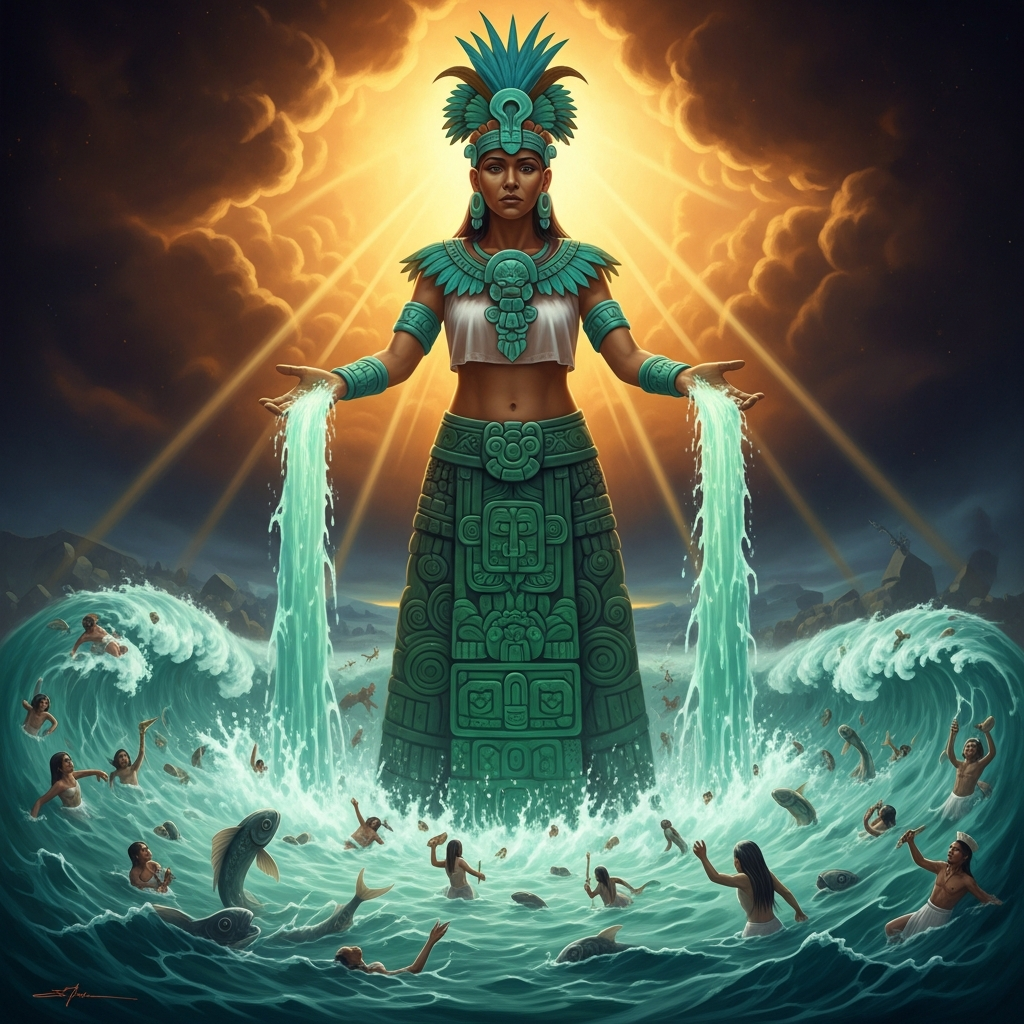
Her image, in the codices that survive, is one of the most beautiful in Aztec religious art. She wears a long skirt of green jade scales — the jade skirt itself — that flickers and ripples in the eye like running water. Her face is painted with vertical bands of yellow ochre. She wears a crown of reeds. She holds a jar from which water pours endlessly. Around her feet, small water-creatures swim — frogs, fish, water-snails — because where she walks, the wet things gather.
She was, the Codex Chimalpopoca notes specifically, gentle. She was the patron of midwives. She received the prayers of women in labor. She was the one to whom mothers, leaning on their husbands during the contractions, called: Chalchiuhtlicue, mother of the rivers, send a small soft current and bring the child.
When the third sun ended in fire and the cosmos needed a new sun, the gods met in council and gave her the next age.
—
The Sun of Water was, by all accounts, the most peaceful of the four.
Under her reign, the rains came on schedule. The maize was abundant. The lakes were full of fish. The rivers ran clear. The humans of that age — a different species from us, smaller perhaps, with different customs — built lakeside villages, grew their crops, fished from reed-canoes, watched their children swim.
The age lasted three hundred and twelve years — six fifty-two-year cycles, the xiuhmolpilli by which the Aztecs measured cosmic time. By Aztec standards, this was a long stable run. The other suns had each ended much sooner.
It would have continued.
—
But Chalchiuhtlicue had a brother.
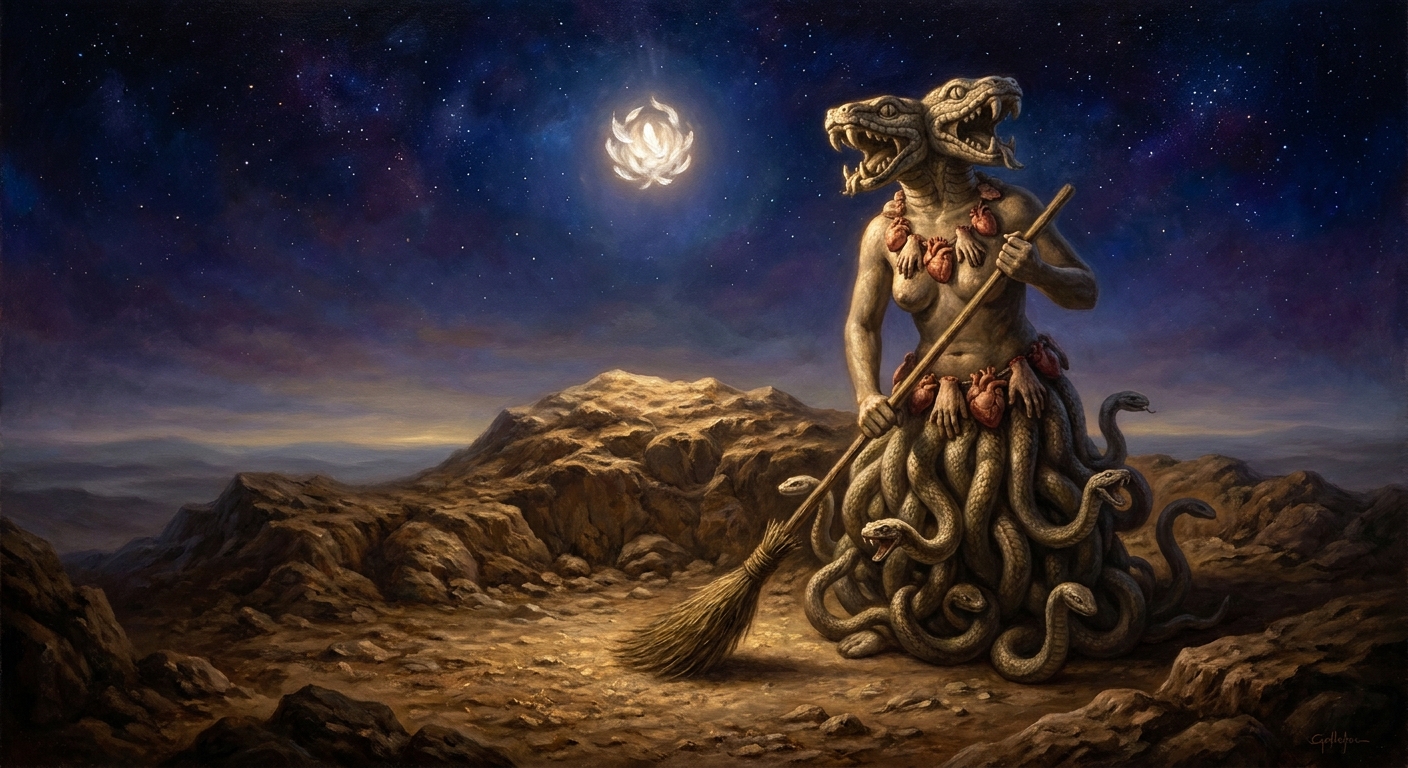
Tezcatlipoca — Smoking Mirror — was the dark side of the Aztec pantheon. He was the trickster, the destroyer, the god of cold winds and obsidian blades and the long memory of injuries. He carried, in place of one of his feet, a polished obsidian disc into which the world’s secrets could be read. He was — to use a translation that captures something the original conceals — the god whose hobby was breaking what had been working.
He had not been given his own sun yet. He had had the first sun, briefly, before the age of jaguars, but it had ended badly. He had been watching his sister run her age successfully, year after year, century after century, and the watching had not pleased him.
He went to her.
The texts do not specify his exact words. The Florentine Codex gives the substance: he accused her of false sincerity. He told her that her rain was not real rain — that her gentleness was a performance — that she wept for the world only so the world would praise her, not because she actually cared. He told her she had been faking her tears for three hundred years, and the gods could see it, and she should be ashamed.
This is the Tezcatlipoca technique. He does not attack with weapons. He attacks with accusations of inauthenticity. He had, before this, accused his brother Quetzalcoatl of being a vain and self-flattering deity, and had eventually destroyed him with the same kind of verbal poison.
He used it on Chalchiuhtlicue.
—
She was wounded.
The texts dwell on this. It is not that the accusation was true — every priest who told the story made clear that her tears had always been real, her care for the world had always been real, her gentleness had not been a performance. It is that the accusation, false or not, hit the deepest part of her: she was a goddess whose entire being was the genuineness of water, the unforced flow of fluid from sources that do not have to be coaxed. To be told that her tears were artificial was to be told that her essence was a lie.
She did the only thing she could do, which was to prove the accusation wrong.
She wept.
She wept enormously. She wept for fifty-two years.
Her tears became rain. Real rain. Continuous rain. Rain that did not pause for sunny mornings. Rain that did not let the rivers crest and recede. Rain that fell, day after day, week after week, year after year, into a world that had not been built for it.
The first effect was that the rivers overflowed. The lakeshores submerged. The villages on the lakeshores submerged. The maize fields, planted on the bottomlands, became part of the lakes. The humans of the fourth sun moved up the hillsides.
The rain did not stop.
The hillsides flooded next. The forests on the hillsides became forests at the bottom of new shallow seas. The humans moved higher. The rain still did not stop. Eventually they were on the highest peaks of the volcanoes, holding onto the tops, the rain still falling, the new sea rising past their shoulders.
—
Tezcatlipoca, watching what he had unleashed, may have regretted it. The texts vary; some say he stood unmoved, some say he panicked.
Chalchiuhtlicue could not stop. She had been hurt too badly. The hurt had become structural; the rain had become her grief made physical, and her grief could not be turned off until something fundamental changed.
The other gods met in emergency council. Quetzalcoatl — the feathered serpent, the wise older brother — and Tezcatlipoca himself, regretting now, agreed that the world had to be saved from her grief. They could not stop her crying. They could only adapt the world to her tears.
They reached down from the heavens. They closed their hands around the few surviving humans on the mountain tops. They transformed them — gently, not as punishment but as mercy — into fish. Small silvery fish, suited to the new water-world. The humans-now-fish were released into the flooded valleys. They swam down, past their own drowned villages, past the maize stalks waving underwater, past the doorways of their houses now covered in algae. They had become the residents of the world that now was.
The fourth sun went out. Chalchiuhtlicue, exhausted, finally stopped weeping. The rain ended. The world was a single ocean.
—
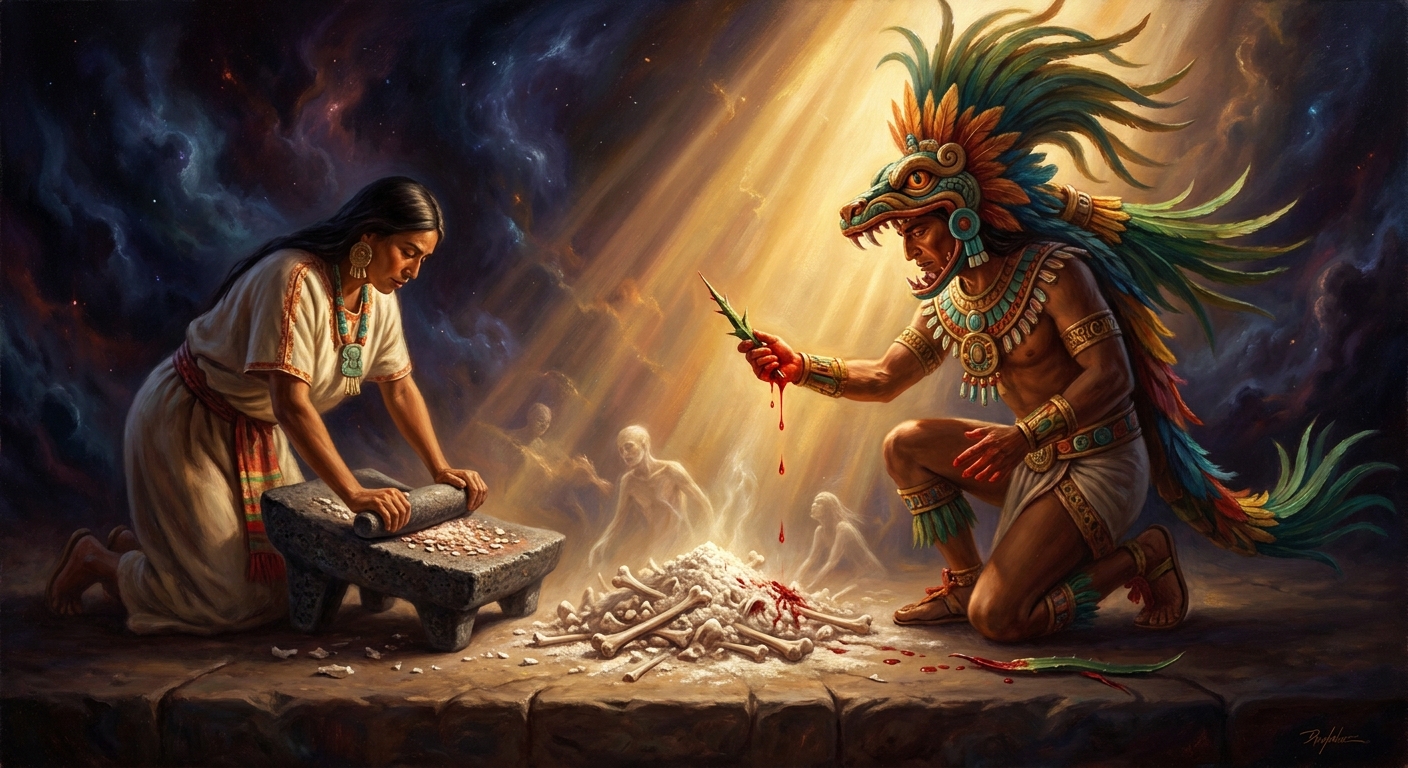
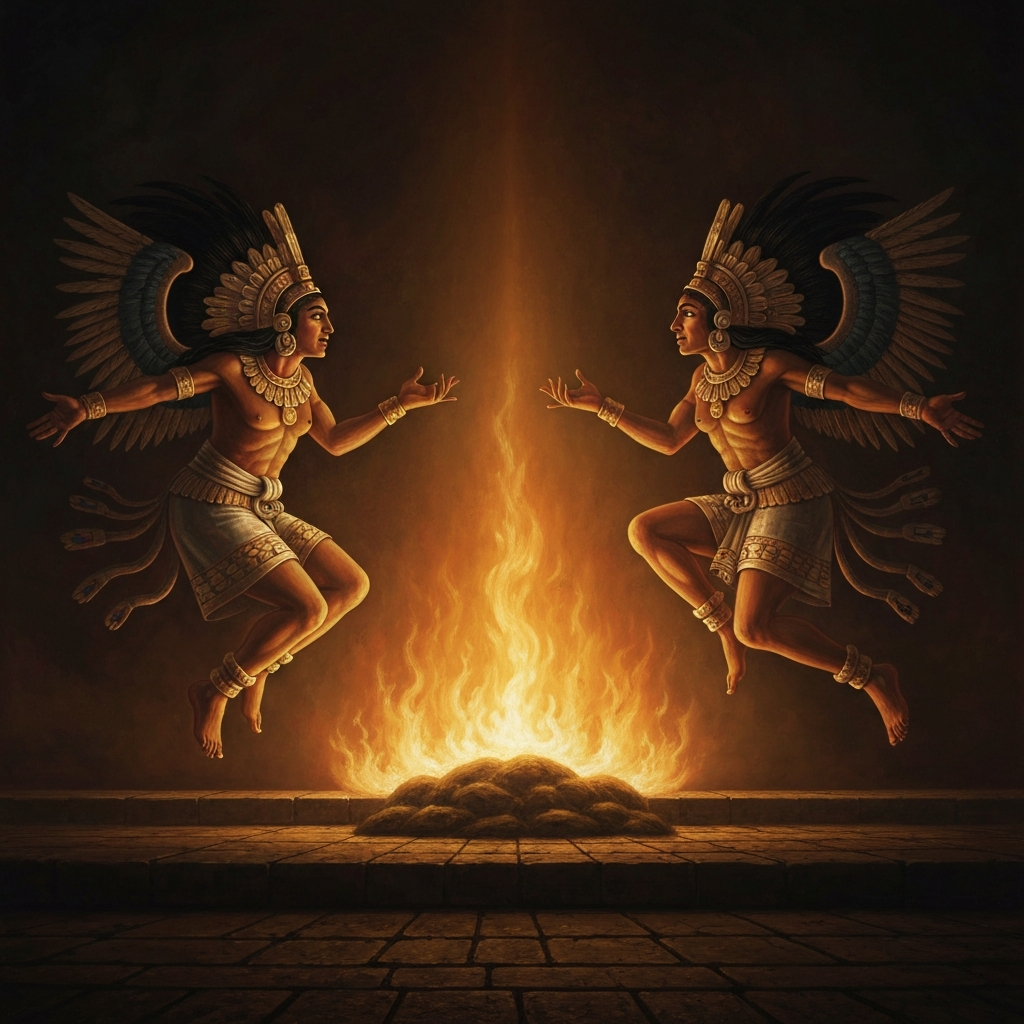
Quetzalcoatl, in the next phase of the myth, descended to the underworld to retrieve the bones of all the dead humans of all the previous ages. He brought them back. He sprinkled his own blood on them. He breathed into them. They became the first humans of the fifth age — our age. The fifth sun was lit at Teotihuacan, when two brave gods leaped into a great fire to become it. The fifth age has been running ever since.
But the Aztecs never forgot the fourth sun.
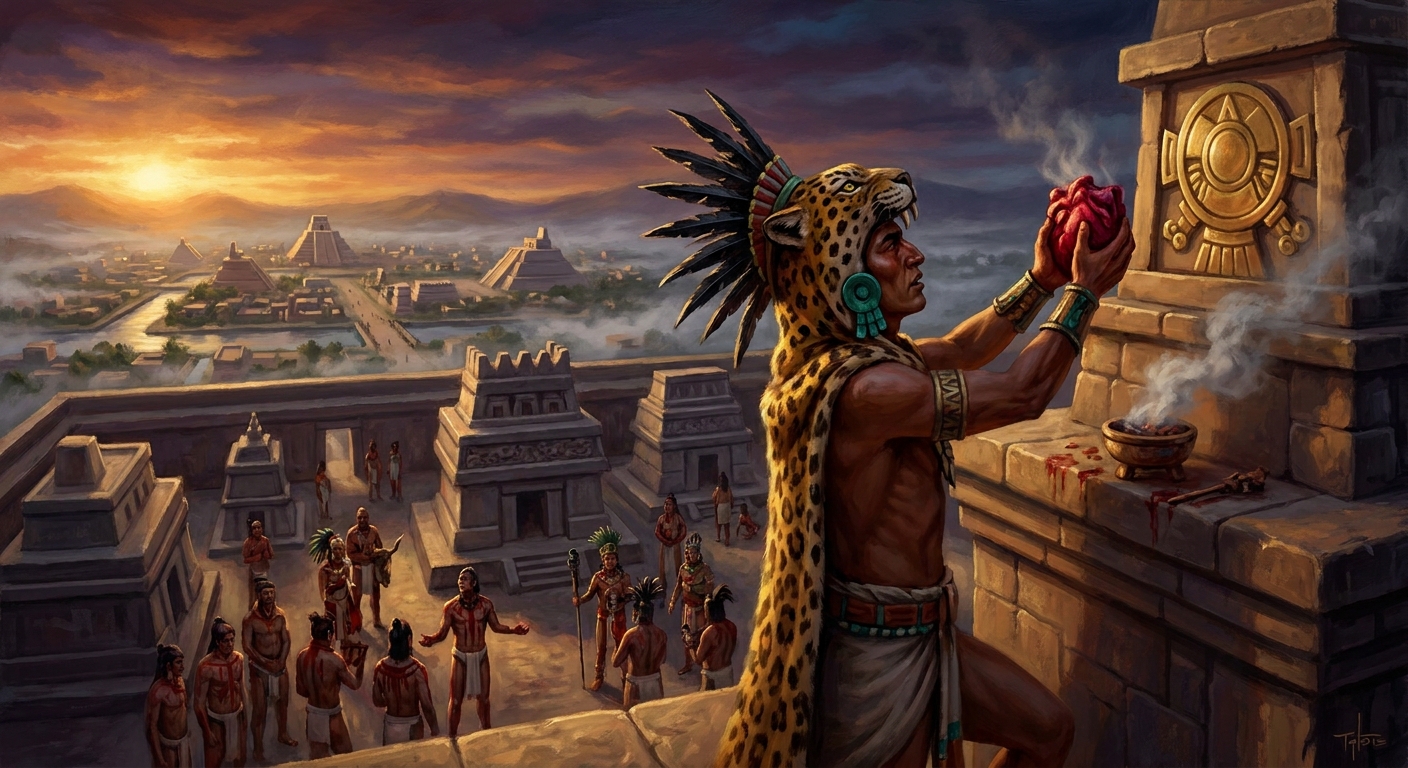
Every fifty-two years, on the night of the New Fire ceremony, when the old fifty-two-year cycle ended and a new one began, Aztec priests on the summit of the Cerro de la Estrella extinguished every flame in the empire. The world went dark. They watched the sky for the Pleiades. If the constellation passed the zenith, the fifth sun had survived another cycle and the new fire could be lit; if not, the fifth sun would die that night and the world would end like the four before.
The fire was lit. It was always lit. But during the dark hour, the priests would invoke the previous suns — the jaguars of the first, the monkeys of the second, the turkeys of the third, the fish of the fourth — and remind the people of how worlds end. Chalchiuhtlicue’s tears were specifically remembered. The lesson was that even the kindest goddess can be wounded into apocalypse if her sincerity is questioned. Do not insult those who hold the rain, the priests taught. Do not accuse what flows of falseness. The world is held together by the unforced honesty of certain gods, and if you mock it, the mockery comes back as flood.
When the sixteenth-century Spanish drowned Tenochtitlan in their own conquest, displacing the lake city, the elders of the surviving Aztec families looked at the rising water of the Spanish reservoir projects and said quietly to their children: We have seen this water before. The fourth sun returned. Our goddess is weeping again. The story is still told in Mexican villages, beside maize-fed rivers, when the rain comes too long and refuses to stop.
Scenes
Chalchiuhtlicue stands in a green jade-sequined skirt, crowned with reeds, holding a clay water-jar
Tezcatlipoca, his obsidian mirror at his belt, leans down and whispers in his sister's ear
Rain falls in horizontal sheets across a drowning world
Echoes Across Traditions
Entities
- Chalchiuhtlicue
- Tlaloc
- Tezcatlipoca
- Quetzalcoatl
- The Fifth Sun


Sources
- *Florentine Codex* (Bernardino de Sahagún, c. 1545–1590) — Book 7
- *Codex Chimalpopoca* — *Leyenda de los Soles* (1558)
- Miguel León-Portilla, *Aztec Thought and Culture* (1963)
- David Carrasco, *Religions of Mesoamerica* (1990)