Gawain and the Green Knight's Bargain
*Sir Gawain and the Green Knight*, anonymous, c. 1390 CE; the Pearl Poet · Arthur's feasting hall at Camelot; the road through midwinter Britain; the castle of Hautdesert; the Green Chapel in the valley
Contents
A green-skinned giant rides into Arthur's feasting hall on New Year's Day and offers a game: any knight may strike off his head, if that knight will accept a return blow in one year. Gawain accepts. The head rolls. The Green Knight picks it up, names the date, and rides away. A year later, Gawain rides to his death — and learns that the test was never about the axe.
- When
- *Sir Gawain and the Green Knight*, anonymous, c. 1390 CE; the Pearl Poet
- Where
- Arthur's feasting hall at Camelot; the road through midwinter Britain; the castle of Hautdesert; the Green Chapel in the valley
The doors of Arthur’s feasting hall open on New Year’s Day, and everything that was stable in the world walks in.
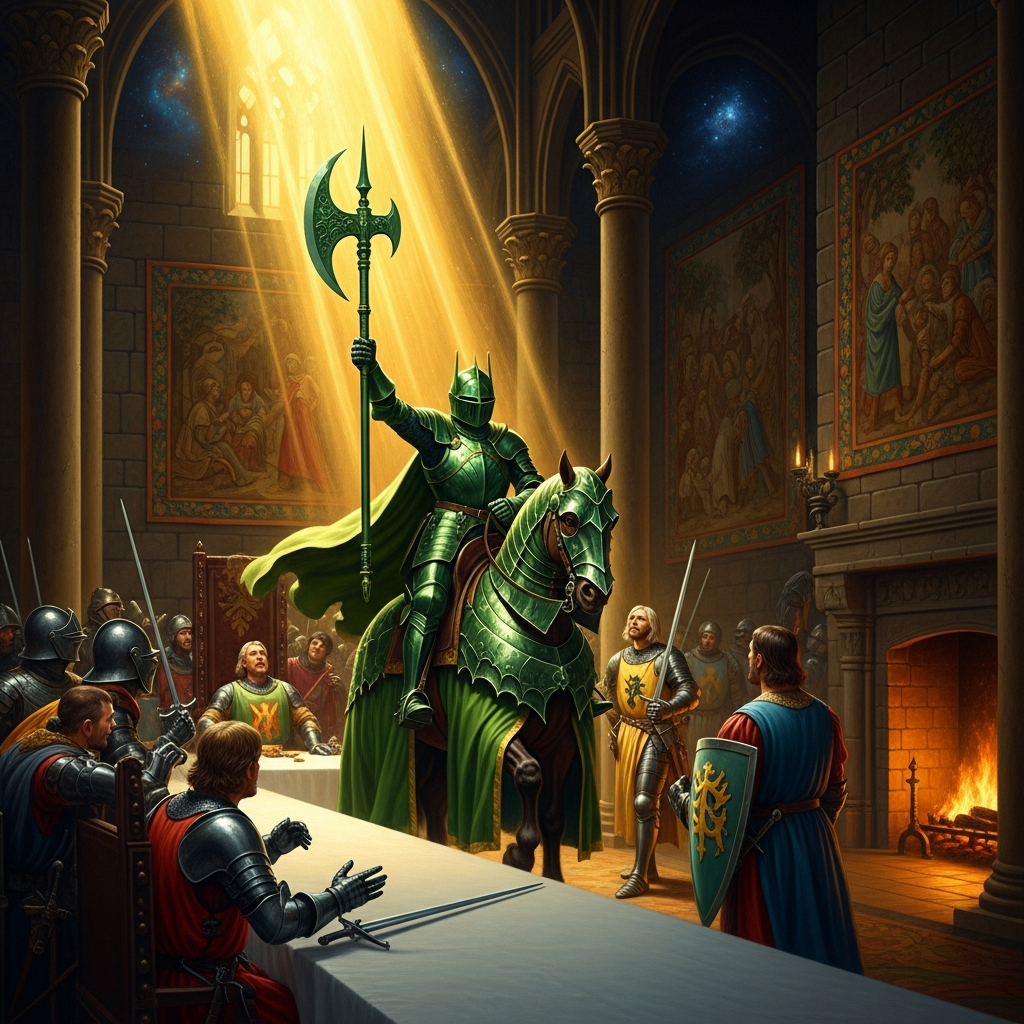
He is enormous. He is green — not metaphorically green, not wearing green, but green, the skin itself, the hands, the neck, the face all the color of new moss or deep water or the inside of a forest in June. His horse is green. His beard, which falls to his chest in braided ropes, is green. He carries in one hand an enormous axe and in the other a bough of holly — the winter plant, the one that stays green while everything else dies — and he rides into the center of the great hall without dismounting and looks around at the assembled court with the expression of someone who has arrived at precisely the moment he intended.
The hall goes silent.
Arthur’s court is the greatest court in the world, in its own estimation and in the tradition’s estimation, and it has seen many strange things. But it has not seen this. The Green Knight has the quality of the uncanny — the thing that is almost natural and exactly wrong — and the silence is the silence of people who cannot place what they are seeing.
The Green Knight looks at Arthur. He is smiling.
I have heard of your fame, he says. I am here to test it. I offer a game. Any knight in this hall may take this axe and strike off my head — here, now, before dinner — on the condition that he will come to me in a year and a day and receive the return blow. Simple terms. One blow for one blow. Who accepts?
The hall stays silent.
Arthur stands.
He is the king; he will not permit his court to appear cowardly, and the silence has lasted long enough. He reaches for the axe. Then Gawain rises.
My lord, let me. This is not a task for the king. Let it be mine.
There is something in Gawain’s offer — the chivalric reflex of protecting the king by absorbing the danger himself — that is both admirable and useful and that the poem is very carefully watching. Gawain is the right knight for this story not because he is the best but because he is the most self-aware, the most concerned with how he appears, the most likely to be tested by exactly the thing that comes next.
Arthur hands him the axe.
Gawain takes it. The Green Knight dismounts, kneels, moves his braid aside to bare the back of his neck. Gawain steps forward. He swings.
The head rolls across the floor. The body doesn’t fall.
The body stands, walks to where the head rolled, picks it up. The head, in the Green Knight’s outstretched hand, opens its eyes. The mouth speaks: Remember our bargain, Gawain. The Green Chapel, one year from today. I will find you.
Then the Green Knight rides out through the doors, and the doors close, and the hall erupts in noise, and Arthur laughs too loudly and says they have had fine entertainment this New Year’s Day.
Gawain eats his dinner.
He does not taste it.
A year is a long time when you have promised to go to your death at the end of it.
The poem does not linger in the waiting. It compresses the year into a stanza and then drops Gawain on the road in November, armored in his green girdle — he does not have the girdle yet, but he will — riding through a Britain that the Pearl Poet renders with the most precisely observed English winter landscape in medieval literature. The snow on the hillside. The hanging ice on the bare branches. The streams running dark under thin ice. The sky the color of iron. And Gawain riding through all of it toward the Green Chapel, which he has been told exists but cannot find.
He arrives, near Christmas, at a castle — Hautdesert — and is welcomed with extraordinary warmth by a lord named Bertilak, a broad-shouldered cheerful man who hunts every day, and by Bertilak’s wife, who is beautiful in a way that the poem describes with unusual precision, and by an old woman who sits near the fire and is always in shadow.
Bertilak offers Gawain a game within the larger game: each day Bertilak will go hunting and give Gawain whatever he catches. Each day Gawain will remain at the castle and give Bertilak whatever he receives. Equal exchange, fair terms. Gawain agrees.
The first morning: Bertilak hunts a deer. Lady Bertilak comes to Gawain’s bedroom, sits on his bed, and makes it very clear what she is offering. Gawain — performing honor, or genuinely honoring, the poem leaves this open — accepts one kiss and nothing else. That evening he gives Bertilak one kiss. Bertilak laughs and gives him the venison.
The second morning: a boar. Lady Bertilak again. Two kisses, no more. Two kisses exchanged for the boar.
The third morning: a fox. Lady Bertilak again — but today she offers him something beyond kisses. She offers him a green silk girdle she wears at her waist. She says it has a property: the man who wears it cannot be killed.
Gawain, who is riding to his death in three days, takes the girdle.
He kisses her three times and that evening gives Bertilak the three kisses. He does not give him the girdle. He says nothing about the girdle.
The Green Chapel is a hollow mound in a valley.
It is a strange place for anything to be called a chapel. It is dark. It is cold. The sound of something being sharpened comes from inside it. Gawain arrives on New Year’s morning, and the Green Knight steps out with a freshly whetted axe, and Gawain kneels on the frozen ground and bends his neck.
The Green Knight raises the axe. He swings — and stops. Gawain flinches. Not much, but enough.
The Green Knight speaks. You moved. The knight I heard of did not flinch.
Gawain straightens. He grips the ground with his certainty, which is all he has left. I will not move again.
The Green Knight raises the axe. He swings again — and holds it just above the neck, a nick, a graze. A thin line of blood in the winter air.
Then he steps back, and he is still green but there is something else now in his face — not threat, not cruelty, but something almost like warmth. He calls Gawain by name and tells him who he is: Bertilak de Hautdesert. Sent by Morgan le Fay to test the court. The test is over. Gawain has passed — all of it, all three days — except for the girdle, which was a small failure, and the nick is for the girdle, and that is all.
Gawain rides back to Camelot wearing the girdle.
Not hiding it. Wearing it as a badge of shame. He tells Arthur’s court what happened and calls himself a coward, and the court laughs with affection and says he did better than any of them would have done, and decides to wear green girdles themselves in his honor.
Gawain does not find this comforting.
This is the poem’s last move, and it is the one that has made the text survive six centuries. The court’s generous reading and Gawain’s harsh reading are both available, and the poem refuses to adjudicate between them. Was the kept girdle a small and understandable failure, the lapse of a man riding to his death? Or was it the essential test — the moment when no one was watching except Gawain himself, and Gawain looked at who he was and found something he could not fully name?
The girdle is still on his arm.
He will wear it his whole life.
He is the only one who knows exactly what it means.
Echoes Across Traditions
Entities
- Sir Gawain
- the Green Knight (Bertilak)
- Lady Bertilak
- Morgan le Fay
- Arthur


Sources
- The Pearl Poet, *Sir Gawain and the Green Knight*, c. 1390 CE
- Simon Armitage, trans., *Sir Gawain and the Green Knight* (Norton, 2007)
- J.R.R. Tolkien and E.V. Gordon, eds., *Sir Gawain and the Green Knight* (Oxford, 1925)
- John Speirs, *Medieval English Poetry: The Non-Chaucerian Tradition* (Faber, 1957)
- Ad Putter, *An Introduction to the Gawain-Poet* (Longman, 1996)
- Fled Bricrenn (*Bricriu's Feast*), trans. George Henderson, Irish Texts Society, 1899