Nhialic and the First Separation
Oral tradition of the Dinka people; collected by Godfrey Lienhardt in *Divinity and Experience* (1961) · The Nile basin; South Sudan; the borderland between sky and earth
Contents
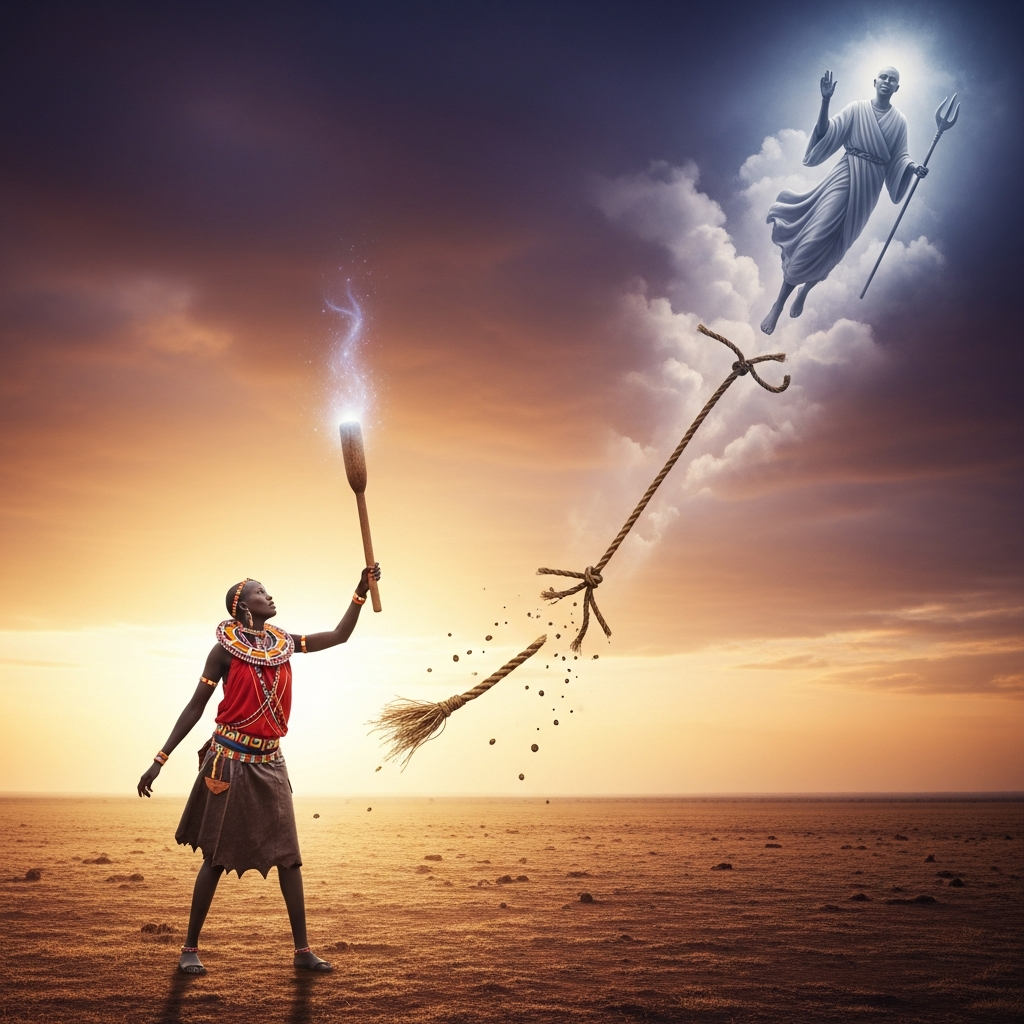
In the beginning, the sky was very low — so close to the earth that people could reach up and touch it. The first woman, pounding grain, struck the sky with her pestle, and Nhialic (God) withdrew upward. With him went the rope that connected heaven and earth, and the easy path to divinity. The world became harder. Death became real.
- When
- Oral tradition of the Dinka people; collected by Godfrey Lienhardt in *Divinity and Experience* (1961)
- Where
- The Nile basin; South Sudan; the borderland between sky and earth
Before, the sky was different.
Not in its appearance — the color was the same blue in the day, the same black with stars at night, the sun and moon in their same positions. But the distance was different. The sky was low enough that a standing person could reach up and touch it without effort. Not with a jump — just a reach, the ordinary extension of an arm toward the ceiling.
This was not remarkable to the first people. It was simply the nature of the sky. They were accustomed to it.
Nhialic was there, in the sky that was close. Nhialic is a word that means both the sky and God, and the Dinka language does not separate these because they were not, in the beginning, separate things. God was the sky. The sky was God. The closeness was itself the relationship.
Abuk was pounding grain.
She had the long wooden pestle that grain requires — the kind that must be swung above the shoulder and brought down with full force into the mortar. This is women’s work in the Nile basin, has always been, the heavy rhythmic pounding that reduces the hard seeds to flour, that fills the morning with the sound of wood against wood and grain being changed from one form into another.
She swung the pestle up.
The end of it struck the sky.
Nhialic did not speak. There was no thunder, no pronouncement, no divine anger in the sense that Greek or Hebrew traditions understand divine anger. What happened was quieter than that: Nhialic withdrew. The sky rose. Not quickly — not a dramatic retreat — but steadily, as a person steps back when they have been inadvertently jostled, putting distance between themselves and the source of the collision.
By the time Abuk had finished pounding her grain, the sky was already higher. By the time the meal was prepared, it was out of reach. By morning, it was where it is now.
The rope had been there from the beginning.
It hung from the sky to the earth, thick as a tree trunk, plaited in the manner of the ropes the Dinka make from bark and reed — the same construction logic, but divine, and permanent, and climable. People and God had used it. It was not a ladder for daily traffic, not a commute between realms, but it was there when it was needed: when someone needed to speak directly, when something had to be negotiated between the human world and the sky world, the rope was the way.
When Nhialic withdrew, the rope went with him.
It did not break — nothing violent happened. The end that had rested on the earth simply lifted as the sky lifted, coiling upward, until it was out of sight. The place on the ground where it had rested was just ground again: a patch of earth that felt, to those who stood on it, exactly like any other patch of earth.
Lienhardt’s great insight in his study of Dinka religion is that Nhialic’s withdrawal is not experienced as abandonment.
Nhialic is still present — still in the sky, still the rain, still the force that moves through cattle and crops and children and the things that matter. The withdrawal is a change in the mode of presence, not an ending of presence. The Dinka do not live under an empty sky. They live under a sky that is further away than it used to be, and the distance requires a different kind of prayer: louder, more insistent, carried by sacrifice and the correct ritual forms rather than simply by speaking upward into the nearby air.
What was lost was ease. What was lost was the rope — the concrete, climbable route, the thing you could hold onto. What remained was everything else: the rain, the cattle, the breath that Nhialic gives and takes, the sense that the sky is watching even if it does not come to dinner.
Death entered with the separation. Before the sky rose, people did not die — or if they died, the rope was there to return by, and the distance between life and death was the same as the distance between earth and sky: manageable. When the sky withdrew, death became a direction that had no return path. Garang, the first man, had been given by Nhialic one seed to plant and one cow to tend; after the separation, the seed grew once and the cow’s calves grew old.
The first person died.
There are Dinka ceremonial specialists called beny bith — masters of the fishing spear — who are understood to be closer than ordinary people to Nhialic. When they die, they do not die in the ordinary way: they are buried alive, by request, because a beny bith does not admit that the separation between sky and earth is final. The act of choosing to enter the earth — rather than having death come to them — is a refusal of the ordinary distance. It is a way of saying: the rope is not entirely gone.
The sky is still there.
The pestle that struck it is still in the mortar, in every Dinka household, in every morning that begins with the sound of grain being pounded. The women who use it know what the first woman’s pestle did. They pound anyway, because the grain needs to become flour, because the work is the work.
The sky stays where it is.
But it watches. That has not changed.
Echoes Across Traditions
Entities
- Nhialic (God)
- Abuk (first woman)
- Garang (first man)
- the rope of heaven
Sources
- Godfrey Lienhardt, *Divinity and Experience: The Religion of the Dinka* (1961)
- Francis Mading Deng, *Dinka Cosmology* (1980)
- Francis Mading Deng, *The Dinka of the Sudan* (1972)
- John Ryle, 'The Dinka of the Southern Sudan,' *Azania* Vol. 12 (1977)