The God Who Breaks Your Mind: Divine Madness and the Sacred Fool
Dionysian cult documented from c. 1500 BCE (Linear B tablets); Euripides' Bacchae performed 405 BCE; Sufi tradition of majnun developed c. 9th-12th century CE; Russian holy fools (yurodivye) as institutionalized category from c. 11th century CE · The slopes of Mount Cithaeron (Greek Dionysian rites), the desert between Arabia and Iraq (Majnun's wandering), the streets of Constantinople and Moscow (Byzantine and Russian holy fools), the cities of the Sufi world from Baghdad to Persia
Contents
Dionysian madness, holy fools, Sufi majnun: every tradition has a category of person whose loss of reason is a form of sacred knowledge. The mad see what the sane cannot.
- When
- Dionysian cult documented from c. 1500 BCE (Linear B tablets); Euripides' Bacchae performed 405 BCE; Sufi tradition of majnun developed c. 9th-12th century CE; Russian holy fools (yurodivye) as institutionalized category from c. 11th century CE
- Where
- The slopes of Mount Cithaeron (Greek Dionysian rites), the desert between Arabia and Iraq (Majnun's wandering), the streets of Constantinople and Moscow (Byzantine and Russian holy fools), the cities of the Sufi world from Baghdad to Persia
Plato, in the Phaedrus, makes an argument that should have been disqualifying and has instead been quoted for two and a half thousand years: madness, he says, is superior to sanity, because the greatest goods come to us through madness.
He lists four kinds of divine madness: prophetic (the madness of Delphi, of the oracle), ritual (the madness that purges old inherited guilt through Dionysian rites), poetic (the madness of the Muses, without which no adequate verse can be made), and erotic (the madness of love, through which the soul recovers its wings and begins the ascent toward the divine).
In all four cases, the madness is a gift. It comes from the gods. The sane person, who has no access to this gift, produces inferior prophecy, inferior poetry, inferior love. The mad person is the instrument. The gods play them.
This is not a fringe position in ancient Greek thought. It is stated directly by one of the most rational philosophers in human history. The fact that it sounds paradoxical is the point.
What the Mad Person Knows
Every tradition that has institutionalized or revered sacred madness is responding to the same observation: the sane person lies continuously. Not necessarily deliberately, but structurally — the social self is a performance calibrated to the expectations and status hierarchies of its audience. The sane person knows what you want to hear and edits their output accordingly. The sane person has reputation to protect, relationships to manage, consequences to calculate.
The mad person has none of these anchors. Having lost the social machinery, they have also lost the social constraints. They cannot flatter. They cannot perform. The Russian term for holy fool, yurodivye, comes from a Greek word meaning “simple” or “foolish in Christ” — the deliberate abandonment of the social self as a spiritual practice.
What they produce in the absence of social calculation is sometimes nothing useful and sometimes the truth that no one else in the room will say.
This is why Basil the Blessed walked up to Ivan the Terrible — the most feared ruler in Russian history, a man who had recently massacred the city of Novgorod — and handed him a piece of raw meat during Lent. The meat was an accusation: you have been eating men. Ivan, who killed metropolitans and boyars for far less, did not touch Basil. When Basil died, Ivan himself helped carry the coffin.
The protection was structural. The sacred fool’s madness placed them outside the social order in which status violence operates. You cannot shame someone who has already abandoned shame. You cannot threaten someone who has already abandoned self-preservation.
Dionysus: The God Who Cannot Be Refused
The Bacchae of Euripides — performed posthumously at Athens in 405 BCE, the year after Euripides died in Macedonia — is the most sustained examination of divine madness in ancient literature, and it reaches a conclusion that cannot be summarized as either endorsement or condemnation.
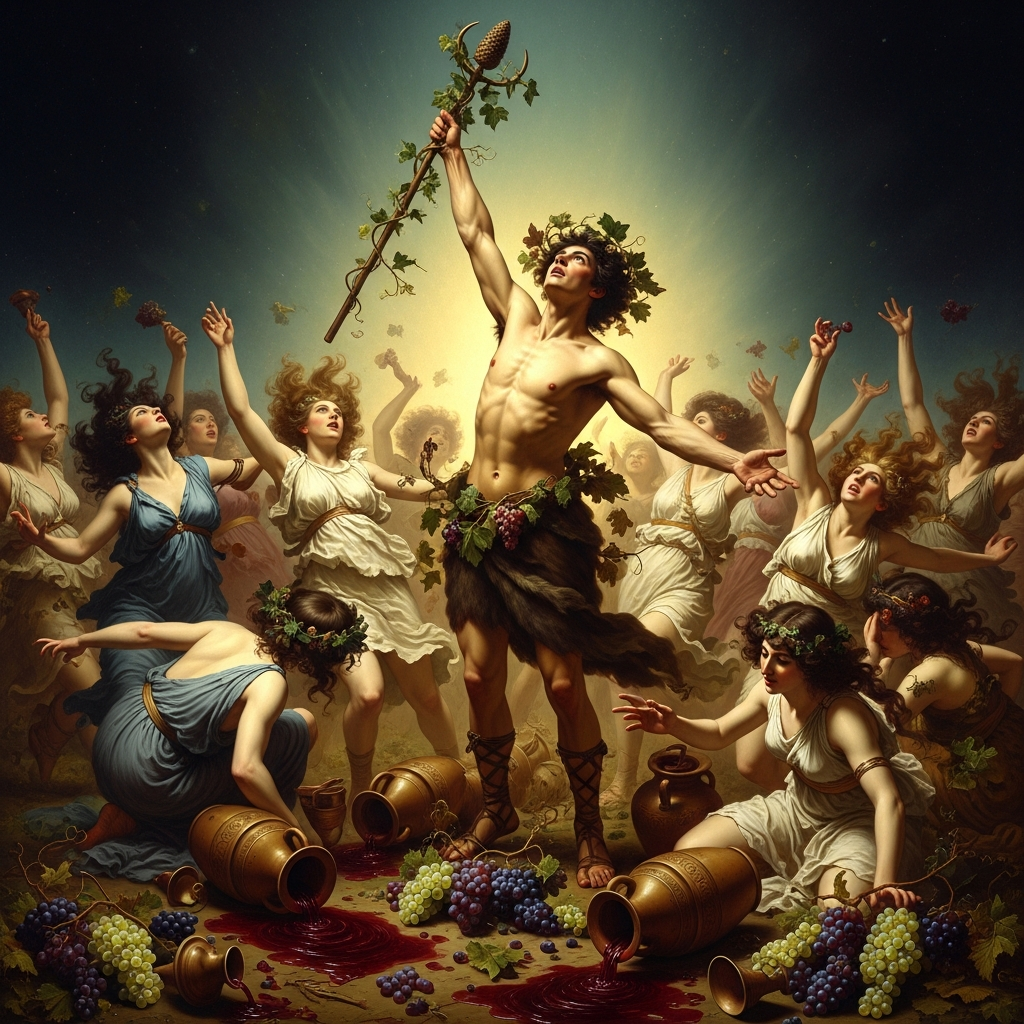
Dionysus returns to Thebes, the city of his mother’s family, disguised as a foreign priest of his own cult. The city has refused to acknowledge his divinity. His punishment for this refusal is to drive the women of the royal family — led by Agave, his own aunt — onto the mountain in divine possession. They run wild on Cithaeron, tearing animals apart with their bare hands, nursing wolf cubs, ripping up trees.
Pentheus, the king, is fascinated and horrified. Dionysus plays on this fascination: he convinces Pentheus to dress as a woman and spy on the maenads from a tree. The maenads, led by his mother Agave who believes herself hunting a lion, tear him apart.
When Agave recovers her sanity — still holding her son’s head as a hunting trophy — she asks: what is this I am holding? And the play’s terrible logic completes itself. The madness was pure. The return to sanity is what brings suffering, because sanity knows what it has done.
Euripides refuses to moralize this neatly. Pentheus was wrong to resist Dionysus; his resistance and his voyeurism were the crimes that called down punishment. But Agave, who was innocent and simply taken by the god, loses her son. The god’s justice does not track human moral categories. The ecstasy is real. The cost is real. The play holds both without resolving the tension.
Majnun: The Annihilation of the Lover
The legend of Majnun and Layla — a pre-Islamic Arabic love story elaborated into Sufi mystical allegory by Nizami in the 12th century — became the central image of divine madness in Islamic mysticism. Qays falls in love with Layla, is refused by her father, and becomes majnun — the mad one — wandering the desert, living among animals, composing poems to a woman he cannot have.
The Sufi reading transposes this story onto the relationship between the soul and God. Layla is the Divine Beloved. Majnun is the soul that has recognized its origin in the divine and cannot be satisfied with anything less than complete reunion. His madness — his inability to function in ordinary social terms — is the symptom of a love so total that all other structures have burned away.
The Sufi term for this annihilation is fana: the passing away of the individual self in the divine. The person who has achieved fana is useless for ordinary social purposes. They have lost what makes ordinary social function possible: self-interest, self-protection, the calculation of personal advantage. What they have gained is, according to the tradition, direct experience of the divine reality — and love that has consumed everything including the lover.
Majnun is mad by any conventional standard. He is also, in the Sufi reading, the most spiritually advanced figure in the story. Layla herself — who loves him but accepts the social constraints that prevent their union — is in a lesser spiritual state, because she has not abandoned everything. Majnun has abandoned everything. His madness is his credential.
The Fool and the King
The structural role of the sacred fool in relation to political power is consistent enough across cultures to constitute a pattern.
The medieval court jester — descended in complex ways from both the classical mime tradition and the Feast of Fools — had a formal license to say what could not otherwise be said in the presence of a king. Shakespeare’s fools (Lear’s fool, Feste in Twelfth Night, Touchstone in As You Like It) use this license to speak truths that the sane characters cannot manage. Lear’s fool alone tells him, during the storm, exactly what he has done wrong and what it will cost him. The fool is the one character in the play who has nothing to lose by being honest.
This is the political function of sacred madness: a society that cannot tolerate direct criticism of power sometimes creates a category of person who is simultaneously too powerless and too holy to be punished for it. The holy fool’s madness is a form of protection — not just for the fool, but for the truth they carry.
The truth cannot be prosecuted if the carrier is not responsible for it.
Ecstasy as Technology
The Dionysian tradition, the Sufi sama (the listening ceremony in which music and movement produce states of ecstasy), the shamanic drum journey, the charismatic tradition in Pentecostal Christianity, the Baul singing of Bengal — all of these are technologies for producing, in a controlled context, the dissolution of the ordinary social self.
What they produce is not madness in the clinical sense but a temporary alteration of the consciousness that underlies social performance — the loosening of the structures that separate the individual from the divine ground. The experience is, in most traditions, valued precisely because it is temporary: the initiate returns from the ecstasy, but they return knowing something that cannot be taught by instruction alone.
The permanently mad holy fool is the extreme case — the person for whom the dissolution has become the permanent condition. Most traditions distinguish sharply between this and the ecstatic experience available to ordinary practitioners: the holy fool has given up what the mystic merely lends, temporarily, to God.
That distinction preserves the social order. The king can tolerate one Basil the Blessed. He cannot tolerate a civilization of them.
Echoes Across Traditions
Entities
- Dionysus
- Agave
- Pentheus
- Qays ibn al-Mulawwah
- Layla
- Basil of Moscow
- Simeon of Emesa
Sources
- Euripides, *The Bacchae* (405 BCE)
- Plato, *Phaedrus* 244a-245c (on divine madness as superior to sanity)
- Nizami Ganjavi, *Layla and Majnun* (c. 1188 CE)
- Leontius of Neapolis, *Life of Simeon of Emesa* (7th century CE)
- Sergius Hackel, ed., *The Byzantine Saint* (1981)
- 1 Samuel 19:18-24 (Saul among the prophets)
- Hosea 9:7 (prophet as madman)
- Ruth Padel, *In and Out of the Mind: Greek Images of the Tragic Self* (1992)
- John Saward, *Perfect Fools: Folly for Christ's Sake in Catholic and Orthodox Spirituality* (1980)
- Annemarie Schimmel, *Mystical Dimensions of Islam* (1975)