The Dullahan: Rider Without a Head
undated folk tradition — medieval and early modern Ireland, concentrated in Connacht and Sligo · The back roads and crossroads of Connacht and Sligo, Ireland — particularly around the passes of County Galway
Contents
Across the dark roads of Connacht and Sligo, a headless horseman rides a black horse, carrying his own head under one arm and a spine-whip in the other hand — stopping before the house where a death is about to occur and calling the name of the one who will die.
- When
- undated folk tradition — medieval and early modern Ireland, concentrated in Connacht and Sligo
- Where
- The back roads and crossroads of Connacht and Sligo, Ireland — particularly around the passes of County Galway
He rides without a head and sees perfectly well.
The Dullahan carries his own head under one arm — a head with a face that glows faintly in the dark like a rotting pumpkin, with eyes that never close, that see through the night across great distances with the specific sight of something that has no body to obstruct its vision. He rides a black horse with a full mane and a gallop that doesn’t make the right sounds on the road, too fast, slightly wrong, the sound of a horse that is covering ground in a way horses shouldn’t.
He holds the spine of a human body in the other hand as a whip. The spine is fresh enough to be flexible. This is not an incidental detail — it is a statement about what the Dullahan is: the body’s death made mobile and purposeful, using the body’s own structure as its instrument.
He rides the back roads of Connacht and Sligo, the passes of County Galway, the roads between the bogs. He rides at night, and a specific night: not necessarily Samhain, not limited to liminal times. The Dullahan operates on the schedule of death, which is to say: whenever. He is moving through the country continuously, stopping at the houses where someone is about to die.
He stops. He lifts the head to face the house. He calls the name.
The name, spoken in the Dullahan’s voice, is the final notification. There is nothing to be done about it after the name is spoken. The person whose name is called will be dead by morning, or within the day, or within three days — the folk accounts vary, but the death is certain. The Dullahan’s business is not prophecy, which allows for alternatives. His business is announcement, which does not.
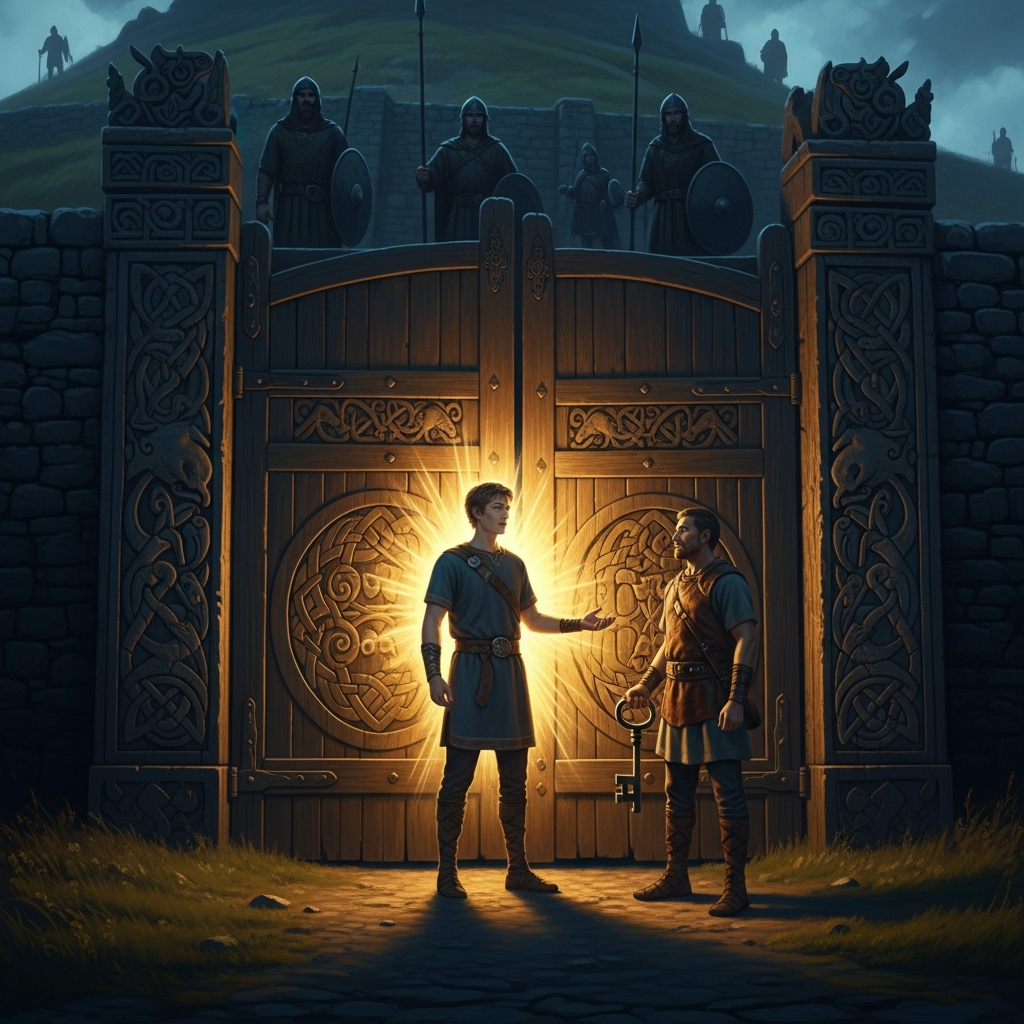
Iron stops him. Gold stops him. This is the only defense: at crossroads on nights when the roads feel wrong, a person who has gold in his pocket and iron at his belt can cause the Dullahan to recoil. Gold thrown at him will blind him momentarily. This is consistent with the broader Irish tradition in which the fairy folk cannot endure certain metals — but it does not permanently prevent him, only delays the route.
The Cóiste Bodhar accompanies him on the largest evenings — the deaf coach, a black carriage pulled by headless horses, carrying the most important deaths. A great lord, a chieftain, someone whose death requires the full conveyance rather than the single rider. The coach stops before the gate.
Some say the Dullahan was Crom Dubh, the dark god who demanded harvest sacrifices before Lugh displaced him and was transformed by that displacement into something that still rides the roads, still claiming, though what he claims now is only the inevitable. Some say he is a fragment of Balor, the severed-eye king, reassembled in a different configuration. The scholars leave these questions open.
The horseman on the Connacht road tonight is moving faster than he should be. He will stop before a house on a hill before morning. He will lift what is under his arm and look at the house. He will say a name.
Whether you hear it or not is not up to you. Whether you are the one called is the question no one can answer until he stops.
Echoes Across Traditions
Entities
- The Dullahan
- The Cóiste Bodhar
- Balor of the Evil Eye

Sources
- Patricia Lysaght, *The Banshee: The Irish Supernatural Death Messenger* (Glendale Press, 1986)
- Katharine Briggs, *A Dictionary of Fairies* (Allen Lane, 1976)
- Dáithí Ó hÓgáin, *Myth, Legend and Romance: An Encyclopaedia of the Irish Folk Tradition* (Prentice Hall, 1990)