The Emerald Tablet: As Above, So Below
Arabic text c. 6th–8th century CE; Latin translation c. 1140 CE; claimed ancient Egyptian origin · The tomb of Hermes Trismegistus (legendary); Baghdad and Islamic Spain (transmission); European universities (reception)
Contents
The Emerald Tablet — attributed to Hermes Trismegistus — is fourteen lines long and contains the entire program of alchemy, Hermeticism, and Western occult tradition. 'That which is above is as that which is below.' It was translated from Arabic in the 12th century by scholars who claimed it was inscribed on an emerald tablet found in a tomb. Newton translated it. Albertus Magnus commented on it. Jung wrote about it for forty years. The tablet does not exist as an object. Its fourteen lines have been more influential than most libraries.
- When
- Arabic text c. 6th–8th century CE; Latin translation c. 1140 CE; claimed ancient Egyptian origin
- Where
- The tomb of Hermes Trismegistus (legendary); Baghdad and Islamic Spain (transmission); European universities (reception)
The text is fourteen lines.
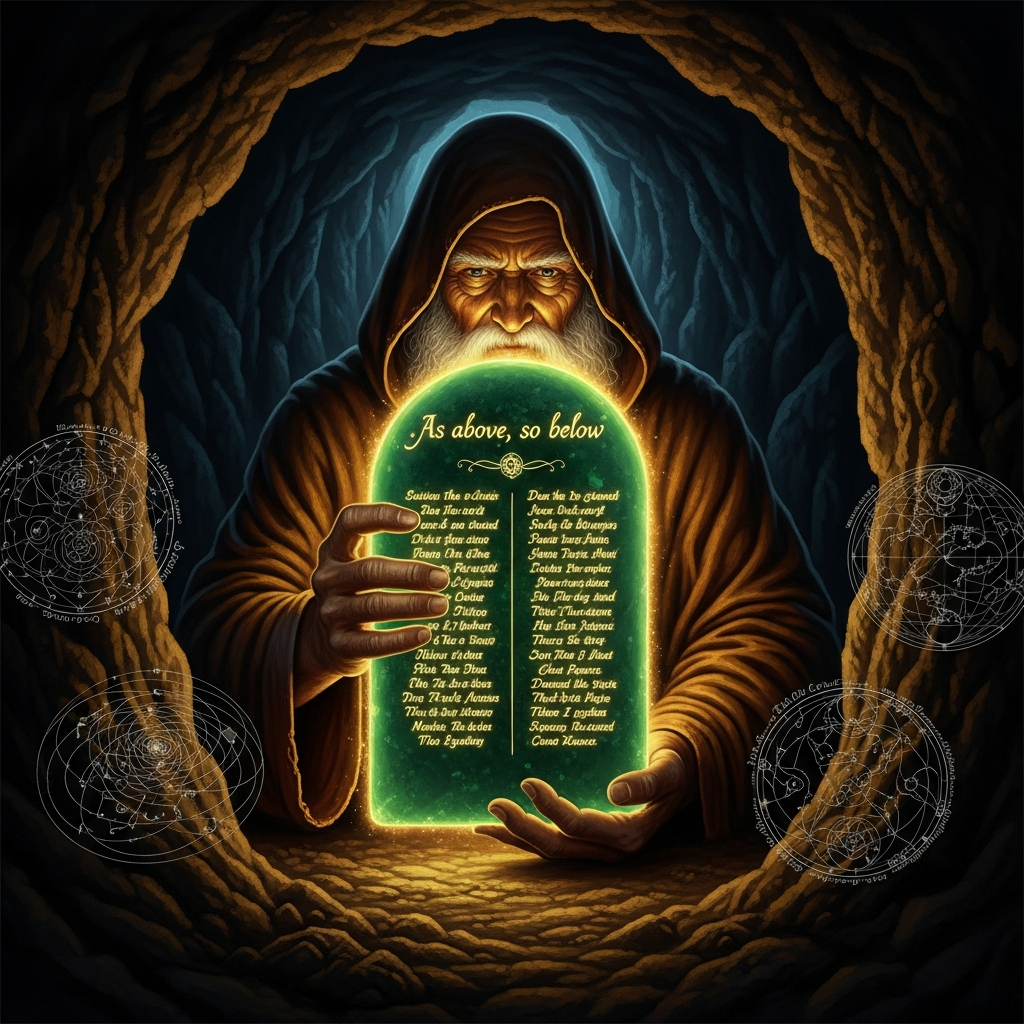
In the most common Latin version, they run approximately as follows: It is true, without lie, certain and most true. That which is below is as that which is above, and that which is above is as that which is below, to accomplish the miracles of the one thing. And as all things have been and came from the one, by the mediation of the one, so all things have their birth from this one thing by adaptation. The Sun is its father; the Moon its mother; the Wind carried it in its belly; the Earth is its nurse. The father of all perfection in the whole world is here. Its force or power is entire if it be converted into Earth. Separate the Earth from the Fire, the subtle from the gross, gently and with great ingenuity. It ascends from Earth to Heaven and again it descends to the Earth and receives the force of things superior and inferior. By this means you shall have the glory of the whole world and thereby all obscurity shall fly from you. Its force is above all force, for it vanquishes every subtle thing and penetrates every solid thing. So was the world created. From this are and do come admirable adaptations, whereof the process is here. Hence I am called Hermes Trismegistus, having the three parts of the philosophy of the whole world. That which I have said of the operation of the Sun is accomplished and ended.
That is the entirety. Fourteen sentences. The Western occult tradition’s founding document.
We do not have the original.
We have an Arabic text from approximately the sixth to eighth century CE, preserved in a book called Kitāb Sirr al-Khalīqa — the Book of the Secret of Creation — attributed to Apollonius of Tyana. The Arabic text claims that the Emerald Tablet was found in the tomb of Hermes Trismegistus, inscribed on a tablet of emerald (some versions say the corpse of Hermes was still holding it). Later Latin translations in the twelfth century removed the frame narrative in some versions and embellished it in others. The oldest Arabic sources do not agree on exactly what the text says; the Latin translations diverge further still; the English versions multiply from there.
What we have is a palimpsest of translations, each generation of translators finding the meaning they were already prepared to find.
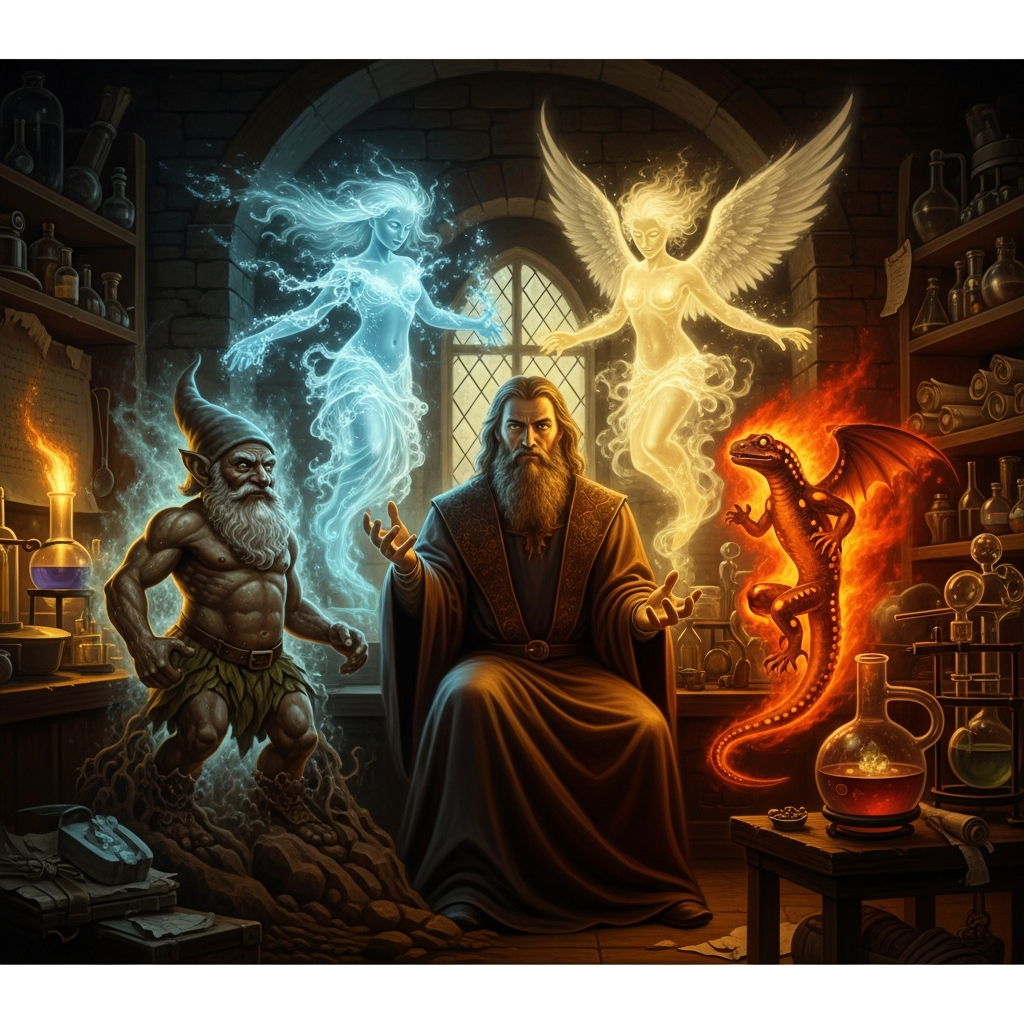
The Arab alchemists who preserved it — Jabir ibn Hayyan in the ninth century, al-Kindi, al-Razi — read it as an alchemical program: a recipe for transformation encoded in cosmological language. The Sun, Moon, Wind, and Earth were not metaphors for celestial bodies — they were the four elements in their active and passive states, the actual materials of laboratory work. The Emerald Tablet was a set of operational instructions for transmutation, if you had the key.
The medieval Europeans who received it through the translation movement in Spain and Sicily — Hugo of Santalla, Robert of Chester — read it as philosophy and theology. The as above, so below principle mapped directly onto the Neoplatonic emanation structure they already accepted: God at the top, matter at the bottom, the human soul in between, mediating. The Tablet confirmed what they already believed.
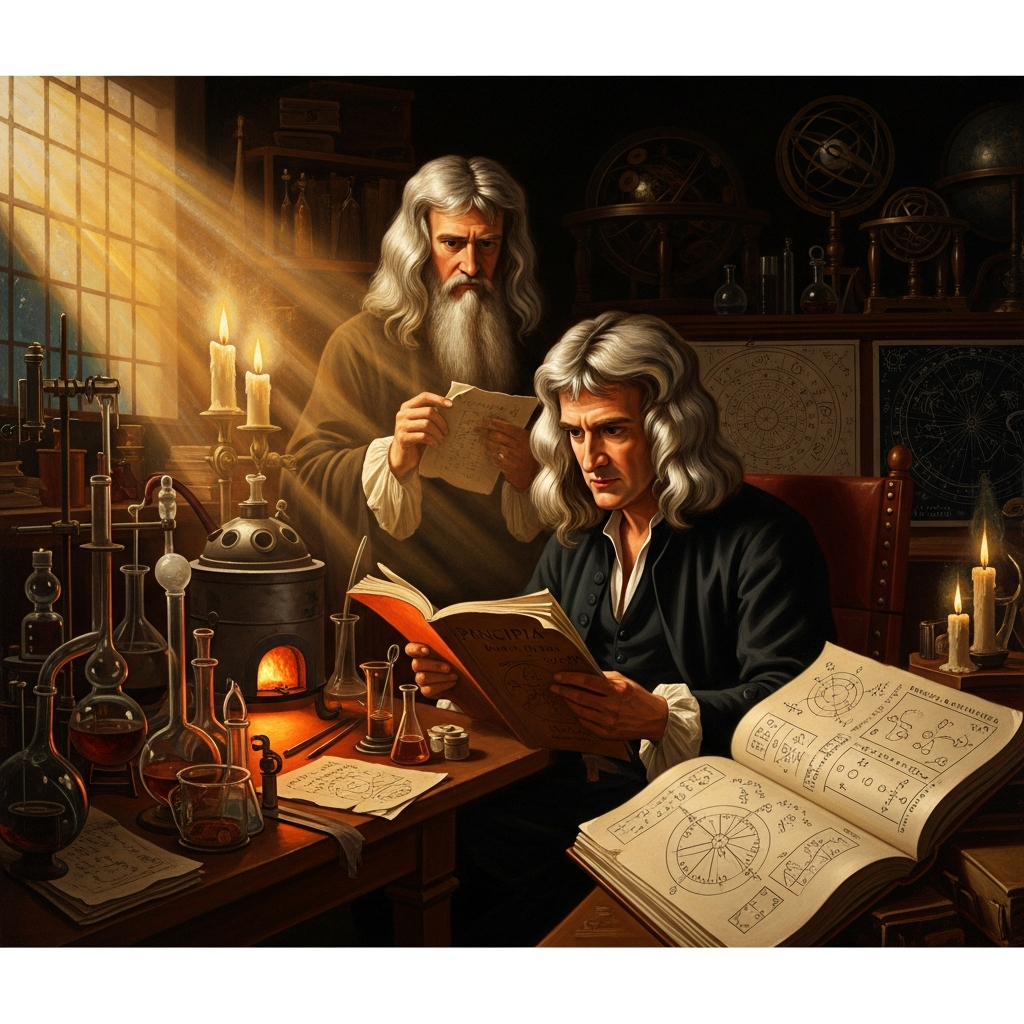
Isaac Newton translated it.
This fact is worth sitting with. Newton — the man who formulated the laws of motion, who described gravity mathematically, who invented calculus, who is one of the two or three most influential scientists in human history — kept a private manuscript translation of the Emerald Tablet among his private papers. He did not publish it. He did not share it. He wrote it in his hand, in English, with marginal annotations.
When John Maynard Keynes bought Newton’s private papers at auction in 1936 — the collection Sotheby’s had called “non-scientific” and removed from the sale of Newton’s scientific papers — he found something unexpected. He found hundreds of thousands of words on alchemy. He found Newton’s notes on the red lion and the green lion, alchemical symbols for sulfur and antimony. He found his correspondence with other alchemists. He found his translation of the Emerald Tablet alongside other Hermetic texts. He found evidence that the man who invented modern physics had spent more calendar hours working on alchemy than on physics.
Keynes gave a lecture on this in 1942, published posthumously. He said: Newton was not the first of the age of reason. He was the last of the magicians. The lecture is still startling.
The doctrine the Tablet encodes — as above, so below — is both simple and inexhaustible.
Simple: the structure of the cosmos is reflected in the structure of everything smaller than the cosmos. The macrocosm mirrors the microcosm. What happens in the heavens is reflected in the earth; what happens in the body is reflected in the soul; the structure of the atom mirrors the structure of the solar system. The word correspondence is the technical term. Everything corresponds to everything else, across scales, across the visible/invisible divide.
Inexhaustible: this claim can generate investigation indefinitely. If you believe it, every phenomenon becomes potentially legible as a symbol of a higher phenomenon, and every symbol potentially legible as an instruction about the phenomenon above it. The planets correspond to metals, metals to the organs of the body, the organs to psychological states, the psychological states to spiritual conditions. The chain has no natural terminus. You can follow it as far as you are willing to go.
Jung followed it for forty years. He called it synchronicity and stripped out the explicitly cosmological frame, but the underlying claim is identical: that the inner world and the outer world are structured by the same patterns, and that meaningful coincidences are the moments when the correspondence becomes visible. Every time a therapist interprets a dream in terms of symbols, every time someone finds meaning in a coincidence, every time an astrologer draws a birth chart, they are working within the doctrine of the Emerald Tablet.
The tablet itself does not exist.
There is no physical emerald tablet in any museum or private collection. The claimed discovery in a tomb is an origin narrative, the standard framing device for ancient wisdom in Arabic literature — the found text, the ancient authority, the transmission from the deep past. Whether the text is genuinely ancient or was composed in the Islamic world in the sixth or seventh century CE cannot be determined from the evidence we have.
It does not matter.
A text does not need a material form to be influential. The Emerald Tablet survived for fourteen centuries without anyone seeing the object it claims to be. Its influence runs from Arab alchemical laboratories to Renaissance courts to Newton’s private notebooks to the paperback occultism shelves of airport bookstores. It did all of this in fourteen sentences that fit on a single page.
The alchemists were right about at least one thing: you can compress everything essential into a very small container if you know what you are doing. The work is to extract it again. The work is always to extract it again.
Echoes Across Traditions
Entities
- Hermes Trismegistus
- the Emerald Tablet
- Isaac Newton
- Jabir ibn Hayyan
- Apollonius of Tyana

Sources
- *Kitāb Sirr al-Khalīqa* (Book of the Secret of Creation), attributed to Apollonius, c. 800 CE — first Arabic source to include the Emerald Tablet
- Jabir ibn Hayyan, *Book of the Composition of Alchemy*, c. 9th century CE
- Hugo of Santalla, Latin translation of the Emerald Tablet, c. 1140 CE
- Isaac Newton, manuscript translation of the Emerald Tablet, c. 1680 CE (Keynes MS 28, King's College Cambridge)
- Julius Ruska, *Tabula Smaragdina: Ein Beitrag zur Geschichte der hermetischen Literatur* (1926)
- Ursula Weisser, *Buch über das Geheimnis der Schöpfung* (1980)