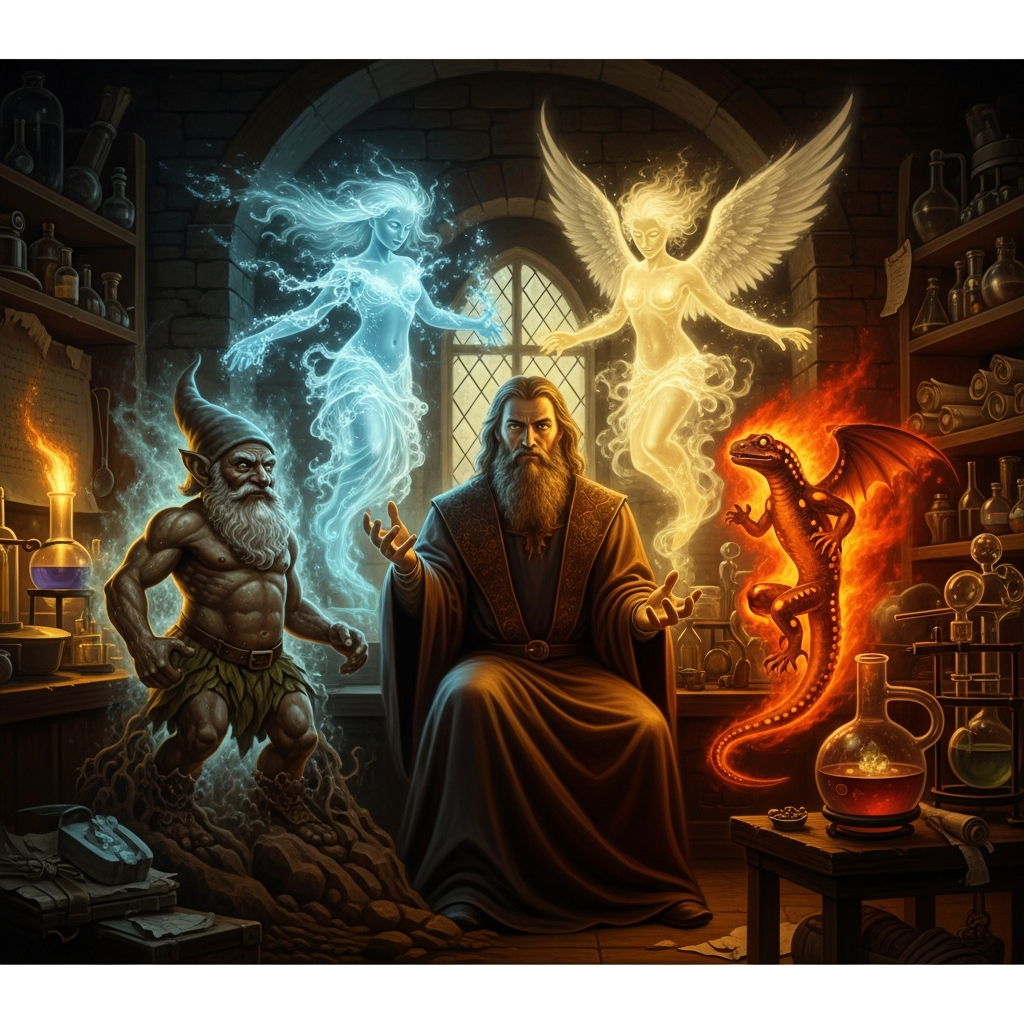
Paracelsus and the Beings of the Four Elements
Paracelsus 1493–1541 CE; active in Switzerland, Austria, Germany; elemental spirit treatise c. 1530–1540 CE · Basel, Switzerland; Salzburg; Strasbourg; Nuremberg; the roads between European cities that repeatedly expelled him
Contents
Paracelsus — the Swiss physician-alchemist who threw Avicenna's medical textbooks into a bonfire and replaced them with his own observations — taught that each element was inhabited by spirits: Gnomes in earth, Undines in water, Sylphs in air, Salamanders in fire. He was the first to use the word 'alchemy' in a systematic medical context. He also invented zinc, described several diseases before modern medicine confirmed them, and was thrown out of every city he ever worked in. The elemental spirits he described have been in English literature ever since: Pope's Sylphs, Shakespeare's Ariel, Tolkien's Ents.
- When
- Paracelsus 1493–1541 CE; active in Switzerland, Austria, Germany; elemental spirit treatise c. 1530–1540 CE
- Where
- Basel, Switzerland; Salzburg; Strasbourg; Nuremberg; the roads between European cities that repeatedly expelled him
He was born Philippus Aureolus Theophrastus Bombastus von Hohenheim.
He renamed himself Paracelsus — meaning “beyond Celsus,” a claim of superiority over the great classical medical authority — which tells you everything about his self-assessment and his relationship with academic tradition. He was born in Switzerland in 1493, the son of a physician, and he began learning medicine the traditional way: texts, commentaries, the canon of Galen and Avicenna that had governed European medicine for centuries.
He then spent most of his career rejecting that canon as decisively as possible.
He did not merely disagree with the classical tradition. He performed his disagreement. In Basel in 1527, where he had been appointed city physician and lecturer at the university — a significant position that he obtained partly through the advocacy of the printer Froben, whom he had treated successfully — he opened his lectures by burning Avicenna’s Canon of Medicine in a copper dish in the street. In front of his students. As a statement of where he stood on the received authorities of medicine.
He was removed from his position in Basel the following year.
Paracelsus was removed from most positions he held.
He moved constantly through German-speaking Europe — Basel, Strasbourg, Nuremberg, Regensburg, Salzburg, Vienna, at various points — and his residence in each city tended to end the same way: controversy with the established physicians, controversy with the authorities, departure (often rapid and involuntary). His personality was combative by any account including his own. He drank heavily. He lectured in the vernacular German rather than Latin, which was democratic and scandalous simultaneously. He treated the poor when the poor could not pay him. He insulted his colleagues in print.
His medical contributions were real. He was among the first to describe the occupational diseases of miners — the lung diseases that came from breathing metal dust for years, which he saw at the mines of the Tyrol and Bohemia. He introduced mineral-based medicines at a time when the entire pharmacological tradition was plant-based — mercury compounds for syphilis (dangerous but sometimes effective), antimony compounds, preparations of sulfur, iron, copper. He is credited with the first systematic use of laudanum (tincture of opium) as a painkiller. He was the first to clearly describe goiter, to describe several psychiatric conditions, to use the term zinc for the metal he identified.
All of this was done inside a cosmological framework that most modern accounts quietly delete.
The cosmological framework is inseparable from the medicine.
Paracelsus did not believe the body was a mechanical system that could be understood by analyzing its parts. He believed the body was a microcosm of the entire universe, that each organ corresponded to a planet and a metal and a spiritual principle, and that disease was a disruption in this correspondence. The stars influenced the body not mystically but materially — through the same forces that governed the natural world, forces that medicine needed to understand as a totality rather than cataloguing symptoms.
Into this framework, the elemental beings fit with perfect consistency.
He wrote the treatise on elementals — Liber de nymphis, sylphis, pygmaeis et salamandris — around 1530, though it was published posthumously. The argument is both cosmological and empirical in his sense: just as every human domain is inhabited by human beings, every elemental domain must be inhabited by beings appropriate to it. Earth, the densest element, is inhabited by Gnomes (also called Pygmies or Gnomi): small, cave-dwelling, mineral-knowing beings who move through rock as easily as humans move through air. Water is inhabited by Undines or Nymphs: beings who dwell in rivers and seas and are capable of human-like emotion and relationship. Air is inhabited by Sylphs: beings of the high atmosphere, the most ethereal of the four types, associated with wind and breath. Fire is inhabited by Salamanders: beings that live within and constitute fire itself, that can pass through flame unharmed.
These were not metaphors for Paracelsus. He discussed their physiology, their relationship to human beings, whether they possessed souls (technically no, because they were not descended from Adam — though they were capable of acquiring souls through relationship with humans, which he discussed in some detail). He described the specific dangers of interacting with each type.
What happened to these beings after Paracelsus is traceable.
Alexander Pope used them in The Rape of the Lock (1712) as comic machinery — the Sylphs who attend Belinda are explicitly Paracelsian, acknowledged in Pope’s prefatory letter to the poem. Pope found the tradition through Rosicrucian texts that had absorbed and transformed Paracelsus. The Sylphs who protect a woman’s honor are the elemental air-beings domesticated into an aristocratic comedic poem about a stolen curl of hair.
Shakespeare’s Ariel in The Tempest (1611) draws on both Celtic fairy tradition and Paracelsian sylph tradition — a spirit of the air, bound to service, capable of remarkable transformations, not quite human in its affective range.
Tolkien’s Ents — the tree-shepherds of The Two Towers — are the most radical transformation of the gnome/earth-elemental tradition: creatures who are of the earth not in Paracelsus’s subterranean sense but in the vegetative sense, earth-beings whose slowness is a function of their deep embeddedness in the material world. Tolkien would have denied the Paracelsian genealogy; the structural inheritance is there regardless.
Paracelsus died in Salzburg in 1541, at forty-seven.
The manner of his death is disputed: some accounts say he was found dead in his room, possibly after a fall; others suggest he was attacked by enemies. He had enough enemies for the latter to be plausible. He died alone, largely without the recognition he had sought, having been thrown out of cities and positions repeatedly, having published combatively and been met with contempt.
He was rediscovered within decades of his death. The Paracelsian school of medicine dominated much of European medical thought through the sixteenth and seventeenth centuries, more influential after his death than during his life. His elemental beings entered the popular and literary imagination and never left.
The man who burned Avicenna in the street was himself burned — or rather, compressed into the categories of the age that followed him, the alchemist-mystic who happened to invent zinc, the elemental spirit theorist who happened to describe occupational lung disease. He was too early for the world he was pointing toward. He is always too early.
Echoes Across Traditions
Entities
- Paracelsus
- Gnomes
- Undines
- Sylphs
- Salamanders
Sources
- Paracelsus, *A Book on Nymphs, Sylphs, Pygmies, and Salamanders, and on the Other Spirits* (*Liber de nymphis, sylphis, pygmaeis et salamandris*), c. 1530–1540 CE (published posthumously 1566)
- Paracelsus, *Opus Paramirum* (1530)
- Walter Pagel, *Paracelsus: An Introduction to Philosophical Medicine in the Era of the Renaissance* (1958)
- Charles Webster, *Paracelsus: Medicine, Magic and Mission at the End of Time* (2008)
- Allen Debus, *The Chemical Philosophy: Paracelsian Science and Medicine in the Sixteenth and Seventeenth Centuries* (1977)