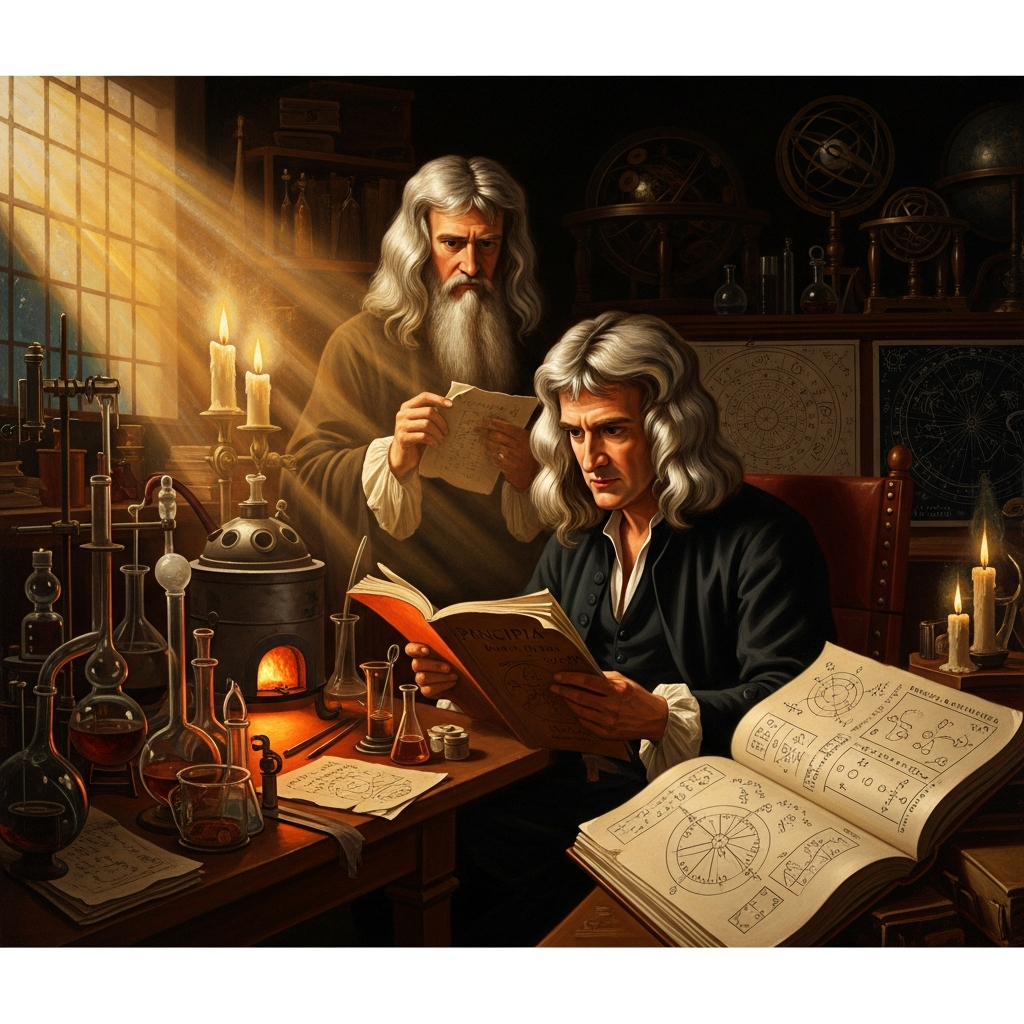
Newton's Secret Work
Newton 1643–1727 CE; alchemical and theological work c. 1668–1710 CE; Keynes's discovery 1936 · Cambridge, England (Trinity College); Newton's private laboratory; the dimensions of Solomon's Temple as Newton calculated them
Contents
Isaac Newton wrote more pages on alchemy and biblical prophecy than on physics. He spent decades trying to decode Revelation, calculate the dimensions of Solomon's Temple, and find the Philosopher's Stone. When John Maynard Keynes bought Newton's private papers at auction in 1936, he announced: 'Newton was not the first of the age of reason. He was the last of the magicians.' The man who described gravity spent more hours searching for the red lion and the green lion — alchemical symbols — than calculating celestial mechanics. The Enlightenment was founded by a man who never believed in it.
- When
- Newton 1643–1727 CE; alchemical and theological work c. 1668–1710 CE; Keynes's discovery 1936
- Where
- Cambridge, England (Trinity College); Newton's private laboratory; the dimensions of Solomon's Temple as Newton calculated them
The sale happened in 1936.
Sotheby’s had been given the task of auctioning Newton’s papers — the papers that Keynes would later estimate at roughly a million words, mostly unpublished, that had been kept in a large collection by the Portsmouth family, who had received them through a descendant. The scientific papers had already been acquired by the University of Cambridge in 1872. What remained were the papers Sotheby’s and the organizing committee classified as “non-scientific” — and these were what went to auction in July 1936.
John Maynard Keynes, the economist, bought approximately half of the lot. He spent the next years reading them with growing astonishment. When he died in 1946, he left an undelivered lecture called “Newton, the Man” that was read to the Royal Society shortly after his death and published later in his collected essays.
Its central claim is still startling: Newton was not the first of the age of reason. He was the last of the magicians, the last of the Babylonians and Sumerians, the last great mind which looked out on the visible and intellectual world with the same eyes as those who began to build our intellectual inheritance rather less than ten thousand years ago.
The numbers are not in dispute.
Betty Jo Teeter Dobbs, who produced the definitive scholarly study of Newton’s alchemy in two volumes (1975 and 1991), estimated that Newton wrote approximately a million words on alchemy and about a million words on biblical prophecy, theology, and church history. His surviving scientific notebooks and publications run to somewhere between a hundred thousand and two hundred thousand words. He spent more time on alchemy than on physics by a factor of at least five.
He kept a private laboratory at Trinity College from approximately 1668 onward. He worked in it, often alone, late into the night. His assistant Humphrey Newton (no relation) left a memoir describing the experiments: fires kept burning for weeks without interruption, the smell of metallic compounds, Newton working through the night and then barely sleeping. He was looking for something. He worked on it for roughly thirty years without finding it.
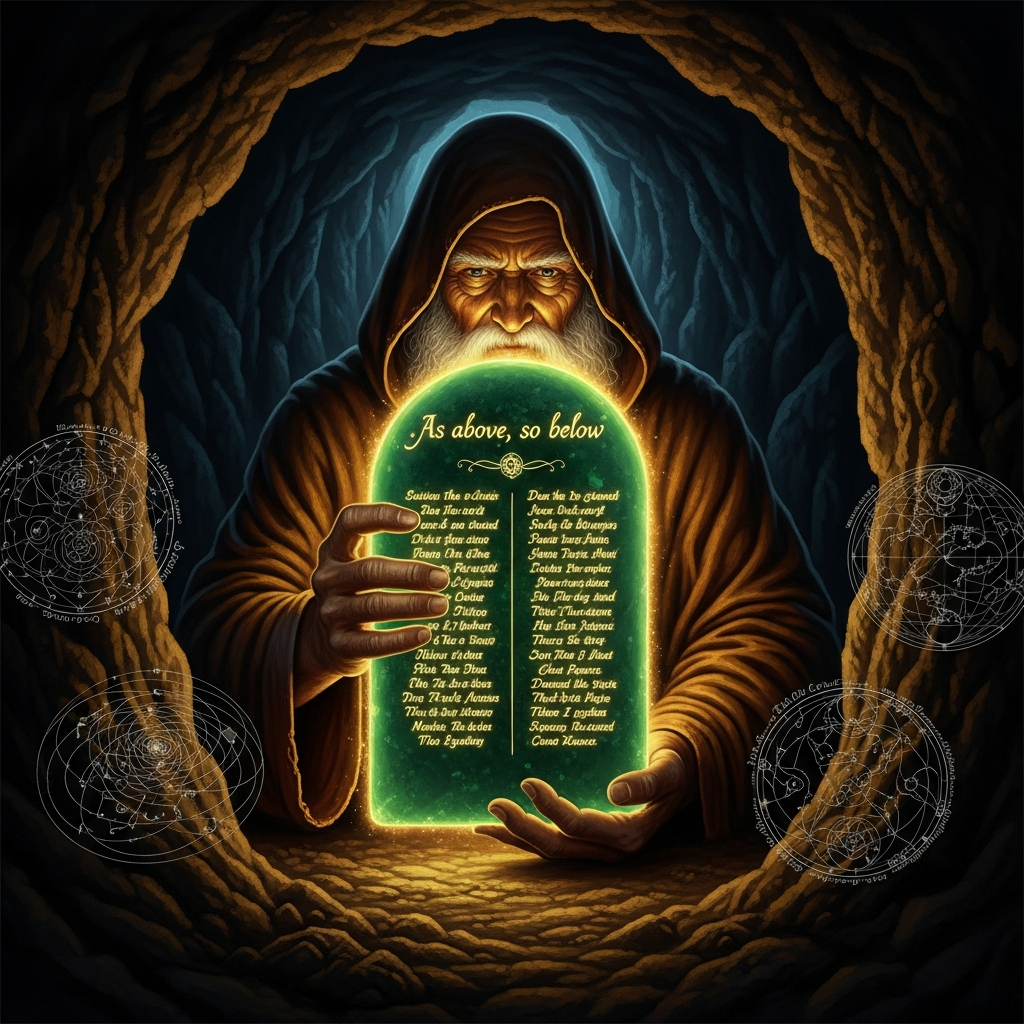
He kept detailed records. They are dense with alchemical language — the red lion (a mercury-antimony compound), the green lion (possibly vitriol or, in some contexts, antimony sulfide), the philosophers’ mercury, the process of putrefaction and regeneration. He also translated and annotated the Emerald Tablet. The manuscript of his translation survives at King’s College, Cambridge, as Keynes MS 28.
He believed he was recovering ancient knowledge, not inventing new knowledge.
This is the key to understanding what Newton thought he was doing, and it differs fundamentally from how later centuries have described him. He did not think of himself as innovating. He thought of himself as recovering the prisca sapientia — the ancient wisdom, the original knowledge of nature that had been given to Adam, transmitted through Noah, encoded in the measurements of Solomon’s Temple, and then scattered and corrupted by the passage of time and the failures of human understanding.
His science was, in this frame, a form of archaeology. He was digging under the corrupted knowledge of the scholastics and the Church to find the original transmission. The mathematics of celestial mechanics was not a new discovery — it was the recovery of what the ancient Egyptians and Chaldeans and Hebrews had known. The inverse square law was not Newton’s invention; it was Newton’s rediscovery of a law that Pythagoras had understood as harmonics, that Solomon’s Temple had encoded in its proportions, that Hermes Trismegistus had compressed into the Emerald Tablet.
He measured Solomon’s Temple. This is documented. He spent years working out the dimensions of the Temple as described in Ezekiel and Kings and Chronicles, and he believed the Temple was a model of the cosmos — that its measurements encoded the distances between the planets, the periods of their orbits, the structure of time itself. If he could reconstruct the Temple precisely, he believed, he could read from it a chronological key that would unlock the prophecies of Daniel and Revelation.
His theology was more radical than his alchemy.
Newton was an Arian — he rejected the doctrine of the Trinity as a corruption of the original Christian revelation, a fourth-century interpolation by Athanasius and his party that replaced the true teaching (Jesus as the greatest of created beings, subordinate to the Father) with a pagan philosophical concept imported from Greek metaphysics. He could not say this publicly. He held the Lucasian Chair of Mathematics at Cambridge, a chair that required its holder to be ordained in the Church of England, which was Trinitarian. He obtained an exemption from ordination through royal dispensation rather than subscribe to a doctrine he believed was false.
He spent decades writing theological history demonstrating that the Trinity was a forgery. This manuscript — the Yahuda manuscript, now in Jerusalem — was unpublishable in his lifetime. He knew it was unpublishable. He wrote it anyway.
He was also a committed millenarian. He believed the prophetic timetable in Daniel and Revelation was literally true and that its decoding was his specific vocation. He calculated dates for the end of the current age — placing them several centuries in the future, further than the enthusiasts of his day were placing them, but finite and determinable. He understood his unique intellect as a divine gift for a divine purpose: he had been chosen to understand the plan.
What Keynes called “the Newtonian legend” is the version of Newton that the eighteenth and nineteenth centuries constructed.
In this legend, Newton is the man who replaced superstition with reason, who showed that the universe runs by mathematical law without divine intervention in its daily operations, who expelled the last traces of occult sympathy and Renaissance magic from natural philosophy and replaced them with experiment and demonstration. Voltaire popularized this Newton. The encyclopédistes celebrated him. By the time of the French Enlightenment, Newton had become the patron saint of a project he would have found partially alien and partially acceptable.
He would have accepted the mathematics. He would have rejected the atheism that followed. He would have rejected the idea that the universe’s mathematical laws were self-sufficient without a God who enforced them. He would have rejected the discontinuity with the ancient wisdom — the idea that knowledge began fresh with him, rather than being recovered from the Hermetic tradition he worked within all his life.
The Enlightenment needed a Newton who had killed magic. The actual Newton was a man who spent thirty years in a private laboratory trying to achieve a chemical transmutation while simultaneously measuring Solomon’s Temple and decoding the prophetic chronology of Daniel. He was both, at once, all his life. The two projects were not contradictions to him.
He never found the Philosopher’s Stone. He did find the laws of motion, the mathematical description of gravity, the nature of white light. He found them because he was looking for something else — because the attention he brought to the natural world was the attention of someone who believed the natural world encoded a divine secret, and that paying close enough attention would eventually reveal it.
The secret was not what he thought it was. The attention produced something he did not expect. This may be the most honest description of how scientific discovery actually works.
Echoes Across Traditions
Entities
- Isaac Newton
- the Philosopher's Stone
- the Emerald Tablet
- Solomon's Temple
- John Maynard Keynes

Sources
- John Maynard Keynes, 'Newton, the Man' (lecture 1942, published in *Essays in Biography*, 1951)
- Betty Jo Teeter Dobbs, *The Foundations of Newton's Alchemy* (1975)
- Betty Jo Teeter Dobbs, *The Janus Faces of Genius: The Role of Alchemy in Newton's Thought* (1991)
- Rob Iliffe, *Priest of Nature: The Religious Worlds of Isaac Newton* (2017)
- Isaac Newton, Keynes MS 28 (Emerald Tablet translation), King's College, Cambridge
- Isaac Newton, Yahuda MS (biblical prophecy manuscripts), National Library of Israel, Jerusalem