The One Thing the Heroes Could Not Find: The Quest for Immortality
Epic of Gilgamesh in Standard Babylonian version c. 1100 BCE (older versions from c. 2100 BCE); Heracles myths in extant form from c. 700 BCE; Chinese Daoist alchemical texts from Han dynasty (206 BCE-220 CE) onward; Philosopher's Stone tradition in European alchemy from c. 12th century CE · The cedar forests beyond Mesopotamia (Gilgamesh), the edges of the known world where Utnapishtim lives in eternal life, the furnaces and laboratories of alchemical Europe, the mountains of Daoist immortals in China, the pyre on Mount Oeta where Heracles burned away his mortal nature
Contents
Gilgamesh, the Philosopher's Stone, the Daoist elixir, Heracles's apotheosis: the quest for immortality is the oldest story. It almost always fails. The failure is the point.
- When
- Epic of Gilgamesh in Standard Babylonian version c. 1100 BCE (older versions from c. 2100 BCE); Heracles myths in extant form from c. 700 BCE; Chinese Daoist alchemical texts from Han dynasty (206 BCE-220 CE) onward; Philosopher's Stone tradition in European alchemy from c. 12th century CE
- Where
- The cedar forests beyond Mesopotamia (Gilgamesh), the edges of the known world where Utnapishtim lives in eternal life, the furnaces and laboratories of alchemical Europe, the mountains of Daoist immortals in China, the pyre on Mount Oeta where Heracles burned away his mortal nature
Gilgamesh, king of Uruk, has crossed the Waters of Death at the edge of the world. He has survived the Scorpion-men at the gateway of the sun’s path. He has spoken to the ale-wife Siduri, who gave him what was probably the best advice he received in his entire journey and which he completely ignored: “When the gods created mankind, they allotted death to mankind, but life they retained in their own keeping. As for you, Gilgamesh, let your belly be full, make merry day and night, dance and play day and night, gaze upon the child who holds your hand, let your wife delight in your embrace — these things alone are the concern of mankind.”
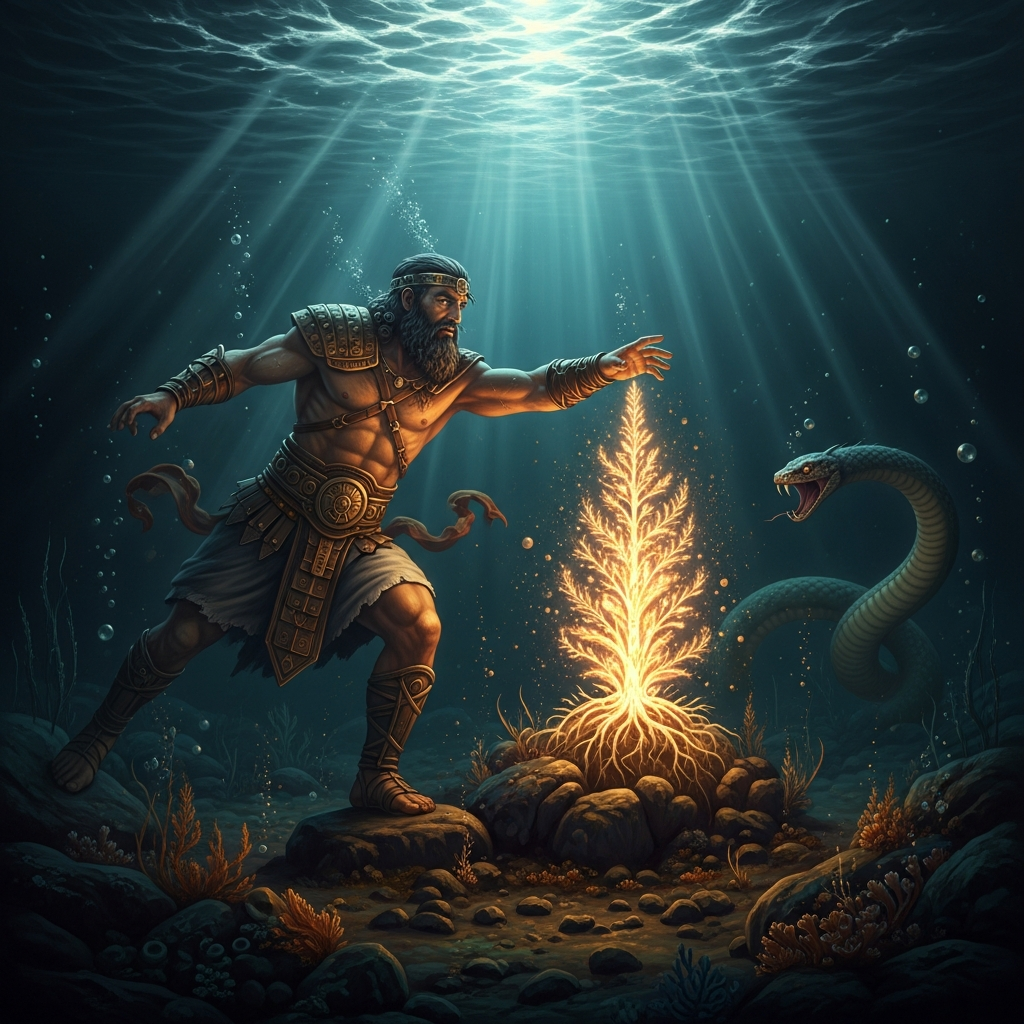
He ignored her and pressed on. He found Utnapishtim. He heard the story of the flood. He failed the test of seven days’ wakefulness (falling asleep immediately upon sitting down). He was told about the plant of rejuvenation at the ocean floor, dove for it, found it, brought it up. And then a snake, smelling its fragrance while Gilgamesh bathed in a pool, came and ate it. The snake shed its skin — it was rejuvenated. Gilgamesh wept.
He returned to Uruk and, the poem ends, pointed at the walls he had built. Here is the city. Look at the walls. This is what remains.
This is the oldest written story in the world making its central point: the quest for immortality fails. What you have instead is the city, the craft, the walls that outlast the builder. The poem is not a tragedy. It is a lesson in what to do with your hands.
The Structure of the Failed Quest
The immortality quest differs from other quests in a critical structural feature: the hero is pursuing something that, in most traditions, was never available to them to begin with. The quest is not a search for a hidden treasure; it is an attempt to cross a categorical boundary between mortal and divine — a boundary that the traditions generally regard as cosmologically fixed.
In the Mesopotamian tradition, immortality was given to one human, once, under exceptional circumstances that have been permanently retired. Utnapishtim himself tells Gilgamesh: “Who will assemble the gods for you, so that you can find the immortality you seek? Come, for six days and seven nights, do not sleep.” The test is impossible not because sleep is impossible to avoid but because the test is designed to show Gilgamesh what he is. You are the kind of being that sleeps. That is what mortal means.
The Greek tradition operates similarly. The heroes who come closest to immortality — Heracles, Achilles, Peleus — all do so through extraordinary divine favor, and the results are mixed. Achilles’ immortality-by-Styx-dipping left one heel unprotected. Tithonus, loved by the dawn goddess Eos who asked Zeus to grant him immortality, was granted it — but Eos forgot to ask for eternal youth as well. He aged forever, shrinking and chattering, until he was transformed into a cricket. The Greeks were grimly creative about the ways that immortality, incompletely achieved, becomes a different kind of horror.
Siduri’s Advice and the Carpe Diem Tradition
The ale-wife’s speech in Tablet X of the Epic of Gilgamesh is one of the oldest carpe diem texts in human literature, predating Horace by over a thousand years. And it is, in retrospect, the thematic center of the epic — the advice the protagonist is given and refuses, which turns out to be the correct answer to the question he is asking.
Gilgamesh is asking: how do I avoid death? Siduri answers: you don’t. The gods kept life; they gave death to humans. Here is what you do instead: eat, drink, dance, hold your child’s hand, embrace your wife. These are the things that are available to mortals, and they are worth having.
This is not nihilism. It is a positive claim about what mortal life is worth. The ale-wife is not saying that nothing matters because we die. She is saying that the specific pleasures available to mortal beings have their own dignity and completeness. They are not consolation prizes for the immortality you can’t have. They are, in themselves, the point.
Gilgamesh is too grief-stricken to hear this when she says it. He is in the acute phase of loss — Enkidu has just died — and loss at that intensity does not make philosophical arguments possible. He does hear it, eventually, inscribed in stone. The walls of Uruk, which the poem asks the reader to contemplate at beginning and end, are Gilgamesh’s response to Siduri’s advice. He built something. He built it knowing he would die. The walls remain.
Heracles: The Apotheosis That Required Total Destruction
The Greek solution to the immortality problem is the most extreme in world mythology: to become immortal, the mortal portion must be completely destroyed. You cannot take your mortality with you into divine existence. You must burn it off.
Heracles’ death on the pyre of Mount Oeta is not a suicide born of despair — though it contains despair. It is a deliberate completion. He has been told (by oracle, by the logic of the myths around him, by the pattern of his life) that he will not die by any living creature’s hand. He has survived everything the world could throw at him. What kills him is the centaur Nessus’s poisoned blood — technically the blood of a dead creature, fulfilling the prophecy. The agony is not survivable.
So Heracles does the only thing that addresses the agony: he has his son light the pyre he has built for himself. The fire takes the mortal portion. The divine portion — the part that is Zeus’s — rises to Olympus. He becomes a god.
Hera, who hated him his entire mortal life and caused most of his labors, reconciles with him on Olympus and gives him her daughter Hebe (Youth) as his wife. The enmity that structured his mortal life was, from the divine perspective, already resolved. It was only from the mortal side that it looked like hatred.
The burning is the initiation. The labors — the twelve impossible tasks — were the preparation. The pyre is the gate.
Qin Shi Huang’s Death by Immortality
The Chinese emperor Qin Shi Huang, who unified China in 221 BCE and built the Great Wall, spent the last decade of his reign in an escalating obsession with immortality. He dispatched the court alchemist Xu Fu with thousands of young men and women to sail east to find the islands of the immortals (the Penglai Islands). They did not return. He consumed mercury-based pills prepared by his court alchemists — pills that would have contained lead and other heavy metals alongside the mercury. He died in 210 BCE, probably of heavy metal poisoning from the immortality preparations.
The irony is so precise that Chinese historians and later Daoist commentators could not resist it. The man who feared death most was killed by his attempt to avoid it. The toxins in the immortality medicine were the direct cause of his death. The elixir and the poison were the same substance.
Later Daoist inner alchemy (neidan) drew the lesson: the immortality you seek externally will kill you. The true immortality — the cultivation of the authentic self, the harmonization with the Dao — is an internal process that cannot be bottled.
What the Quest Teaches by Failing
The snake that steals the plant of rejuvenation from Gilgamesh while he bathes is the most efficient moment of cosmic irony in world literature. The hero found the plant. He held it in his hands. It was real. A snake — a creature associated throughout mythology with regeneration precisely because it sheds its skin and seems to be reborn — took it from him while he was doing the most ordinary human thing: washing himself in a pool.
The snake gets the immortality. Gilgamesh gets the lesson.
Every tradition that runs the immortality quest to its conclusion reaches a version of this conclusion: the quest teaches you what you are by showing you what you cannot be. The Waters of Death that Gilgamesh crossed, the pyre that Heracles climbed, the laboratory where the alchemists worked toward the Stone — these are all the same threshold. The hero who approaches it, fully and honestly, does not cross it. They return changed.
What changes is the relationship to death. The quest is not for immortality. The quest is for the understanding of what mortality means. That understanding, unlike the plant, cannot be stolen.
Echoes Across Traditions
Entities
- Gilgamesh
- Enkidu
- Utnapishtim
- Siduri
- Heracles
- Zeus
- Hera


Sources
- *Epic of Gilgamesh*, Standard Babylonian version, Tablets IX-XI (c. 1100 BCE)
- Andrew George, *The Babylonian Gilgamesh Epic* (2003)
- Sophocles, *Women of Trachis* (c. 450 BCE) — Heracles's death
- Ovid, *Metamorphoses* IX.134-272 (Heracles's apotheosis)
- Ge Hong, *Baopuzi* (c. 317 CE) — Daoist alchemical treatise
- Nathan Sivin, 'Chinese Alchemy and the Manipulation of Time,' *Isis* (1976)
- Lawrence Principe, *The Secrets of Alchemy* (2013)
- Genesis 2:9, 3:22-24 (tree of life); Revelation 22:2, 14
- Alexander Heidel, *The Gilgamesh Epic and Old Testament Parallels* (1946)