The Rosicrucian Manifestos: The Brotherhood That May Not Exist
*Fama Fraternitatis* published 1614 CE; *Confessio* 1615 CE; *Chemical Wedding* 1616 CE; Kassel and Tübingen, Germany · Germany (Kassel; Tübingen; the printer's houses of Protestant Europe); the imaginary castle and tomb of Christian Rosenkreuz
Contents
In 1614, a pamphlet appeared in Germany claiming the existence of a secret brotherhood of learned men — the Rosicrucians, Brothers of the Rose Cross — who had been working in secret since the 15th century to transform European knowledge. Two more manifestos followed. Thousands of people sent letters to the Brotherhood seeking admission. No one responded. No one could find them. They may have been the first viral hoax — or a real organization so secret it left no trace. Either way, they invented modern occultism and left a permanent mark on Freemasonry, Theosophy, and Western esotericism.
- When
- *Fama Fraternitatis* published 1614 CE; *Confessio* 1615 CE; *Chemical Wedding* 1616 CE; Kassel and Tübingen, Germany
- Where
- Germany (Kassel; Tübingen; the printer's houses of Protestant Europe); the imaginary castle and tomb of Christian Rosenkreuz
The pamphlet appeared in Kassel in 1614.
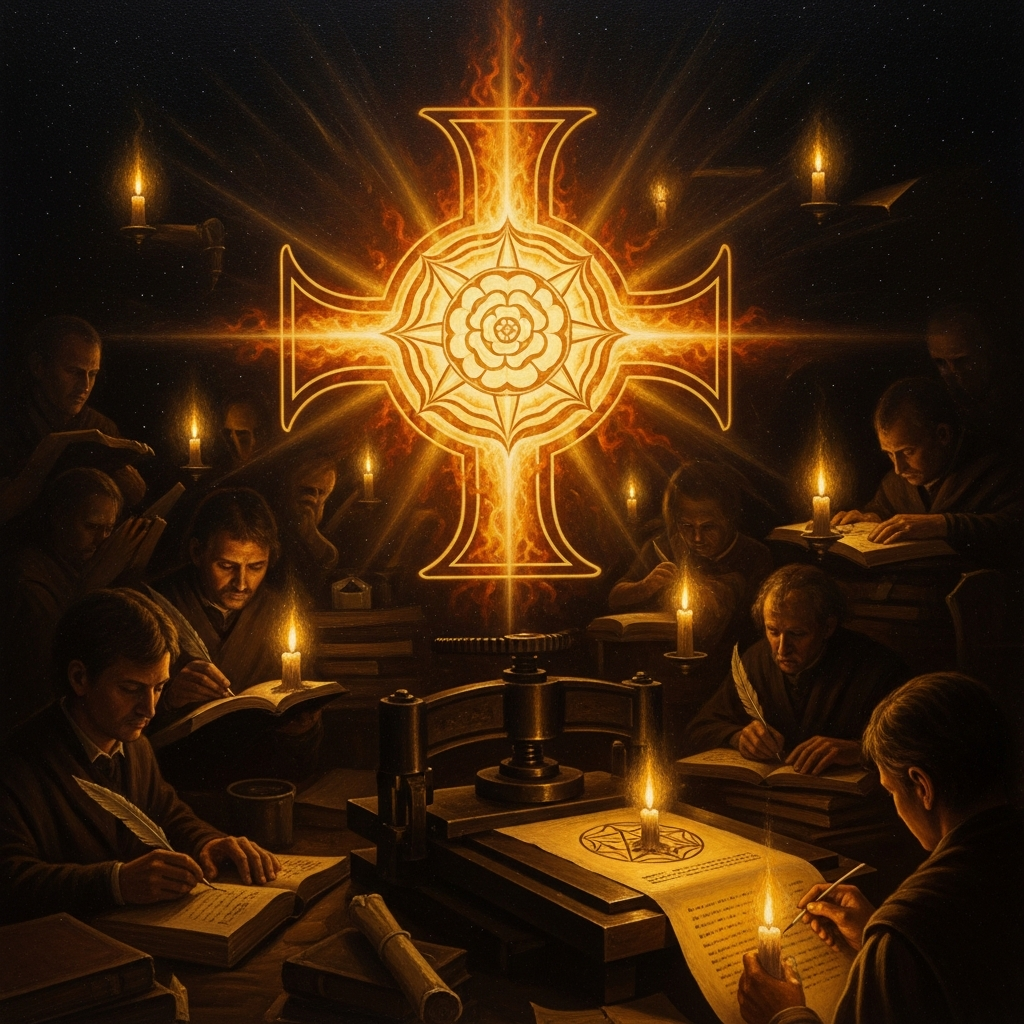
It was called the Fama Fraternitatis — the Report of the Brotherhood — and it was anonymous. It ran to approximately twelve printed pages. Its opening declared that God, seeing the corruption of the age, was preparing a great transformation of human knowledge, and that a Brotherhood of the Rosy Cross had been working toward this transformation in secret for a hundred and fifty years.
The Brotherhood had been founded, the pamphlet explained, by a German nobleman called Christian Rosenkreuz who had been born in 1378. As a young man he had traveled to the Near East — Damascus, then the city of Damcar in Arabia, then Fez in Morocco — and had learned from sages there a universal knowledge encompassing medicine, mathematics, philosophy, and the occult arts. He returned to Germany, gathered a small group of disciples, and formed the Brotherhood. They agreed to six rules: to heal the sick for free, to wear no distinctive dress, to meet once a year, to find a suitable successor before dying, to use the symbol of the Rose Cross as their seal, and to remain secret for a hundred years.
Rosenkreuz died in 1484, the pamphlet said, at the age of 106. His tomb was sealed.
The Brotherhood had recently opened the tomb.
This was the dramatic center of the Fama’s narrative. After 120 years, members of the Brotherhood had rediscovered the vault, opened it, and found it in perfect condition — lit from within by a sun that was not the sun, containing the body of Rosenkreuz perfectly preserved, and surrounded by texts, instruments, and the complete record of the Brotherhood’s knowledge. The opening of the vault was a sign: the time of secrecy was over. The Brotherhood was ready to receive new members.
The pamphlet invited all learned men of goodwill to declare their interest.
The following year brought the Confessio Fraternitatis, a shorter text that confirmed the Brotherhood’s existence, clarified its Protestant Christian theology, and promised that its knowledge would transform the world. The year after that brought the Chemical Wedding of Christian Rosenkreuz — a long allegorical narrative about Rosenkreuz being invited to a royal alchemical wedding and participating in a complex sequence of symbolic trials. The Chemical Wedding was later attributed to a specific author: Johann Valentin Andreae, a young Lutheran theologian from Tübingen, who in later life described it as a ludibrium — a jest or playful fiction.
The response was enormous.
Letters addressed to the Brotherhood of the Rosy Cross arrived at print shops across Germany. Pamphlets appeared by the dozen: some accepting the manifestos as genuine, some attacking them as dangerous heresy, some offering to join, some claiming already to be members. Scholars, physicians, alchemists, theologians — everyone with a claim to learned status had an opinion about the Brotherhood.
No one received a reply.
This is the central fact around which all subsequent Rosicrucian history circles. Thousands of attempts to contact the Brotherhood over the following decades produced no confirmed contact. No one was admitted. No member came forward. No vault was located. No meeting was attended by anyone who could verify their attendance to a skeptic. The Brotherhood either did not exist, or it was exactly as secret as it claimed to be, or it existed but had no interest in the people who wrote to it.
Frances Yates, who wrote the definitive twentieth-century study of the Rosicrucian phenomenon (The Rosicrucian Enlightenment, 1972), argued that the manifestos were a kind of thought experiment — a fictional projection of what an ideal learned brotherhood would look like, published in the specific political moment of the Bohemian Protestant movement, in the hope of inspiring actual reform. The fiction created the demand for the reality; the demand then created, over the following century, real organizations that tried to answer it.
The legacy is measurable in every occult organization that followed.
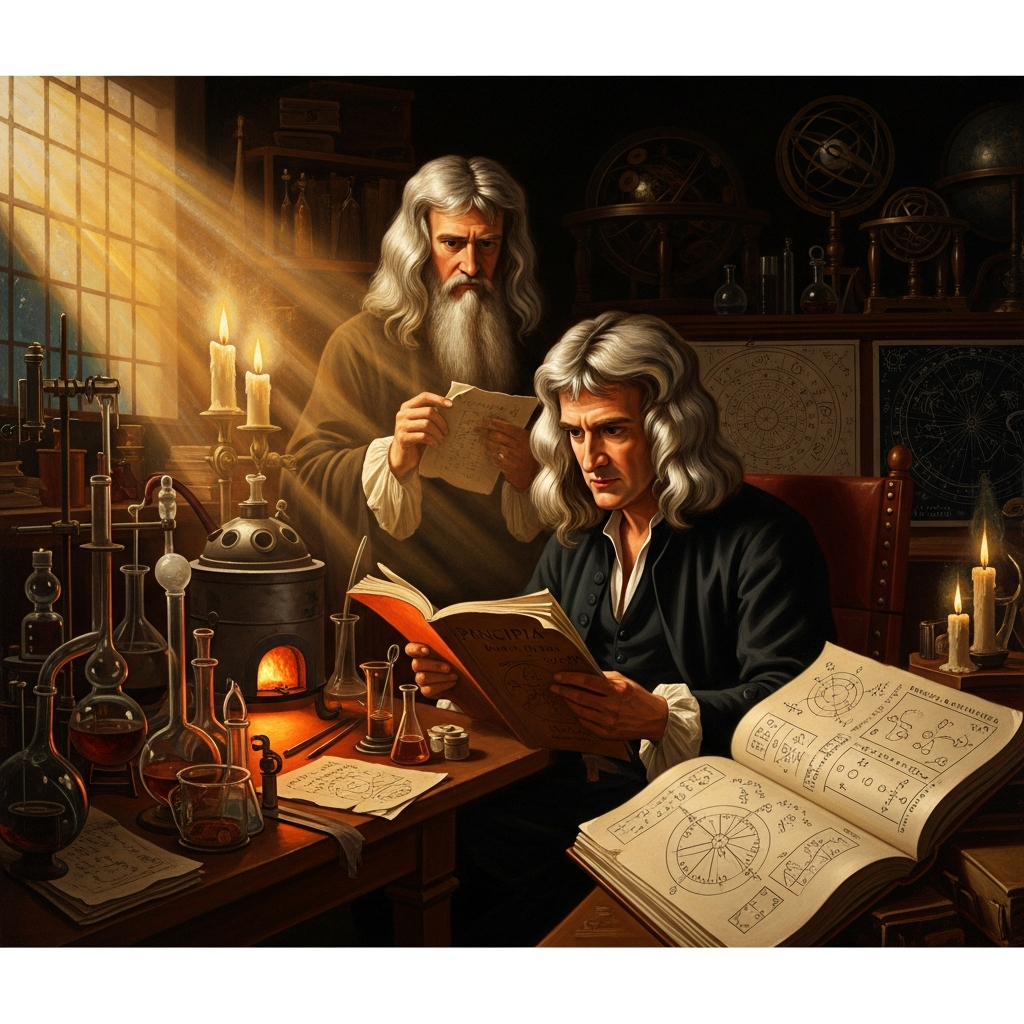
Elias Ashmole — the English antiquarian whose collection founded the Ashmolean Museum in Oxford — was a Rosicrucian enthusiast and a Freemason. He was one of the conduits through which Rosicrucian symbolism entered the emerging Freemasonic tradition in England. By the eighteenth century, the higher degrees of Continental Freemasonry were explicitly Rosicrucian in their titles, symbols, and claimed histories.
The Gold- und Rosenkreutz order in Germany in the late eighteenth century was an actual initiatory organization that claimed Rosicrucian descent — its members included the Prussian king Friedrich Wilhelm II. Helena Blavatsky’s Theosophical Society (founded 1875) claimed Rosicrucian adepts among the Masters who guided it. The Hermetic Order of the Golden Dawn (founded 1888) included explicitly Rosicrucian grades and symbolism. Aleister Crowley’s A∴A∴ and Anthroposophist Rudolf Steiner’s later work both invoked Rosicrucian lineage.
Each of these organizations was, in some sense, an attempt to answer the letter that the original manifestos sent out and that the Brotherhood never answered: here we are, we are ready, we have heard of your transformative knowledge, tell us how to receive it. The answer never came from the source. It kept coming from successors.
The question of whether the Brotherhood ever existed is, at this point, less interesting than the question of what the manifestos created.
They created the model of the invisible college — the dispersed network of learned correspondents working across national boundaries toward universal knowledge. This model directly influenced Francis Bacon’s New Atlantis (1627), with its imaginary Solomon’s House of experimental scientists. The Royal Society of London, founded 1660, was described by some of its early members as a realization of the Rosicrucian project in institutional form. Robert Boyle, one of its founders, had read the manifestos.
The line from the 1614 pamphlet to modern science is indirect but real. The manifesto’s fantasy of a brotherhood of learned men sharing knowledge freely, healing the sick without payment, working toward the reform of all human knowledge — this was also the fantasy of the scientific revolution. The difference was that the scientists eventually built institutions and published results rather than remaining anonymous and never responding to letters.
Andreae, if it was Andreae, wrote a jest that haunted European intellectual life for centuries. He may have found this outcome alarming, or he may have understood exactly what he was doing. The pamphlet released an idea into the world. The idea was that the most important work might be done in secret, by people you will never meet, in service of a transformation that will change everything and that you will not live to see.
The idea does not require the Brotherhood to exist. It only requires that you believe the Brotherhood could exist. That belief turned out to be enough.
Echoes Across Traditions
Entities
- Christian Rosenkreuz
- the Brotherhood of the Rosy Cross
- Johann Valentin Andreae
- the Fama Fraternitatis
- the Chemical Wedding
Sources
- *Fama Fraternitatis R.C.* (1614), anon., Kassel
- *Confessio Fraternitatis R.C.* (1615), anon., Kassel
- *Chymische Hochzeit Christiani Rosencreutz anno 1459* (1616), attributed to Johann Valentin Andreae
- Frances Yates, *The Rosicrucian Enlightenment* (1972)
- Christopher McIntosh, *The Rosicrucians: The History, Mythology, and Rituals of an Occult Order* (1997)
- Donald Dickson, *The Tessera of Antilia: Utopian Brotherhoods & Secret Societies in the Early Seventeenth Century* (1998)