Erzulie Freda: She Who Always Weeps
Haitian Vodou tradition; documented from late 18th century CE · Haiti; the spirit realm; anywhere love is made and broken
Contents
Erzulie Freda is the Vodou Lwa of love, luxury, and heartbreak — a spirit who wears three wedding rings (she is married to Ogou, Agwe, and Danbala) but is always betrayed. When she mounts a believer, she dresses in pink and gold, perfumes herself, dances — and then the weeping begins. She weeps because human love cannot equal what she knows love should be. She weeps until the ceremony ends.
- When
- Haitian Vodou tradition; documented from late 18th century CE
- Where
- Haiti; the spirit realm; anywhere love is made and broken
The room is prepared before she arrives.
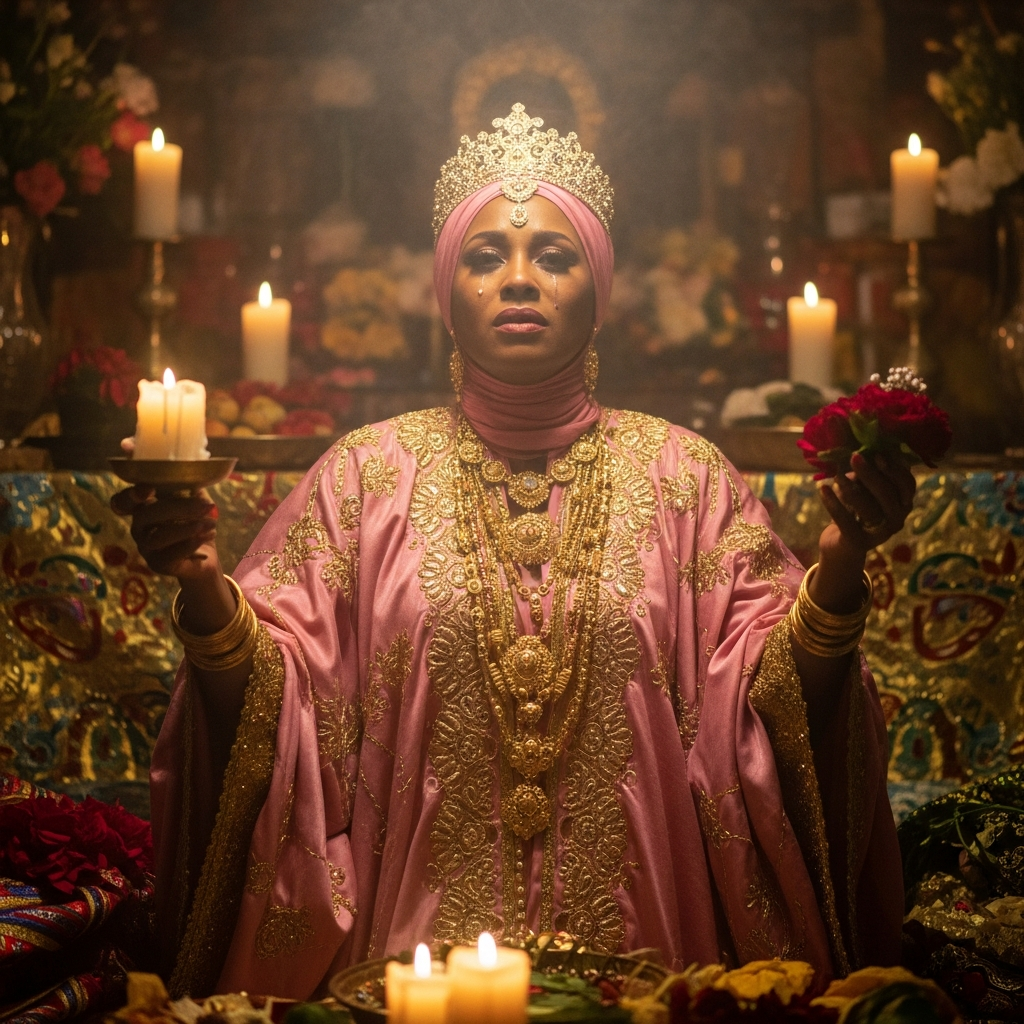
Pink cloth over the altar. Mirrors angled so that whoever stands before them sees themselves through the lens of beauty. Perfume — good perfume, French perfume if it can be obtained, because Erzulie Freda is the Lwa of luxury and she notices the quality of the offerings. Champagne, or the sweetest rum available. Sweets. Flowers: roses, hibiscus. The colors are gold and pink and the shimmer of water catching afternoon light.
Three gold wedding rings are placed at the center of the altar.
One for Ogou, the warrior. One for Agwe, the sea. One for Danbala, the great serpent who lives in water and sky. She is married to all three. She is faithful to all three. All three fail her, in the way that everything human fails the divine — not from malice but from limitation, the limitation that is the defining condition of anything that lives inside time.
The drums call her. The room holds its breath.
She arrives differently than Ogou arrives.
When Ogou comes, the body he takes changes its posture immediately — squares up, fills with force, reaches for the machete. When Erzulie comes, the transformation is slower and more intimate. The person who receives her goes first to the altar, where the beautifying begins. The hair is touched. Powder is applied. Perfume is applied to the wrists and neck. She is dressing in the human body she has borrowed for the evening, turning it into a surface fit for her occupancy.
She moves through the room when she is ready. She dances. The Haitian hounsis — the Vodou initiates who assist at the ceremony — know to treat whoever she has mounted as a queen: they hold her train, fan her, bring her the champagne. She receives these attentions with pleasure and without false modesty. She is beautiful and she knows she is beautiful and she allows this knowledge to fill the room.
People approach her for blessings. She kisses them. She holds their faces in her hands and looks at them with an expression that is hard to translate — tenderness and grief in the same gaze, the look of someone who knows you and loves you and already knows how the story ends.
The dancing goes on for a while.
And then, without warning, she stops.
The weeping does not announce itself.
One moment she is dancing — graceful, regal, entirely present — and then the laughter is gone from her face. The tears start. They start simply: her eyes fill, her face shifts, the expression that comes over her is one of total desolation. She does not sob loudly. She weeps quietly, the way people weep when they have been weeping for a long time and it is not dramatic anymore, just ongoing.
She cannot say exactly why.
The priests and the houngans who have worked with Erzulie for decades will tell you that she weeps because the world disappoints her — that she carries within herself the knowledge of what love is supposed to be, a perfect love, a love that does not diminish and does not condition and does not eventually become territorial or afraid, and the world she arrives into at every ceremony falls short of this knowledge. The offerings are beautiful. The people who receive her are trying their best. And still it is not enough, because nothing in the human world is ever enough to match the love she knows love can be.
She weeps at the altar. The ceremony holds around her weeping.
No one tells her to stop. No one rushes her. The correct response, in a Vodou ceremony, when Erzulie begins to weep is to weep with her — to hold the grief alongside her, to let the ceremony contain it rather than cutting it short.
There is a theological argument inside Erzulie’s tears that most commentators rush past.
She is the Lwa of love. She carries three wedding rings. She has three divine husbands, each one representing a different form of cosmic power — Ogou’s iron, Agwe’s sea, Danbala’s sky-serpent. She is loved by the three most powerful forces in the pantheon. And yet she weeps.
This is not a story about being unloved. This is a story about the inadequacy of even the best love available within the world.
The Vodou theologians who shaped her mythology understood something that the dominant Western love stories tend to obscure: that love as a cosmic force is not the same thing as love as it is practiced between limited beings in limited lives. The gap between those two things is not a failure. It is a structural condition of what it means to be finite. Erzulie weeps at that gap. She is the deity who holds open the space between what love is and what love should be, and her tears are the measurement of the distance.
The three rings on the altar are not a symbol of romantic abundance. They are a symbol of trying — three times, with three different divine husbands — and of the love that even divine marriages cannot contain.
She must leave before the ceremony ends.
This is always the case. Erzulie cannot stay until the ceremony concludes — the person she is riding is exhausted by her presence, and the spirit cannot hold the beautiful suffering indefinitely in a human container. She withdraws. The person she leaves behind often cannot remember what happened while she was there.
Sometimes they are told she wept. Sometimes they are shown the powder on the altar, the empty champagne glass, the roses laid at strange angles by hands they do not recognize as their own. The body she used returns to its ordinary occupant quietly, the way a room returns to stillness after music stops.
At the altar, the three rings remain.
They are still there at the next ceremony, and the one after that. Each time the drums call her, she arrives, dresses, dances, and weeps, and the ceremony holds the weeping the way a river holds water — without asking it to be something else, without apologizing for what it is.
She is the most honest Lwa in the pantheon: the one who loves completely and is disappointed completely and returns to try again.
That is, in the end, what the three rings mean. Not three husbands. Three attempts. And another ceremony always being prepared.
Echoes Across Traditions
Entities
- Erzulie Freda
- Damballa
- Ogou
- Agwe
- the women who are mounted


Sources
- Karen McCarthy Brown, *Mama Lola: A Vodou Priestess in Brooklyn* (University of California Press, 1991)
- Alfred Métraux, *Voodoo in Haiti* (Oxford University Press, 1959)
- Leslie G. Desmangles, *The Faces of the Gods: Vodou and Roman Catholicism in Haiti* (University of North Carolina Press, 1992)
- Donald Cosentino (ed.), *Sacred Arts of Haitian Vodou* (UCLA Fowler Museum, 1995)
- Joan Dayan, *Haiti, History, and the Gods* (University of California Press, 1995)
- Kyrah Malika Daniels, 'Erzulie's Mirrors: Imagining Black Queer Genders and Transnationalism in Haitian Vodou,' *Callaloo* (2015)