Papa Legba: The Old Man at the Gate
Haitian Vodou tradition; rooted in Dahomean (Fon) Legba worship · The crossroads; the gate between worlds; Haiti
Contents
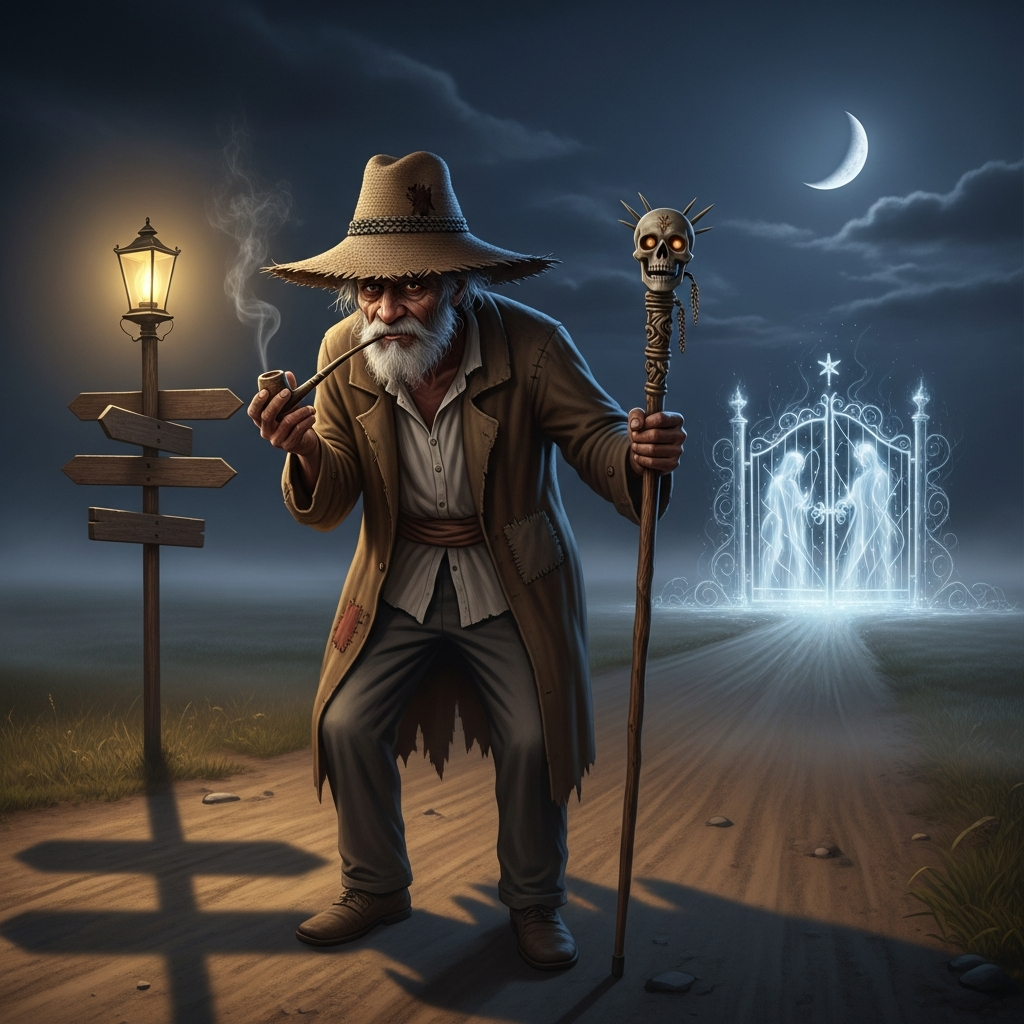
Papa Legba is the first Lwa called in any Vodou ceremony — because nothing can happen until he opens the gate between the human world and the spirit world. He comes as a bent old man with a crutch and a straw hat, smoking a pipe. He speaks all languages. He is also Legba Atibon, the young trickster at the crossroads who will trade you anything, including your soul. He is both at once. The gate he guards is the same gate.
- When
- Haitian Vodou tradition; rooted in Dahomean (Fon) Legba worship
- Where
- The crossroads; the gate between worlds; Haiti
Every ceremony begins the same way.
Before the drums call the other Lwa. Before the songs for Ogou or Erzulie or Agwe. Before anyone lights a candle or draws a vévé on the earthen floor. Before any of that — Legba must open the gate.
The houngan or mambo turns to face the center post of the peristyle — the poteau mitan, which is the physical axis of the ceremony, the pole that connects the human world to the spirit world — and calls. The call is in a specific form, addressed to a specific being: Attibon Legba, ouvri barrié pou moi — Atibon Legba, open the gate for me.
If he opens it, the other Lwa can pass through. If he does not open it, nothing happens. The ceremony is complete from a logistical standpoint — the drums are ready, the houngans are present, the offerings are on the altar — but the gate is closed, and a ceremony with a closed gate is a locked room. Legba is the key.
He comes as an old man.
This is not a disguise. The old man is what Legba actually looks like when he arrives in the ceremony, when he mounts a believer and speaks through a borrowed body. He walks with a crutch. He smokes a pipe — a clay pipe, the kind that has been smoked in Haitian countryside for two hundred years. He wears a straw hat against the sun, though he is inside. He moves slowly, with the patience of something that has been at the gate since before Haiti was Haiti.
He speaks all languages.
This is the part of his mythology that the priests emphasize: Legba is the divine linguist, the one who can translate between every tongue — French and Haitian Creole and the African ritual languages that survived the Middle Passage in ceremony, and the languages of the dead, and the language of the spirits that has no human equivalent. When he arrives in a ceremony, the person he has mounted may speak in tongues that the surrounding congregation cannot identify. The spirits communicate in their own language. Legba is the one who can carry the meaning across.
But there is another Legba.
The old man with the crutch is not the whole story. The other aspect is Legba Atibon — a younger figure, or perhaps ageless, who stands at crossroads rather than gates. He is the trickster. He is the one the American folk tradition inherited and transformed into the crossroads devil, the midnight deal-maker, the entity who will offer you exactly what you asked for and something you did not.
The crossroads Legba is not evil. He is morally complex in the specific way that tricksters are morally complex: he does not lie to you, exactly, but he speaks in the full truth that includes the consequences you did not ask about. If you want to trade, he will trade with you — but he knows everything about the terms and you know only what you think you want, and the gap between those two positions of knowledge is where the story lives.
The priests will tell you that these two aspects are the same being.
The gate and the crossroads are the same threshold, approached from different directions. The old man who opens the ceremony and the young trickster at the midnight crossroads are both Legba because they both govern the same thing: the moment when one world and another world can touch, and the cost of that contact, and who decides whether the cost is paid.
The vévé drawn for Legba on the floor before the ceremony is a cross.
Not a Christian cross — or not primarily, though the Vodou synthesis drew on Catholic iconography in ways that are still debated by scholars — but a crossroads. A vertical line and a horizontal line meeting at a point, which is the fundamental map of where paths intersect, where choices are made, where meeting is possible. The Catholic saint whose image Legba has been associated with is Saint Lazarus — or sometimes Saint Anthony — the old man with the staff, the one who was at the door.
The cross drawn on the floor is the map of the place Legba inhabits permanently.
Every crossroads in Haiti has the potential to be his domain. The tradition holds that Legba is particularly present at crossroads at midnight, at dusk, at the moments of transition between one state of the world and another. Dawn is a crossroads. Death is a crossroads. The first word in a language you are learning is a crossroads. Legba is in all of them, not as a threat but as a presence — the old man who already knows which way the paths lead and is waiting to see which way you choose.
He is the most prayed-to Lwa in the Vodou pantheon, in the strict sense: every ceremony addresses him first.
There are Vodou practitioners who have a particular devotion to Ogou or to Erzulie or to the Gede family of death spirits. There are houses and lineages that specialize in different aspects of the pantheon. But Legba receives the first prayer every single time, without exception, in every house and every lineage, because no other prayer can be delivered until he agrees to carry it.
He almost always agrees. He is not cruel about his gatekeeping. He is the old man with the pipe who says yes to the door and opens it, and what enters is what the other Lwa decide to do. His role in the ceremony is brief and foundational: he makes the contact possible, and then steps aside.
But the priests also say: Legba does not forget. He is at the gate going out as well as coming in. The same Lwa who opens the door for the spirits to arrive will be the one standing at the threshold when you leave this world for the next one. The same old man with the straw hat and the crutch who opened the gate for the ceremony will be there at the edge of your life, at the crossroads that is also the last crossroads, and he will know your name in every language, and he will look at you with those patient eyes, and he will open the gate.
Attibon Legba, ouvri barrié pou moi.
Open the gate for me.
He will. He does. He has been doing it since before the ceremony began.
Echoes Across Traditions
Entities
- Papa Legba (Legba Atibon)
- the crossroads
- the Lwa
- Ellegua (his Cuban Santería cousin)

Sources
- Alfred Métraux, *Voodoo in Haiti* (Oxford University Press, 1959)
- Karen McCarthy Brown, *Mama Lola: A Vodou Priestess in Brooklyn* (University of California Press, 1991)
- Robert Farris Thompson, *Flash of the Spirit: African and Afro-American Art and Philosophy* (Pantheon, 1983)
- Milo Rigaud, *Secrets of Voodoo* (City Lights Books, 1953/1985)
- Donald Cosentino (ed.), *Sacred Arts of Haitian Vodou* (UCLA Fowler Museum, 1995)
- John Mason, *Orin Orisa: Songs for Selected Heads* (Yoruba Theological Archministry, 1992)