Agwe and the Kingdom Below the Sea
Haitian Vodou tradition; rooted in Fon/Ewe water deity Agbe · The ocean; Vilokan (the underwater spirit realm); Haitian coastal ceremony sites
Contents
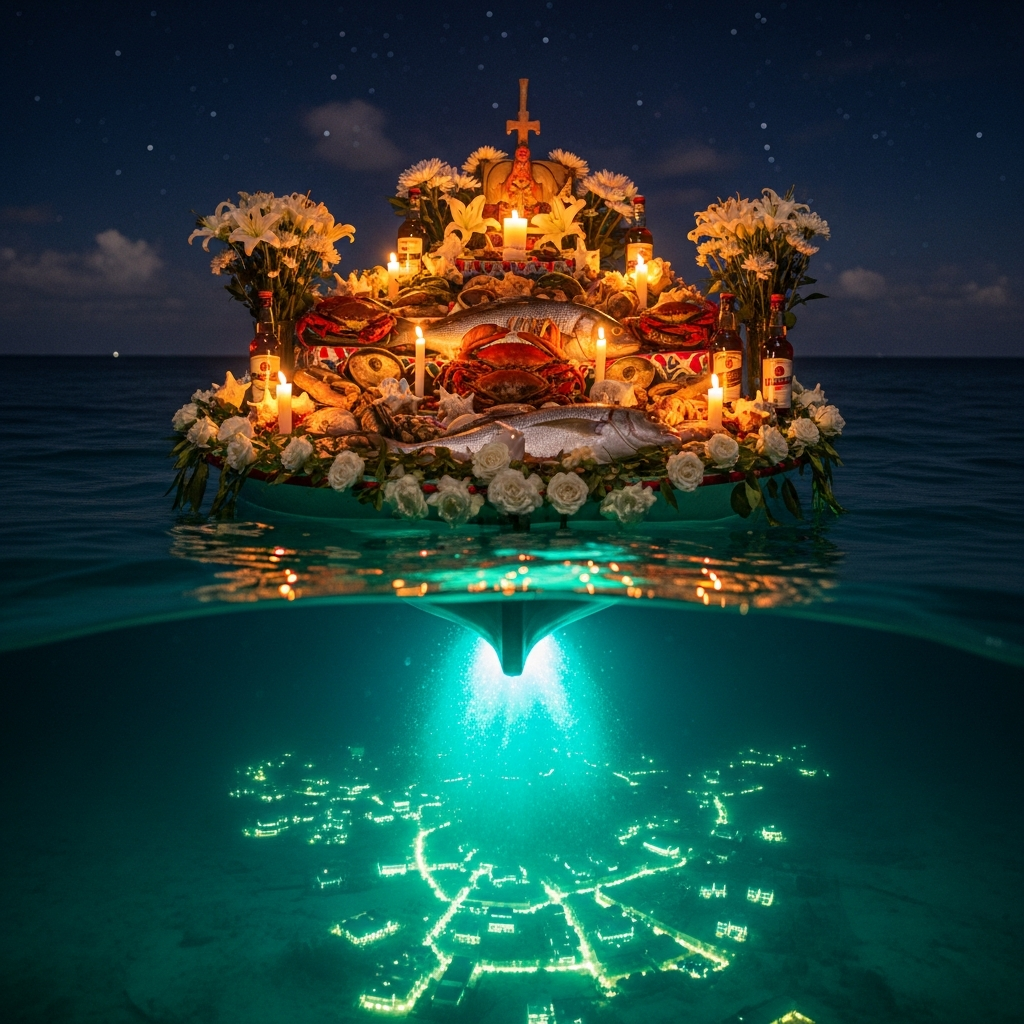
Agwe Woyo is the Lwa of the sea — a military admiral who rules the underwater realm called Vilokan, where the ancestral spirits of the African diaspora live beneath the water. When Haitians hold a ceremony for Agwe, they build a boat-shaped altar, load it with food and rum and white flowers, and float it out to sea. If it sinks, Agwe has accepted. If it floats back, they try again.
- When
- Haitian Vodou tradition; rooted in Fon/Ewe water deity Agbe
- Where
- The ocean; Vilokan (the underwater spirit realm); Haitian coastal ceremony sites
The boat is built before the ceremony.
It takes most of a day. The carpenters who build it are working to a traditional form: a flat-bottomed wooden tray, painted in Agwe’s colors — blue and white, the colors of sea and foam — and shaped like a ship’s hull, wide enough to carry the offerings without capsizing in the first small wave. The sides are decorated with images of fish, of anchors, of the symbol that is Agwe’s vévé: the steering wheel of a ship over an anchor.
The offerings go in carefully. Champagne. White flowers — tuberose and white roses, because Agwe’s aesthetic is naval officer’s white. Food prepared specifically for him: fish, naturally, but also sweet things, because the ceremony requires pleasing him and Agwe is particular about what pleases him. Bottles of his rum. A small mirror, sometimes, because Agwe is also associated with clarity — the way clear water shows you what lies beneath.
The boat is carried to the shore. It is put in the water. The congregation watches.
Agwe Woyo is not a wild sea god.
He is an admiral. This distinction matters in the Vodou imagination: he wears a naval uniform, he carries the bearing of military authority, he moves through the spirit world with the measured confidence of someone who has charted these waters completely and knows every hazard and every safe passage. When he arrives at a ceremony and mounts a believer, the body he takes on changes its posture toward formality — the spine straightens, the gaze becomes commanding, the gestures are precise.
He speaks of the sea with the familiarity of a man who has lived on it his whole existence. He can describe Vilokan in detail to those who ask: the underwater palace, the order of it, the way the currents move through the chambers. The ancestral spirits are there, in Vilokan — not in suffering but in continuation, presided over by Agwe’s authority. He is their admiral as much as he is the sea’s.
This is where the Middle Passage theology lives: in the idea that the sea took what could not be buried and did not simply lose it.
The ships left the West African coast loaded with people who had names and families and languages and devotional practices, and many of them died before the ships arrived. Dysentery. Dehydration. Violence. Suicide — some jumped rather than complete the crossing. The ship logs of the Atlantic slave trade, where they have survived, record these deaths in economic terms: units of cargo lost in transit. The bodies went over the side.
There was no burial. There was no ceremony. There was no one to do the things that every West African tradition required for the proper passage of the dead into the next world.
Vodou, which was built partly from those West African traditions, built Vilokan as the answer.
The sea did not destroy them. The sea received them into a kingdom. Agwe, the admiral of the waters, gathered those souls and holds them in the realm beneath the waves. They are the ancestors whose names were not recorded, whose graves are not on land. They are beneath the water where they were placed, but they are not lost. Vilokan is not a prison. It is a home.
The ceremony with the boat-altar is, among other things, a communication with those specific dead.
When the boat is in the water, the ceremony enters its most attentive phase.
Everyone watches. The houngan may pour libations over the side of the shore. Songs for Agwe are sung — they are different in cadence from the songs for other Lwa, rolling and rhythmic in a way that suggests the movement of water. Agwe may mount a believer at this point, or he may not; sometimes he accepts his offerings without arriving.
The test is what the boat does.
If it sinks, Agwe has accepted the offerings. The food and the champagne and the flowers have been taken beneath the surface, into Vilokan, and the communication has been completed. The ancestors have been fed. The ceremony is successful.
If it floats back to shore, the congregation reads this as refusal — the offerings were insufficient, or something about the ceremony was wrong, or Agwe is sending a message that requires interpretation. The houngans consult. Better offerings may be prepared. The boat may be rebuilt and tried again.
This is the epistemology of the ceremony: the ocean is the instrument of the answer, and the answer is binary. Accepted or not. Below the surface or back on the shore. The sea itself adjudicates.
La Sirene lives in Agwe’s kingdom too.
She is the mermaid Lwa — half woman, half fish, beautiful and terrifying in the specific way that things that live at the boundary of two worlds are terrifying. She is sometimes described as Agwe’s wife or consort, sometimes as an independent power in the underwater realm. She can pull people beneath the surface and teach them in Vilokan and return them changed, with gifts of healing or music or prophecy. She can also not return them.
La Sirene and Agwe govern the same domain from different angles: Agwe is the naval authority, the military organizer, the admiral of structure. La Sirene is the depth itself — the part of the ocean that cannot be charted, that does not respond to military rank, that simply draws and holds.
The boat-altar ceremony navigates between them: it is formal enough for Agwe, beautiful enough for La Sirene, and it goes down to both.
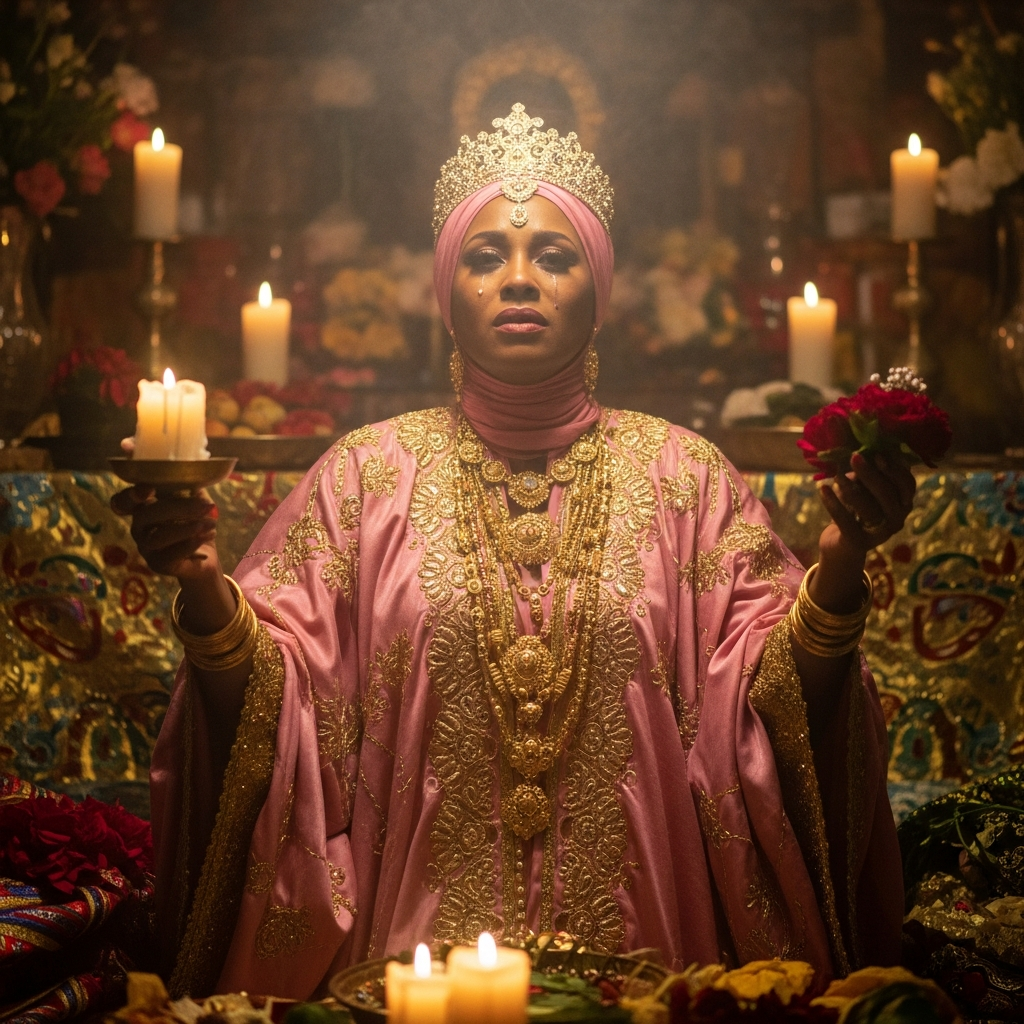
Erzulie Freda is Agwe’s wife in the Vodou mythology — one of the marriages she carries among her three wedding rings. The two of them together form one of the most resonant pairings in the pantheon: the sea and love, the ocean and heartbreak, the admiral who rules what lies beneath and the goddess who weeps at what love cannot hold.
The priests say that Agwe loves Erzulie completely and that his love, like all love, does not equal what she knows love should be. Even the admiral of the underwater kingdom cannot fill the space she carries. His sea is vast and deep and real, and it is still not enough.
He does not argue with this. He loads the boats and sinks them. He tends to Vilokan. He waits at the edge of the water for the offerings to come down.
The boat floats out. The congregation watches the water.
It sinks.
Agwe has accepted.
Echoes Across Traditions
Entities
- Agwe Woyo
- Erzulie Freda
- La Sirene
- the ancestral spirits in Vilokan

Sources
- Alfred Métraux, *Voodoo in Haiti* (Oxford University Press, 1959)
- Karen McCarthy Brown, *Mama Lola: A Vodou Priestess in Brooklyn* (University of California Press, 1991)
- Donald Cosentino (ed.), *Sacred Arts of Haitian Vodou* (UCLA Fowler Museum, 1995)
- Leslie G. Desmangles, *The Faces of the Gods: Vodou and Roman Catholicism in Haiti* (University of North Carolina Press, 1992)
- Elizabeth McAlister, *Rara! Vodou, Power, and Performance in Haiti and Its Diaspora* (University of California Press, 2002)
- Patrick Bellegarde-Smith, *Haiti: The Breached Citadel* (Westview Press, 1990)