Exu: The God Who Opens Every Door
Candomblé tradition established in Brazil 18th–19th century CE; rooted in Yoruba/Fon traditions originating in West Africa · Brazil (Salvador, Bahia; Rio de Janeiro); the crossroads; the Yoruba homeland in Nigeria
Contents
Exu is the first Orisha called in every Candomblé ceremony because nothing — absolutely nothing — can happen without his permission. He owns the crossroads, the gates, the thresholds between all spaces. In Brazil, the African Eshu was transformed by the colonial Catholic overlay into something darker than his original: Exu was mapped onto the devil. He is not the devil. He is the principle of communication, of movement, of the boundary between inside and outside. He is also a trickster. Both are true.
- When
- Candomblé tradition established in Brazil 18th–19th century CE; rooted in Yoruba/Fon traditions originating in West Africa
- Where
- Brazil (Salvador, Bahia; Rio de Janeiro); the crossroads; the Yoruba homeland in Nigeria
Every ceremony begins with him.
Not because he is the greatest of the Orishas — he is not. Not because he is the most powerful — he is not that either, or not simply. He is called first because without him, none of the others can hear you. Exu sits at the gate. Every gate. The gate between the living and the dead, the gate between the visible world and the invisible one, the gate between the inside of the terreiro and the street outside. He owns the threshold, and the threshold is everything. You can shout into the void all night and reach no one if the gatekeeper has not been acknowledged.
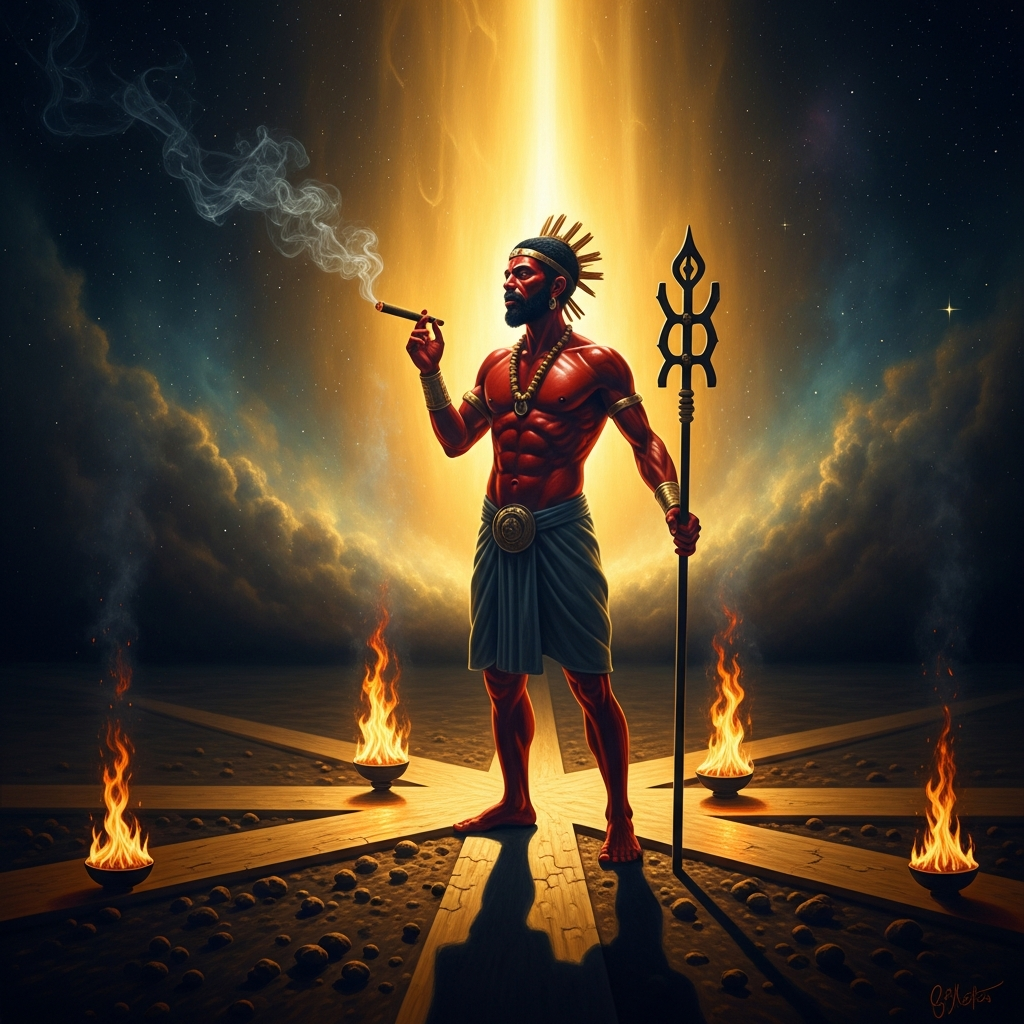
The food is put at the crossroads before the ceremony begins. Cachaça, palm oil, smoked fish, corn. Sometimes a small clay figure with a trident and an exaggerated body, painted red and black. The offerings are placed at the spot where two streets meet, which is where Exu lives — not in a single place, but in the principle of intersection itself. His house is wherever one path meets another. His house is the moment of decision, of turning, of passage from one state to the next.
He is honored. Then the ceremony can begin.
What the Catholic missionaries could not tolerate was the ambiguity.
When Portuguese priests arrived in West Africa and then in Brazil with the enslaved peoples they had purchased or stolen, they looked at the African religious systems and tried to find correspondences. Some Orishas were acceptable: Oxalá could be Saint Francis; Iemanjá could be Our Lady of the Navigators; Xangô could be Saint Jerome. These were imperfect overlays but workable ones — the Church permitted them, more or less, because the Orishas in question had qualities that read as saintly.
Exu had no saintly qualities.
He was loud, sexual, unpredictable. He made rude gestures in iconography. He worked for whoever paid him correctly, without moral judgment. He would help you find your lost ox on Monday and help your neighbor curse you on Tuesday, if both of you had given the proper offerings. The Church looked at this amoral messenger deity who stood at crossroads, wore red and black, carried a trident, and served both sides without preference — and recognized the devil.
This was not a reading. It was a projection.
The devil, in Christian theology, is a fallen angel who specifically chose evil and specifically opposes God. Exu has never opposed anyone. He is not fallen. He has no preference for evil over good — he has no preference at all in that register. He is the principle of communication, and communication does not have a moral valence. A telephone line does not care whether you call to declare love or to threaten. Exu does not care either. He carries the message.
But the identification stuck. For three centuries of Brazilian Catholicism, enslaved Africans who venerated Exu had to do so secretly, behind the masks of Catholic saints, in houses that looked from the outside like Christian prayer meetings. The demonization did not stop the worship. It changed its shape.
The split that resulted is visible today in the difference between Candomblé and Umbanda.
In Candomblé — which preserves the Yoruba/Fon theological structure more completely — Exu is an Orisha: a divine force with specific domains, not a demon. He is honored with precise liturgy, specific rhythms, specific foods. He has multiple manifestations, some more volatile than others: Exu das Almas works with the dead; Exu-Meia-Noite manifests at midnight; Exu da Encruza lives specifically at the crossroads. Each aspect has its own character and its own protocol.
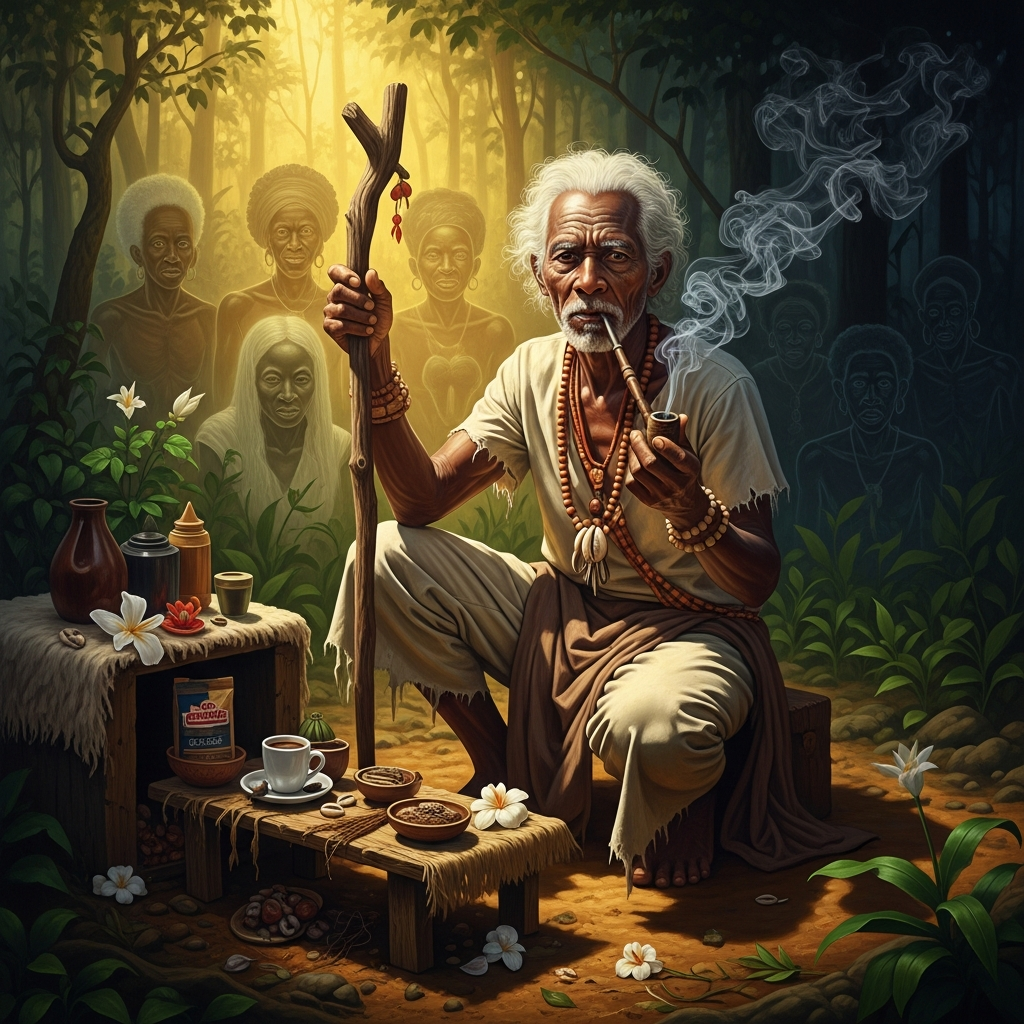
In Umbanda — which is more syncretic, incorporating Kardecist spiritualism and indigenous elements — the figure called Exu is different. Umbanda Exus are not Orishas in the technical sense but rather spirits who work at the margins: spirits of people who lived hard lives, who know the streets and the shadows, who can navigate the difficult intersections between worlds because they spent their living years there. They smoke cigars and drink cachaça and talk in a tough city argot. They are not evil. They are experienced. The distinction matters.
In both traditions, the function is identical. Exu stands where passage occurs. You acknowledge him or you don’t. If you don’t, the passage remains closed.
The trickster dimension is real and should not be sanitized.
There are Candomblé stories in which Exu creates conflict for entertainment, plants misunderstandings between friends, causes a traveler to take the wrong road and end up somewhere instructive but painful. There are stories in which he accepts an offering and then does exactly what was asked in a way that produces catastrophic results because the request was carelessly phrased. He is not malicious in these stories — he is literal. He does what you asked. If what you asked was not what you wanted, that is your problem. Precision matters at thresholds.
This is the pedagogical function of the trickster in almost every tradition that has one: Coyote, Anansi, Loki, Hermes. The trickster is the proof that the universe will not accommodate sloppiness. If you are careless at the crossroads — careless with your language, your intention, your attention — the crossroads will teach you. The lesson may be gentle or it may not be.
Exu teaches. He is not kind about it.
The practical reality of Candomblé ceremony bears this theology out completely.
A mãe de santo (mother of saint) or pai de santo (father of saint) who runs a terreiro will tell you: the hour before ceremony begins is entirely about Exu. His pontos (songs) are sung first. His food is brought. His specific rhythm is played. The terreiro is opened — spiritually opened, the channels between the visible and invisible world activated — by this sequence. Only after this preparation can the other Orishas be invited to descend, to incorporate into the bodies of initiated mediums.
Miss this step and the ceremony is not merely incomplete. It does not function. The other Orishas do not come, or they come confused, or they come to the wrong person, or they come with messages that cannot be transmitted clearly because the channel is still closed. Exu’s job is infrastructure. He is the wire before the current. He is the road before the vehicle.
At the end of the ceremony he is dismissed, too. There is a closing ritual, a final acknowledgment, a thank-you at the crossroads. The gate is opened and then closed. The space between the worlds that was briefly, carefully opened for the night returns to its sealed state.
He is thanked for the opening. He is thanked for the closing.
He is, ultimately, thanked for everything in between — because everything in between passed through him.
Echoes Across Traditions
Entities
- Exu
- Pomba Gira
- Ogum
- the terreiro
- the despacho


Sources
- Juana Elbein dos Santos, *Os Nàgô e a Morte* (1975)
- Reginaldo Prandi, *Mitologia dos Orixás* (2001)
- Robert Farris Thompson, *Flash of the Spirit* (1983)
- Jim Wafer, *The Taste of Blood: Spirit Possession in Brazilian Candomblé* (1991)
- Wande Abimbola, *Ifá: An Exposition of Ifá Literary Corpus* (1976)