Iemanjá and the Sea That Receives
Candomblé / Umbanda tradition in Brazil; New Year's Eve sea-offering formalized through the 20th century CE · Copacabana beach, Rio de Janeiro; Salvador, Bahia (February 2 celebration); the Atlantic Ocean
Contents
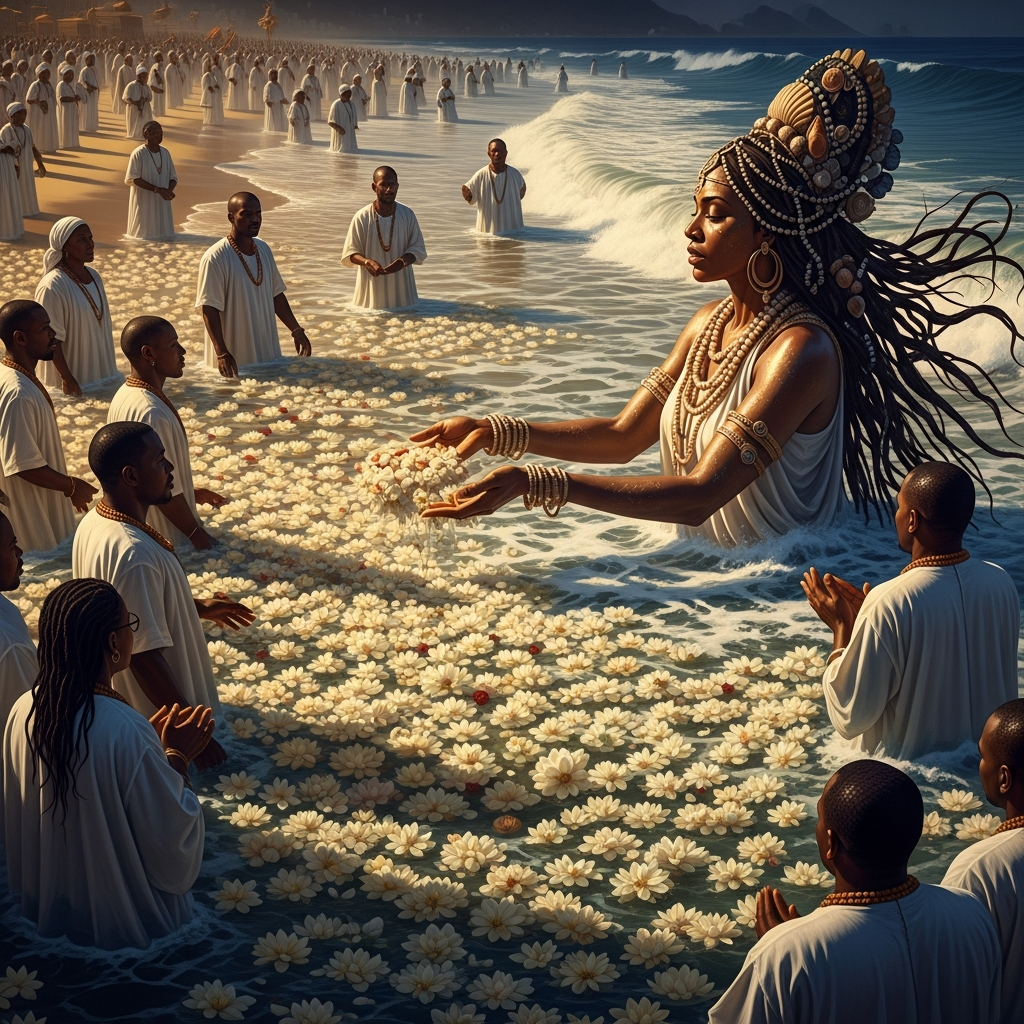
Every New Year's Eve, millions of Brazilians dress in white, walk to the sea, and launch small boats loaded with flowers, mirrors, combs, and perfume into the waves for Iemanjá — the Queen of the Sea, the mother of the Orishas. If the boat floats out, she has accepted. If it washes back, the offering was refused. On Copacabana beach, a crowd larger than most cities performs this ritual beside fireworks and samba and champagne. It is the largest public religious ceremony in the world that most of the world has never heard of.
- When
- Candomblé / Umbanda tradition in Brazil; New Year's Eve sea-offering formalized through the 20th century CE
- Where
- Copacabana beach, Rio de Janeiro; Salvador, Bahia (February 2 celebration); the Atlantic Ocean
The boats are small. They are made of cardboard or balsa wood or Styrofoam — whatever holds together long enough. They are painted white. Inside them go mirrors, because Iemanjá loves mirrors. Combs, because she combs her long hair in the moonlight on the water’s surface. Perfume, flowers, lipstick, small figures of the Queen herself in her blue and white robe. The boats are filled with these gifts and carried to the water’s edge.
This is December thirty-first. The night is warm. The beach is white with people and the air smells like flowers and the sea.
The person who carries the boat wades into the surf up to their knees. They hold the boat in both hands. They wait for the right wave. And then they release it.
If the ocean takes the boat — if it catches the next wave and rides out past the breakers toward deep water — she has accepted. The prayer is heard. The year ahead is blessed. The person who launched the boat stands in the surf and watches until the tiny white shape disappears into the dark water, and then they turn back to the shore.
If the wave returns the boat — if it washes back to knock against the person’s calves, if it grounds on the sand at their feet — the offering has been refused. She does not want it, or she does not want it from you, or you have asked for something she will not give. The person retrieves the boat, and they think about what they did wrong, or what they asked wrong, or what they owe.
The crowd on Copacabana on New Year’s Eve is approximately two million people.
This number should be held for a moment. Two million is the population of Paris. It is larger than Houston. It is more people than attended Woodstock by a factor of several. They are on a single beach — four kilometers of sand in the southern zone of Rio de Janeiro — dressed in white, which is Iemanjá’s color and the color of purity in Candomblé, and they have come for the same reason: to put the old year into the ocean and ask for a new one.
The fireworks begin at midnight. The samba schools play on stages at the back of the beach. There is champagne and caipirinha. The New Year’s Eve celebration on Copacabana is famous worldwide as a party — as possibly the greatest party in the world — and the worldwide image of it is secular. Fireworks, music, crowds.
What the image tends not to center is the boats. What it tends not to center is that the white clothing is a liturgical garment. What it tends not to center is that the first act of the new year, for an enormous fraction of those two million people, is a prayer sent out on the water in a small boat that may or may not come back.
The tradition on Copacabana is relatively recent — formalized through the twentieth century — but the older ceremony is in Salvador, Bahia, on February 2nd, the Feast of Iemanjá.
In Salvador the ceremony is more overtly religious in its frame. There are processions, singers, priestesses of Candomblé in full regalia carrying offerings. The date is synchronized with the Catholic Feast of Our Lady of the Navigators, which is one of the layers of colonial overlay: Iemanjá was mapped onto Mary, the Queen of Heaven whose blue robes match the Queen of the Sea’s. Enslaved Africans could venerate her under the Catholic name and thus be left alone. The names have separated again in the centuries since abolition, but the date remains double.
The duality is not hypocrisy. It is syncretism as survival strategy that has become sincere theology. People who launch boats for Iemanjá on February 2nd in Salvador may also attend mass. The two acts are not experienced as contradictions. The sea received the enslaved Africans who died in the Middle Passage. The sea is the body of the deity who mourned them. The sea is also the body of Mary who guides sailors. These are different languages for the same vast fact of the ocean.
Iemanjá is the mother of the Orishas.
In Yoruba cosmology, Yemoja is the great river and ocean deity from whose waters the other Orishas emerged. She is not simply a water deity — she is the source. Oxum (fresh water, rivers, love) is her daughter; Ogum (iron, war, work) is her son; Xangô (thunder, justice) is connected through marriage and adoption. The family of the Orishas is the structure of existence: elemental forces in relationship, each governing its domain but related to all the others through the genealogy that Yemoja anchors.
This is why she receives the new year. The mother of everything is the appropriate recipient of the request that a new beginning be possible. The ocean — which is where the year ends, where the old things go, which is also where Brazil itself began for the African people who arrived across it in chains — is the appropriate body for that prayer.
The boat is a message in a bottle. It is a request placed into the hands of the one large enough to hold it.
She takes it or she returns it. She knows better than you what you actually need.
The question the offering ritual makes visceral is the question all petition-based religion eventually confronts: what does acceptance mean?
The ocean does not speak. It moves. A wave carries the boat out, or a wave returns it. The physics of surf determines this as much as any divine decision — the wind, the tide, the weight of the offerings, the angle of the launch. Practitioners know this. They are not naive about hydrodynamics. They understand that the ocean is also a body of water governed by physical forces.
But the ocean is also Iemanjá. Both things are true. The physical fact of the wave and the theological fact of the deity are not competing explanations — they are simultaneous truths operating on different registers. The wave that carries the boat out is both a wave and a yes. The wave that returns the boat is both a wave and a no.
This is not the same as saying the ritual is metaphorical. It is saying that the visible and invisible worlds are not separated by an impermeable membrane. The surface of the water is the threshold. What happens at thresholds is always double.
The boat goes out. The person in the surf watches until it disappears. Then they turn and walk back up the beach into the new year, into the fireworks, into whatever is coming, into whatever she has or has not accepted.
Echoes Across Traditions
Entities
- Iemanjá
- the white-clad faithful
- the small boats of offerings
- the Atlantic Ocean
- Oxum

Sources
- Reginaldo Prandi, *Mitologia dos Orixás* (2001)
- Robert Farris Thompson, *Flash of the Spirit* (1983)
- Stefania Capone, *Searching for Africa in Brazil* (2010)
- Mattijs van de Port, *Ecstatic Encounters: Bahian Candomblé and the Quest for the Really Real* (2011)
- Livia Steinberg, *Festa de Iemanjá: Ritual, Symbol, and Transformation in Salvador, Bahia* (2003)