Contents
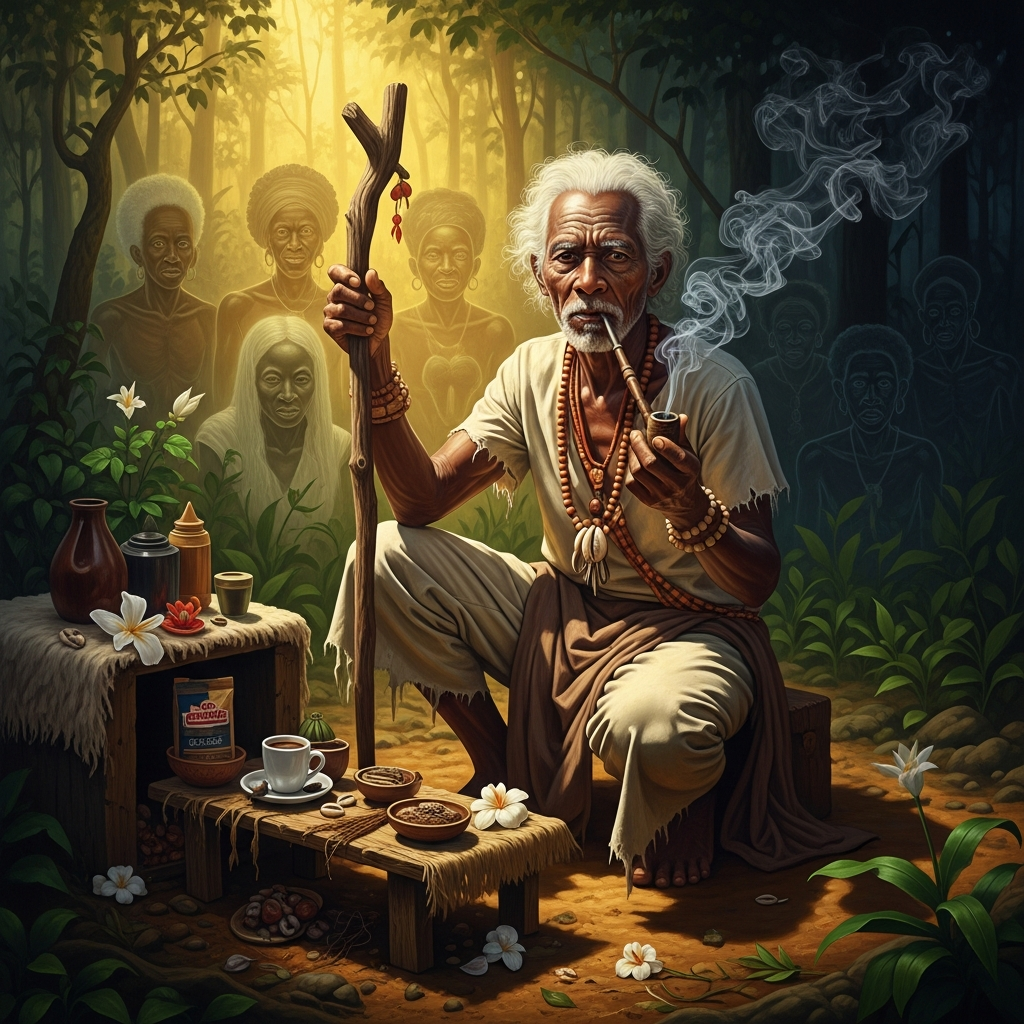
In Umbanda — the Afro-Brazilian spirit religion that blends Candomblé, Kardecist spiritualism, and indigenous tradition — the Preto Velho are the spirits of enslaved Africans who died in Brazilian slavery. They appear as very old, very black, very gentle figures who smoke pipes, drink strong coffee, and dispense wisdom. They are the most beloved spirits in Umbanda. They are the dead who came back not to demand justice but to heal. Their patience is the most astounding thing in the religion.
- When
- Umbanda formalized as a religion c. 1908–1940s CE; rooted in centuries of Brazilian syncretism
- Where
- Brazil (Rio de Janeiro; São Paulo; throughout); the terreiro ceremony space
He arrives bent.
The medium — standing, perhaps dancing, in the center of the terreiro — suddenly slows. The back curves. The head drops. The steps shuffle. The hands, which were open, now reach for something: an invisible walking stick, an invisible pipe. When the medium sits down on a low stool in the corner and raises a head that is now somehow both the medium’s face and an old man’s face, the Preto Velho has arrived.
He is very old. He is very tired. He has been through things.
He takes the pipe from someone who brings it. He takes the small cup of strong coffee. He smokes and drinks in silence for a moment, settling into the body he has borrowed, getting his bearings in a world he left a long time ago. Then he begins to receive visitors.
The line forms to one side.
People come with their problems one at a time. They crouch or kneel to be at his level — one does not stand over the Preto Velho; one comes down to where he sits. They speak quietly. He listens without interrupting. He may close his eyes while he listens, or he may watch the person’s face with the patient, measuring attention of someone who has seen every kind of suffering and is not surprised by this one.
When the person finishes, he responds.
He speaks in the argot of the old plantation — a slow, careful Portuguese that sounds archaic, heavily accented, the language of someone who learned the colonizer’s tongue under duress and made it into something new. He uses diminutives the way old people do. Meu filho — my son. Minha filha — my daughter. He smokes. He thinks. He says what he sees.
What he sees is not always what the person wants to hear. He is gentle about it, but he does not lie. If the problem is that the person’s marriage is failing because of something the person is doing, he says so. If the problem is that the person is carrying grief they have not yet named, he names it. If the problem has a practical solution, he gives the practical solution. If the problem has no solution, he helps the person understand how to carry it.
He dispenses herbal remedies sometimes — instructions for plants to find, specific preparations to make. He assigns spiritual tasks: prayers to say, rituals to perform, offerings to leave. He gives people permission to stop punishing themselves for things they could not have controlled. He tells people the truth about whether they are going to be all right.
Then the next person crouches down.
The Preto Velho spirits are numerous.
Each one has a name, a specific history, a specific personality. Pai José is among the most famous — a gentle patriarch associated with the quilombo (communities of escaped slaves) as much as with the senzala (the slave barracks). Vovó Maria Conga is the corresponding grandmother figure: an old Black woman of Congolese origin who knows root medicine, who can fix what medicine cannot fix, who has been watching the living make their mistakes for a very long time and still loves them anyway. There are Preto Velho associated with specific regions, specific traditions, specific areas of expertise.
What they share is the quality of having survived the unsurvivable.
This is the thing that makes them trustworthy. They were enslaved. They were beaten, separated from their families, worked to death in the sugarcane fields that produced the wealth of colonial Brazil. They died in the cane, in the mills, in the mines, on the ships. They died in numbers so large that the demographic history of Brazil is still shaped by the losses. And they came back — not as accusers, not as avengers — as healers.
The theological meaning of this choice is enormous and is rarely stated explicitly because it does not need to be. The Preto Velho are the answer to the question of what happens to the wronged dead. The wronged dead become the greatest healers. The people who were least heard in life become the most listened-to in death. The people who were not allowed to be elders become the elders of the entire tradition.
Brazil abolished slavery in 1888 — the last nation in the Western Hemisphere to do so.
Umbanda formalized as a distinct religion shortly thereafter, with the date often given as 1908, when the medium Zélio de Moraes received a spirit who declared himself a caboclo (spirit of indigenous/mixed ancestry) and announced a new tradition that would belong to all Brazilians. The Preto Velho became central to this new tradition almost immediately. They came in great numbers.
It is not possible to disentangle the historical timing from the spiritual meaning. Slavery ended; the enslaved dead began to speak. The bodies that had been the property of the colonial economy were gone; the spirits who had inhabited those bodies arrived in the ceremony houses of the cities where those bodies’ descendants now lived. Umbanda is, among other things, the religion of the freed dead working on behalf of the freed living.
The Preto Velho do not speak about slavery directly, as a rule. They speak about what the person in front of them needs. But their presence is the statement about slavery that no political speech has ever made with equal force. Here they are. They are still here. They are not angry. They are taking care of you.
The medium wakes slowly at the end.
The Preto Velho withdraws the way he arrived: a gradual straightening, a change in the posture and breath, the return of the medium’s own face and bearing behind the eyes. The pipe is set down. The coffee cup is set down. The session is over.
The medium does not always remember what was said. The body was on loan. The wisdom belonged to the elder, not the vessel.
People leave the terreiro with instructions, with the sense of having been listened to by someone very old and very patient, with the strange comfort of having spoken to a dead person who was not frightened by death and was therefore not frightened by anything they could bring.
The Preto Velho smoke their pipes in the corner until the ceremony ends. Then they go back to wherever the dead go, to be called again next week, to sit on the same low stool and listen to the same human problems with the same infinite patience of someone for whom suffering holds no more surprises — only people who have not yet learned what he already knows.
Echoes Across Traditions
Entities
- Preto Velho spirits
- Pai José
- Vovó Maria Conga
- the Umbanda terreiro
- the medium who is mounted
Sources
- Umberto Eco, *The Role of the Reader* (referenced in: Bernardo Lewgoy, 'Espiritismo e Umbanda' 2012)
- Diana Brown, *Umbanda: Religion and Politics in Urban Brazil* (1986)
- David Hess, *Spirits and Scientists: Ideology, Spiritism, and Brazilian Culture* (1991)
- Patrícia Birman, *Fazer Estilo Criando Gênero* (1995)
- Reginaldo Prandi, *Mitologia dos Orixás* (2001)