Contents
Oxossi is the Orisha of the hunt and the forest — patron of Bahia, the Brazilian state that calls itself his domain. In Candomblé, he is the king of Ketu, the one who feeds the community when all other methods fail. His arrow flies once and never misses. He is also the lord of abundance, of knowledge (because the hunter must know the forest to survive), and of the indigenous peoples of Brazil, whose forest knowledge was absorbed into his mythology when African and Indigenous traditions met in the Americas.
- When
- Yoruba/Candomblé tradition; Oxossi worship in Brazil documented from 18th century CE
- Where
- The forest; the Candomblé terreiro; Bahia, Brazil; the Yoruba kingdom of Ketu
The hunter leaves before sunrise.
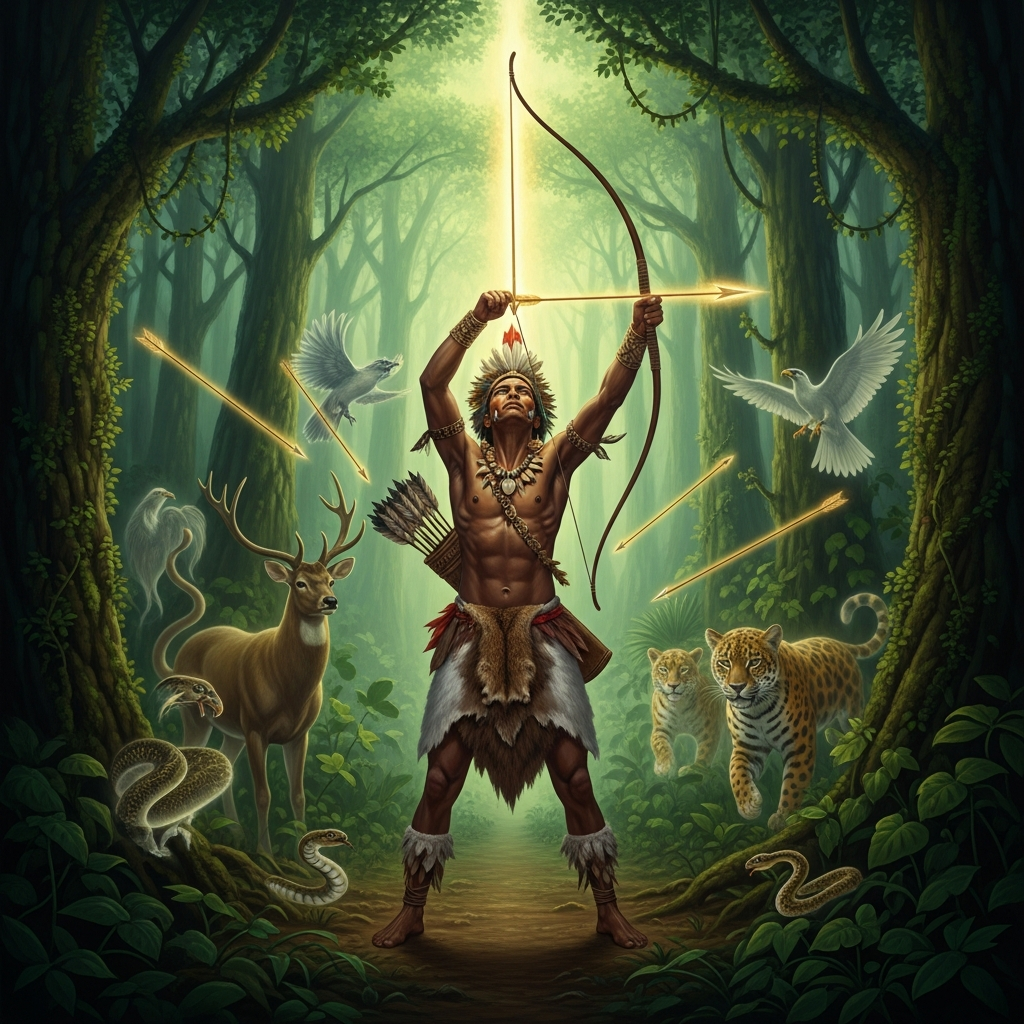
He does not announce himself. He does not wear bright colors. He moves through the trees with the particular silence of someone who has spent enough time in a forest to understand that the forest is always paying attention. He carries the ofá — the bow and arrow, the instrument of the single, irreversible act. He does not hurry. He does not need to. He will shoot once, and he will not miss.
This is Oxossi’s essential nature: precision as a theological virtue. The hunter who wastes arrows does not eat. The community that follows a wasteful hunter does not eat. Precision feeds. Accuracy is not just skill — it is responsibility to everyone who depends on you. When Candomblé devotees invoke Oxossi, they are invoking this quality: the ability to identify exactly what is needed, move toward it exactly, and achieve it in one clean motion.
In the Yoruba tradition, Oxossi is the king of Ketu.
Ketu is a Yoruba kingdom in present-day Benin — the city from whose diaspora much of Brazilian Candomblé’s theological structure derives. The Candomblé houses of Bahia call themselves Nação Ketu (Ketu nation) and trace their ritual lineage directly to this city and its Orisha worship. When those enslaved Ketu people arrived in Brazil in the eighteenth and nineteenth centuries, they brought Oxossi with them — king of their homeland, patron of their forests.
But the forests of Brazil were not the forests of Ketu.
The Amazon is not West Africa. The cerrado of Bahia has different trees, different animals, different medicinal plants than the forests of Nigeria and Benin. The enslaved Ketu people survived by learning these new forests — learning which plants could heal, which animals could be hunted, which trees held which spirits. In doing so they worked beside and learned from the indigenous peoples of Brazil, who had been reading those forests for thousands of years before any African or European arrived.
Oxossi absorbed this encounter. His mythology in Brazil began to include the caboclo spirits — indigenous forest guides, the spirits of Brazil’s First Peoples, who appear in Umbanda and some Candomblé houses as Oxossi’s companions or manifestations. The king of Ketu became also the king of the Brazilian mata. His arrow passed through the Atlantic and found new targets on a new continent, and hit them all.
His relationship with Ogum defines both of them.
Ogum is the Orisha of iron, war, and the clearing of paths — the deity who opens the way, who clears the bush with the machete. In the mythology of their fraternity, Ogum and Oxossi are brothers who work in sequence: Ogum opens the forest, Oxossi hunts in it. The machete and the arrow, the brute force and the precision, the path-clearer and the path-user.
There are stories about their conflict, too. In some accounts Oxossi fled into the forest after a quarrel with Ogum and stayed there, becoming more and more a creature of the deep woods, more and more the lord of what lies beyond the path Ogum cleared. His domain is the interior of the forest, the places the path does not reach. Ogum belongs to the road. Oxossi belongs to everything beside the road that the road exists to make accessible.
In ceremony, when Oxossi’s rhythm is played, those who are mounted by him move with a hunter’s lightness — crouching, turning, aiming the invisible bow, releasing the invisible arrow. The gesture is recognizable across every culture that hunts. The bow drawn back, the stillness before release, the moment in which all the hunter’s knowledge of the animal’s path converges on a single point in space and time: this.
The arrow that never misses is also a metaphor for the specific knowledge the hunter carries.
You cannot hit what you do not know. The hunter who misses has not failed in the moment of release — they have failed in the hours before, in the lack of attention to the animal’s habits, the wind direction, the terrain. The single arrow is the product of a lifetime of watching. Every shot that connects is the sum of everything the hunter has ever learned in the forest.
This is why Oxossi is also associated with knowledge — a less immediately obvious domain but one deeply embedded in his mythology. The forest teaches. The person willing to be in it, to be still enough to be in it, to be patient enough to let the forest show itself, learns things unavailable in human settlements. Oxossi’s worship is in part a worship of this kind of learning: practical, embodied, acquired through long exposure to a living system that does not explain itself.
Ossain, the Orisha of plants and herbal medicine, is Oxossi’s close companion. Both belong to the forest. Both require this attentional knowledge. Ossain’s medicines work because he knows which plant does what; Oxossi’s arrows land because he knows where the animal will be. The forest gives its knowledge to those who know how to ask.
Bahia calls him its patron.
The Brazilian state of Bahia — the geographic center of Candomblé, the place where the most traditional Candomblé houses operate, the city of Salvador that is the religious capital of Afro-Brazilian tradition — identifies Oxossi as its Orisha. His colors are blue and green, the colors of forest light. His day is Thursday. His number is seven.
At the great Candomblé houses of Bahia — the Ilê Axé Opô Afonjá, the Casa Branca, the Ilê Iyá Nassô Oká, the oldest continually operating Candomblé houses in the New World — Oxossi is sung for in ceremonies that have been running since enslaved Ketu people first gathered to keep the tradition alive in a country that banned their religion.
The tradition survived because it hid. Because it adapted. Because when the forest changed, the hunter changed how he hunted, but did not stop hunting.
The arrow flies. It lands exactly where it was aimed. It has not missed in three hundred years of diaspora and suppression and survival.
Echoes Across Traditions
Entities
- Oxossi
- Ogum
- Ossain
- the arrow Ofá
- the forest

Sources
- Reginaldo Prandi, *Mitologia dos Orixás* (2001)
- Pierre Verger, *Orixás: Deuses Iorubás na África e no Novo Mundo* (1981)
- Robert Farris Thompson, *Flash of the Spirit* (1983)
- Wande Abimbola, *Ifá: An Exposition of Ifá Literary Corpus* (1976)
- Luis Nicolau Parés, *A Formação do Candomblé* (2006)