Pomba Gira: The Spirit They Could Not Tame
Umbanda tradition, 20th century CE; rooted in older Afro-Brazilian and Iberian traditions · Brazil; the Umbanda terreiro; the crossroads at midnight; wherever women are told they have gone too far
Contents
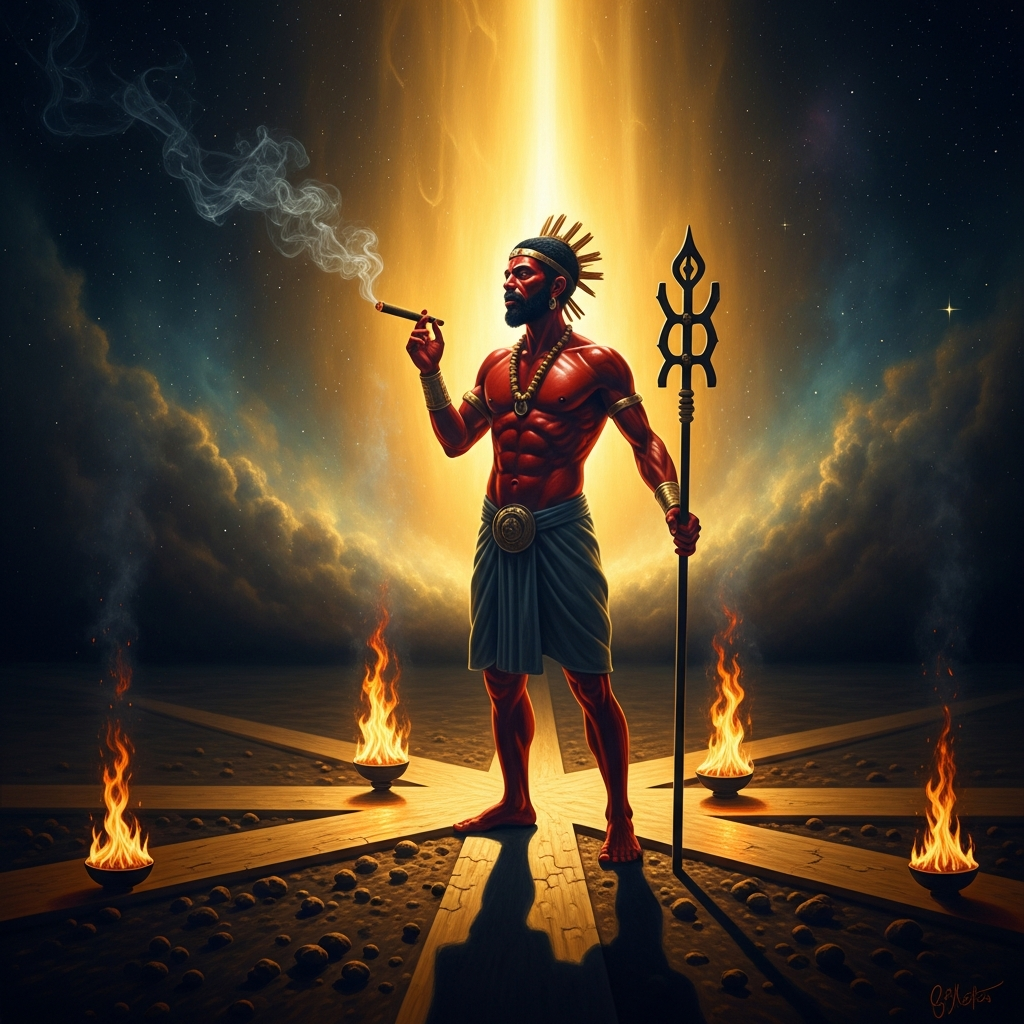
Pomba Gira is the female consort of Exu in Umbanda — the spirit of female sexual power, of the crossroads, of everything the colonial Church tried to suppress. She manifests as a beautiful, fierce woman in red and black who drinks red wine and laughs at pretension. She is also the patron of sex workers, of women who have been humiliated, of anyone society has tried to make invisible by calling them shameful. When she mounts a medium, the medium laughs. No one tells Pomba Gira what to do.
- When
- Umbanda tradition, 20th century CE; rooted in older Afro-Brazilian and Iberian traditions
- Where
- Brazil; the Umbanda terreiro; the crossroads at midnight; wherever women are told they have gone too far
She arrives laughing.
The medium’s posture changes the same way it changes for any spirit possession in Umbanda — a shift in the body’s center of gravity, a change in the face’s expression — but Pomba Gira arrives differently from the Preto Velho, from the Orishas, from the caboclos. She arrives with energy. She arrives taking up space. The medium who receives her begins to move with a hip-led swagger; the hands go to the hips or sweep through the air in large, owning gestures. The laugh — the Pomba Gira laugh, which is famous throughout Brazilian Umbanda — begins as something inside the chest and comes out as something that fills the room.
She is here. She will be here until she chooses to leave. No one is going to rush her.
The offering at her crossroads is specific.
Red roses. Red wine. Cigarettes or cigars. Small mirrors. Perfume — the expensive kind, if you can manage it, but she understands poverty and will accept what you have. The offerings are set at the crossroads or at the base of a tree with a red cloth, on a Friday night, which is her night. She prefers to be addressed formally: Pomba Gira, here is your offering, here is what I ask. She does not respond well to demands, to attempts at coercion, to the kind of manipulative petition that treats the spirit as a tool.
She responds well to honesty.
This is the quality her worshippers describe most often: Pomba Gira sees through performance. She has seen every kind of pretension, every social mask, every carefully constructed presentation of respectability. She is not impressed by any of it. If you come to her crossroads with your actual problem — the real one, the one you have not told anyone, the one you are ashamed of — she will hear it. She will not judge the nature of the problem. She will judge whether you are being honest about it.
Her name is a Portuguese rendering of the Kimbundu word bombojira, a spirit of the crossroads from the Bantu-speaking regions of Central Africa — Angola, Kongo — whose people were enslaved alongside the Yoruba and Fon people and brought to Brazil in enormous numbers. The Bantu traditions contributed enormously to Umbanda even as the Yoruba theological framework provided the Orisha structure. Pomba Gira is one of the places where the Bantu contribution is visible.
She was also shaped by Iberian tradition. Maria Padilha — the most famous of Pomba Gira’s manifestations — is named for a fourteenth-century Spanish woman who was the mistress of Pedro I of Castile, a woman notorious in Spanish popular tradition for her power over the king and for the deaths associated with her. She became, in the Iberian magical tradition, a spirit who could be petitioned for matters of love and revenge. When this Iberian spirit figure arrived in Brazil, she encountered the Bantu crossroads spirit and the Yoruba tradition of Exu’s female consort, and all three fused into the figure now called Pomba Gira.
She is the product of three continents.
The question her devotees are always asked is: why her?
Why petition a spirit associated with sex work, with the night, with the crossroads, with everything polite society calls shameful? The answer, given consistently across decades of ethnographic work in Brazilian terreiros, is that she is the one who does not judge the petitioner’s situation by the social categories that created it.
A woman whose husband is unfaithful has no claim in many social frameworks — the infidelity is normalized, expected, her complaint unseemly. Pomba Gira will hear the complaint. A woman who works as a sex worker and has been robbed, beaten, or abandoned has no claim in any official system. Pomba Gira is her patron, specifically. A woman whose desire has been called sinful by the Church, by her family, by her neighbors — Pomba Gira will not call it sinful. She will receive it without commentary.
This is the pattern across all the figures she protects: people who have been told their pain does not count because of what they are. Pomba Gira’s theology is simple. She disagrees. She does not organize her hierarchy of whose suffering matters around the same principles the social order uses. She is the spirit of the crossroads, and the crossroads is where society’s hierarchies break down — where the road out of the respectable neighborhood passes through the street where the marginalized live, where the official map meets the actual territory.
When a medium is ridden by Pomba Gira, they often speak directly to the people in the room in a way that other spirits do not.
She observes. She teases. She names things that are not being said. She may address a man in the room about his treatment of his wife, directly, without ceremony, in the middle of a ceremony about something else. She may comment on the nature of a petitioner’s actual desire versus the one they have presented. She is not cruel about it — cruelty is the prerogative of the small, and she is not small — but she is not diplomatic.
The laugh is the instrument of this function. Laughter is the great leveler. The Pomba Gira laugh — which comes from the medium’s chest and fills the room — punctures. It punctures pretension, rigidity, false piety, self-deception. It is the laugh of someone who has seen too much to be shocked by anything and is genuinely, infectiously amused by the human comedy of people trying to be more respectable than they are.
The colonial Church tried to absorb, suppress, or replace every African spirit in Brazil.
It succeeded with many of them, at least superficially. Oxalá became Jesus. Iemanjá became Mary. Xangô became Saint Jerome. These overlays were negotiated, accepted, eventually internalized by some practitioners as sincere double devotion.
Pomba Gira was mapped onto the devil. There was no female Catholic saint who would accept the mapping. The Church had no category for a female divine power associated with sexuality, the crossroads, and refusing to be controlled. She could only be the enemy.
She survived anyway. She more than survived — she became one of the most petitioned spirits in Brazil. Millions of people who would identify as Catholic on a census form have lit candles at the crossroads for Pomba Gira. She is the proof that certain human needs — for acknowledgment, for protection outside the official protection systems, for a divine presence that does not share the social order’s values about which women deserve help — will find their expression somewhere, in some tradition, in some crossing of roads.
The Church did not tame her. She is untameable by definition. The crossroads belongs to no one system.
Echoes Across Traditions
Entities
- Pomba Gira
- Maria Padilha
- Exu
- the medium who is mounted
- the roses and red wine of her offering


Sources
- Patricia Birman, *Fazer Estilo Criando Gênero* (1995)
- Lísias Nogueira Negrão, *Entre a Cruz e a Encruzilhada* (1996)
- Renato Ortiz, *A Morte Branca do Feiticeiro Negro* (1978)
- Kelly Hayes, *Holy Harlots: Femininity, Sexuality, and Black Magic in Brazil* (2011)
- Diana Brown, *Umbanda: Religion and Politics in Urban Brazil* (1986)