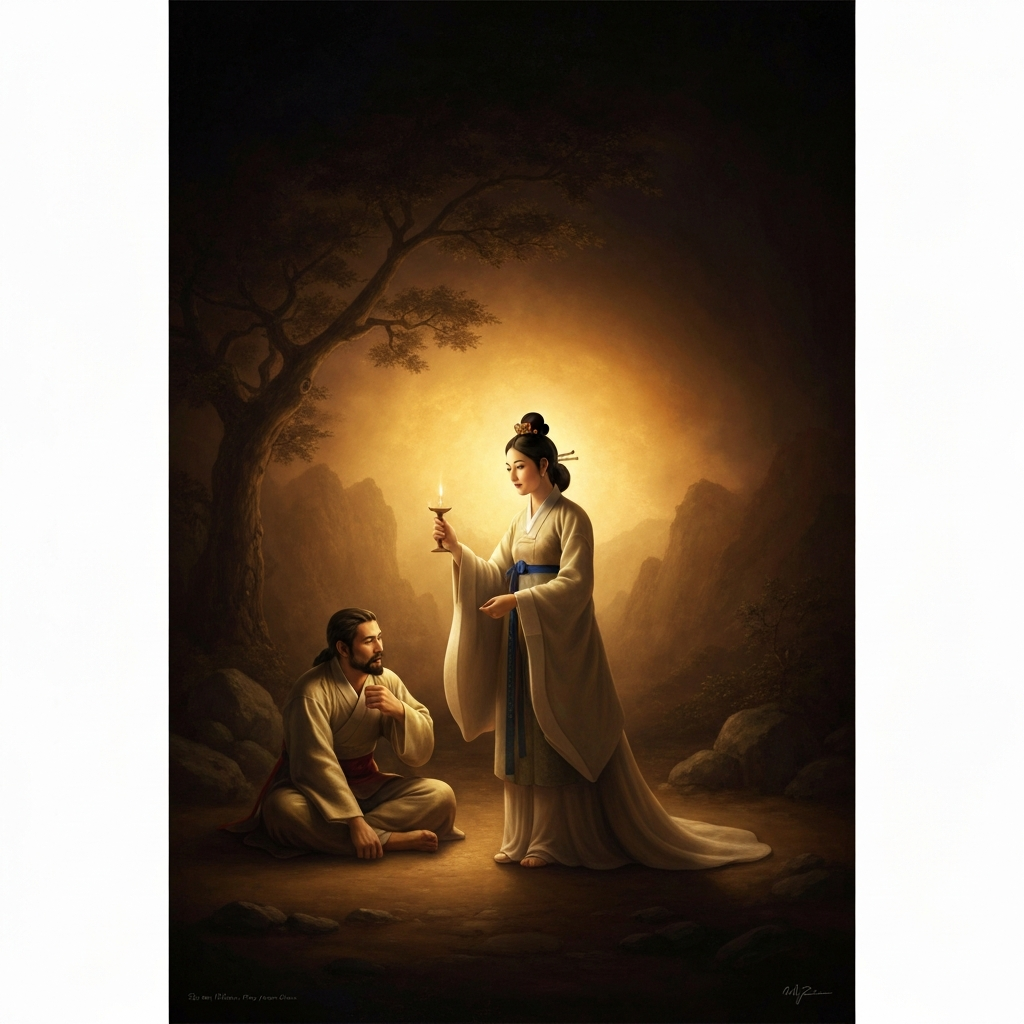
Sim Cheong: The Daughter Who Bought Her Father's Eyes
Pansori tradition, *Simcheongga*, formalized c. 18th century CE · Indang Sea (Yellow Sea); the Dragon King's underwater palace; the royal court
Contents
Sim Cheong's blind father Sim Hak-gyu is promised sight if three hundred sacks of rice are offered to the Buddha. Sim Cheong sells herself to merchant sailors as a human sacrifice to the Dragon King of the sea. She is thrown into the water — and is received by the sea king, given a palace, and eventually returned to the world inside a giant lotus. The lotus opens at court; her father sees her face and his eyes open.
- When
- Pansori tradition, *Simcheongga*, formalized c. 18th century CE
- Where
- Indang Sea (Yellow Sea); the Dragon King's underwater palace; the royal court
She was born in a house with no rice.
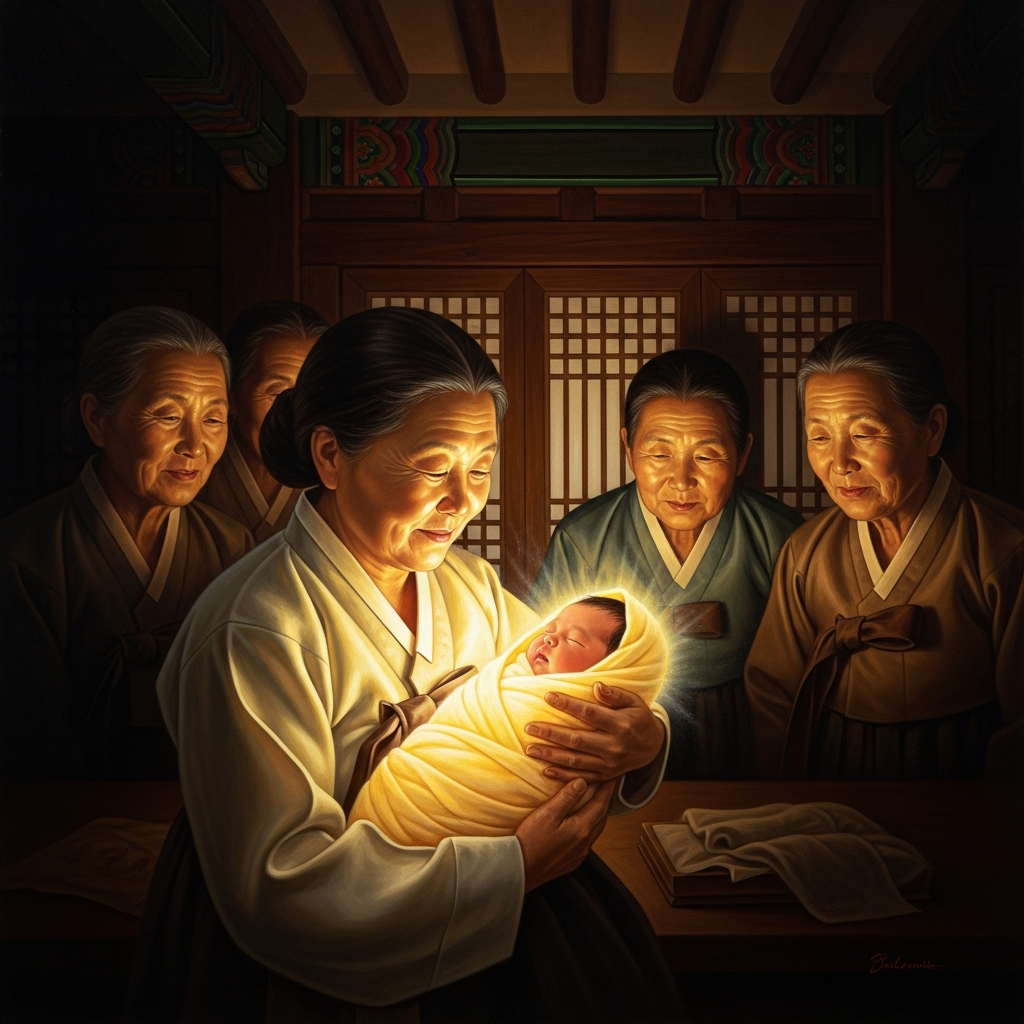
Her mother died the night she was born — this is how the pansori begins, with the double entry of a life and a death, arrival and loss in the same breath — and her father Sim Hak-gyu, who had been blind since before she could remember, was left to raise her on the charity of neighbors, on the scraps that the village women left at his gate because they pitied him, and on the sound of his daughter’s voice telling him where the edge of the path was, where the step was, where the bowl was on the table.
He was a man who had once been something — a scholar, a minor official, a man of some local standing — and had lost most of it along with his sight. What remained was his love for his daughter, which was the kind of love that blooms most extravagantly when there is nothing else left to tend.
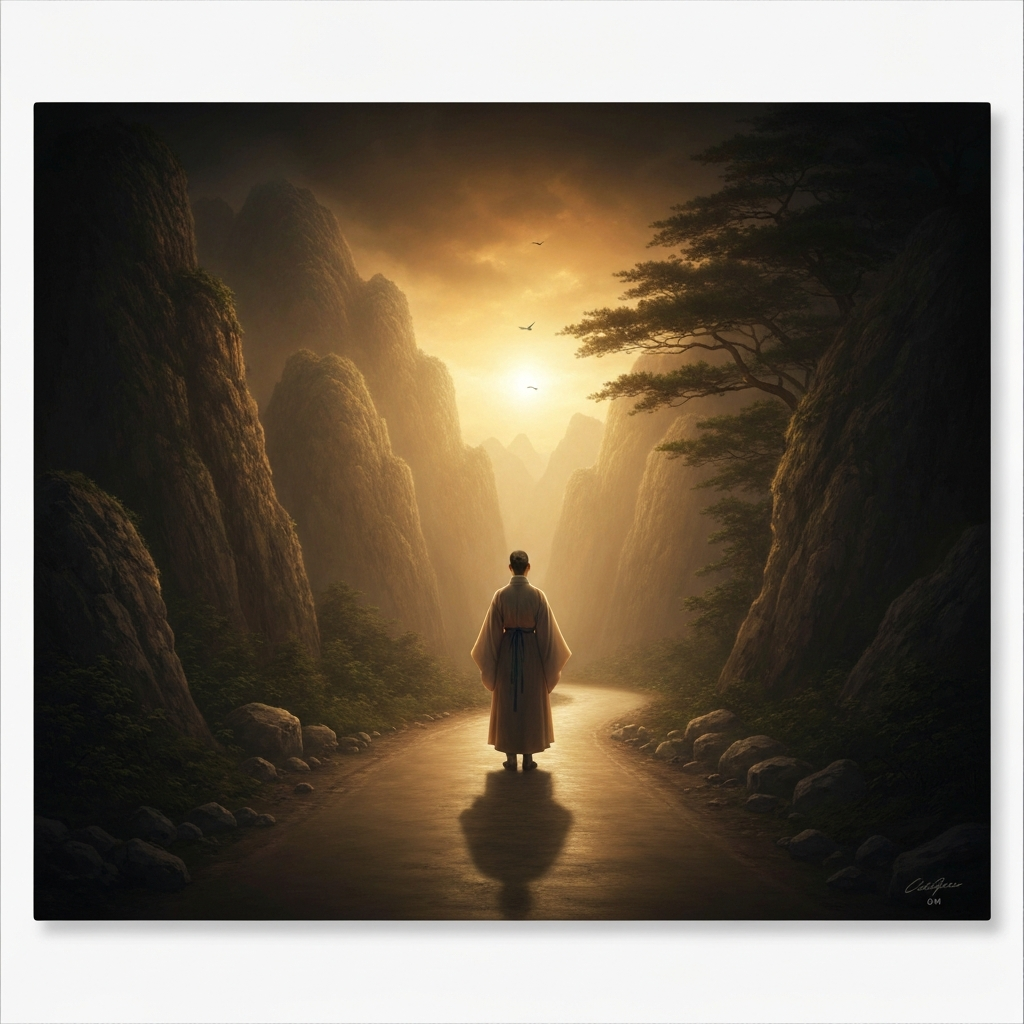
One day Sim Hak-gyu, walking alone along a road he knew badly, stumbled and fell into a ditch.
A monk found him there — a Buddhist monk of the kind that Korean stories fill with convenient wisdom — and helped him to his feet. The monk said: There is a way for you to have your sight back. Three hundred sacks of rice, donated to the Buddha at our temple, and your prayers will be answered.
Sim Hak-gyu, who did not have three hundred sacks of rice, said: I will do it.
He said this the way the desperately poor make promises: with a sincerity that ignores the problem of means, with the faith that somehow the promise, once made sincerely enough, will find its own path to fulfillment. He went home and told Sim Cheong what he had promised.
Sim Cheong, who was fifteen, looked at her father and thought about three hundred sacks of rice. Then she went out and found the answer.
Merchant sailors had come to port looking for a girl.
The Indang Sea was treacherous for the routes they sailed, and there was a tradition — ancient, expensive, specific — of appeasing the Dragon King with a human sacrifice. They needed a girl who would consent to be thrown into the sea at the place called Indangsu. They were offering three hundred sacks of rice.
Sim Cheong came to them and said: I will go.
She did not tell her father immediately. She went home and cooked meals and swept the floor and looked at her father’s face with the attentiveness of someone who is memorizing. She let the days pass. Then she told him.
He collapsed. He raged. He refused. He begged. He said that no sight in the world was worth his daughter’s life, which was true, and which Sim Cheong already knew, and which was why she had not asked him.
You already promised the Buddha, she said. I am the one who is keeping your promise.
The three hundred sacks of rice were delivered to the temple. The arrangements were made. On the appointed day, Sim Cheong put on white mourning clothes and went with the sailors to the sea.
The Indang Sea on the day of the sacrifice was the color of iron.
The sailors gathered at the prow. A priest spoke the prayers. The merchants who had bought Sim Cheong’s body for the Dragon King watched from the stern, because they had paid for a transaction and they wanted to confirm the transaction was completed. The sea around the boat was still.
Sim Cheong stood at the edge.
She prayed. She prayed for her father’s sight, which was the reason for all of this; she prayed for the soul of her mother, whom she had never known; she prayed in the manner that fifteen-year-olds pray when they are doing something they know is final — with the desperate sincerity of someone who has run out of other tools.
She jumped.
She did not drown.
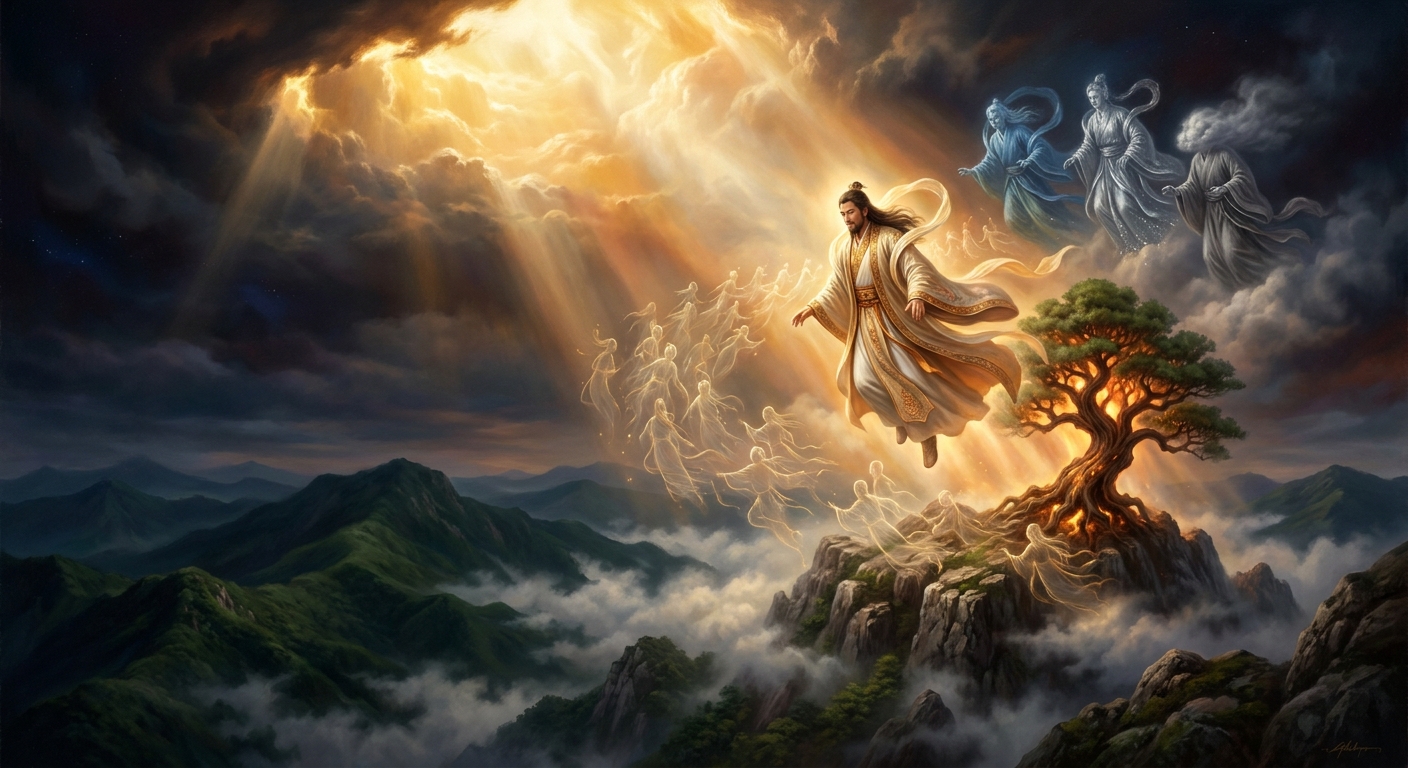
The sea opened — this is the pansori, and the pansori does not flinch from the miraculous — and she was received. Not consumed, not taken, but received: the Dragon King’s court beneath the Indang Sea is a palace, and Sim Cheong woke in it on a bed of kelp and sea-jade, and the Dragon King’s daughters were arranged around her, and there was no salt in the water, and the light came from somewhere she couldn’t identify, warm and even, the way light looks when it has been filtered through a thousand feet of sea.
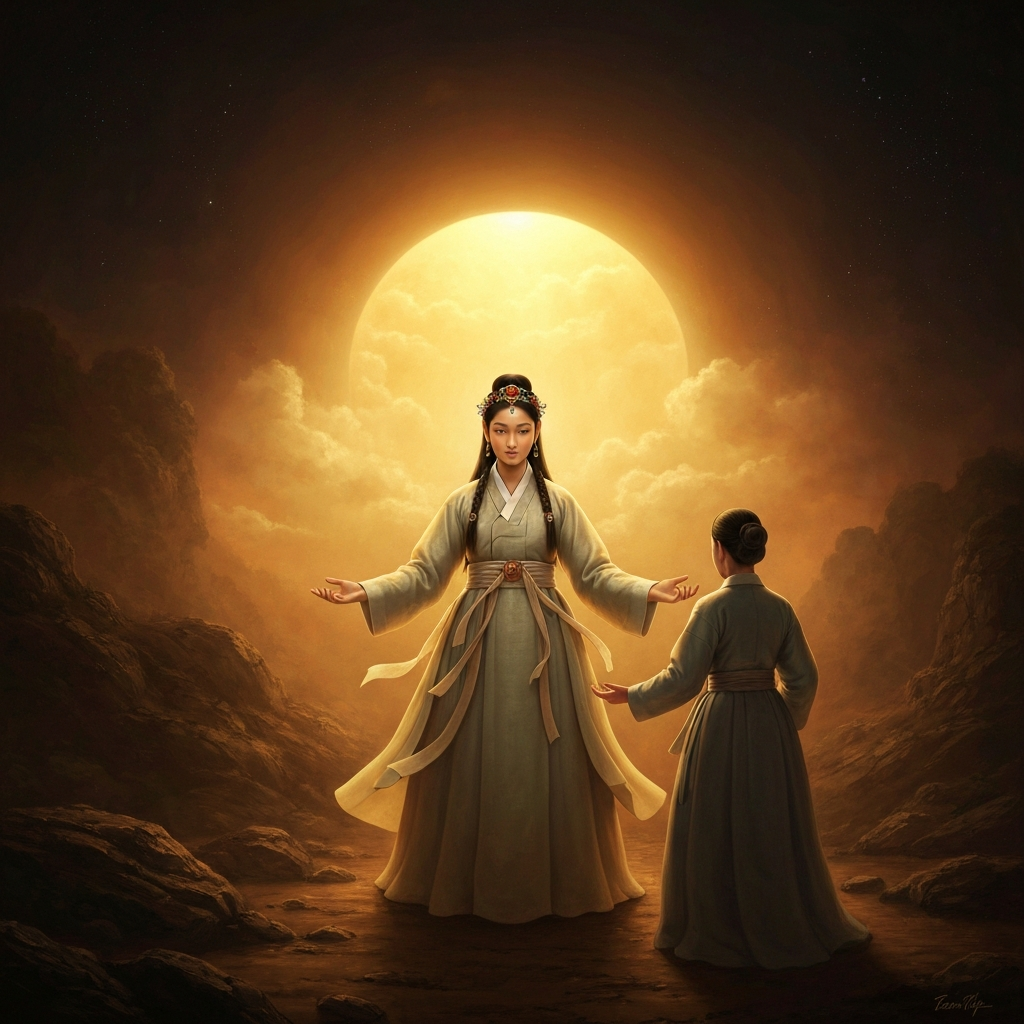
The Dragon King himself came to receive her.
He had been expecting the sacrifice. What he had not expected was the reason for it: a girl who had traded herself for her father’s sight. This kind of transaction was unusual. The Dragon King, who was in the business of receiving what the surface world threw down, recognized it as something different — not an offering made in fear but one made in love, which has always been understood across traditions as the only currency that the divine cannot refuse.
He gave her a palace. He gave her attendants. He gave her, in some versions, the company of her mother’s spirit. She lived beneath the sea for what felt like a season.
Then the Dragon King placed her inside a lotus.
The lotus surfaced in the waters near the royal court.
No one had ever seen a lotus so large. The court sent servants to bring it ashore. It was pulled from the water and carried to the palace garden, where it sat for a day in the sun, enormous, white, closed. The king was called. Officials gathered. Then the flower opened.
Sim Cheong was inside it.
She stood in the opening petals the way a painting stands in a frame, and the assembled court went silent, and the king — who had been searching for a queen — stood looking at this girl who had come out of the ocean in a flower and did not know what category to place her in.
He married her.
There is a banquet.
In the pansori, this banquet is the device that pulls the plot closed: the new queen, wishing to find her father, holds a feast for all the blind people in the kingdom. The blind come from every province, guided by their children and their neighbors, and they gather in the palace and eat the food that Sim Cheong has arranged for them, and they are given gifts.
Among them is Sim Hak-gyu.
He comes in his old robe. He comes not knowing whose banquet this is or why the blind have been invited. He sits in the great hall and eats the rice and listens to the sounds around him — the clink of bowls, the murmur of conversation, the music from somewhere distant — and then a voice speaks his name, and it is the voice of his daughter, and it is the voice of the dead.
He opens his eyes.
This is how it is in the story: the sight returns in the moment of recognition, as if his eyes had been keeping themselves closed for the moment they would be needed most. He opens them and there is his daughter in front of him, in court robes, in a palace that should not exist, alive in the way that things are alive when they have passed through something that should have destroyed them and been given back.
Sim Cheong is not a story about reward. The Buddha does not grant sight because Sim Cheong was good; the Dragon King does not return her because she earned it. The logic of the myth is older and simpler: love that is spent entirely becomes a different substance. It goes down into the water as a girl and comes back up as something the water cannot hold.
The three hundred sacks of rice are at the temple. The temple is still there. The sea is still the Indang Sea. The lotus is the only part of the story that no one has found a location for, and it is also the only part that everyone believes.
Echoes Across Traditions
Entities
- Sim Cheong
- Sim Hak-gyu (blind father)
- The Dragon King of the sea
- The Buddha
Sources
- *Simcheongga* (The Song of Sim Cheong), one of the five surviving *pansori* texts; oral tradition from at least the 17th century CE
- *Simcheongjeon* (The Story of Sim Cheong), anonymous prose version; multiple manuscripts from the Joseon Dynasty
- Peter Lee (ed.), *Anthology of Korean Literature from Early Times to the Nineteenth Century* (University of Hawaii Press, 1981)
- Marshall R. Pihl, *The Korean Singer of Tales* (Harvard, 1994)
- Laurel Kendall, *Shamans, Housewives, and Other Restless Spirits* (University of Hawaii Press, 1985) — on the Buddhist and shamanic layers of the Simcheong narrative