Contents
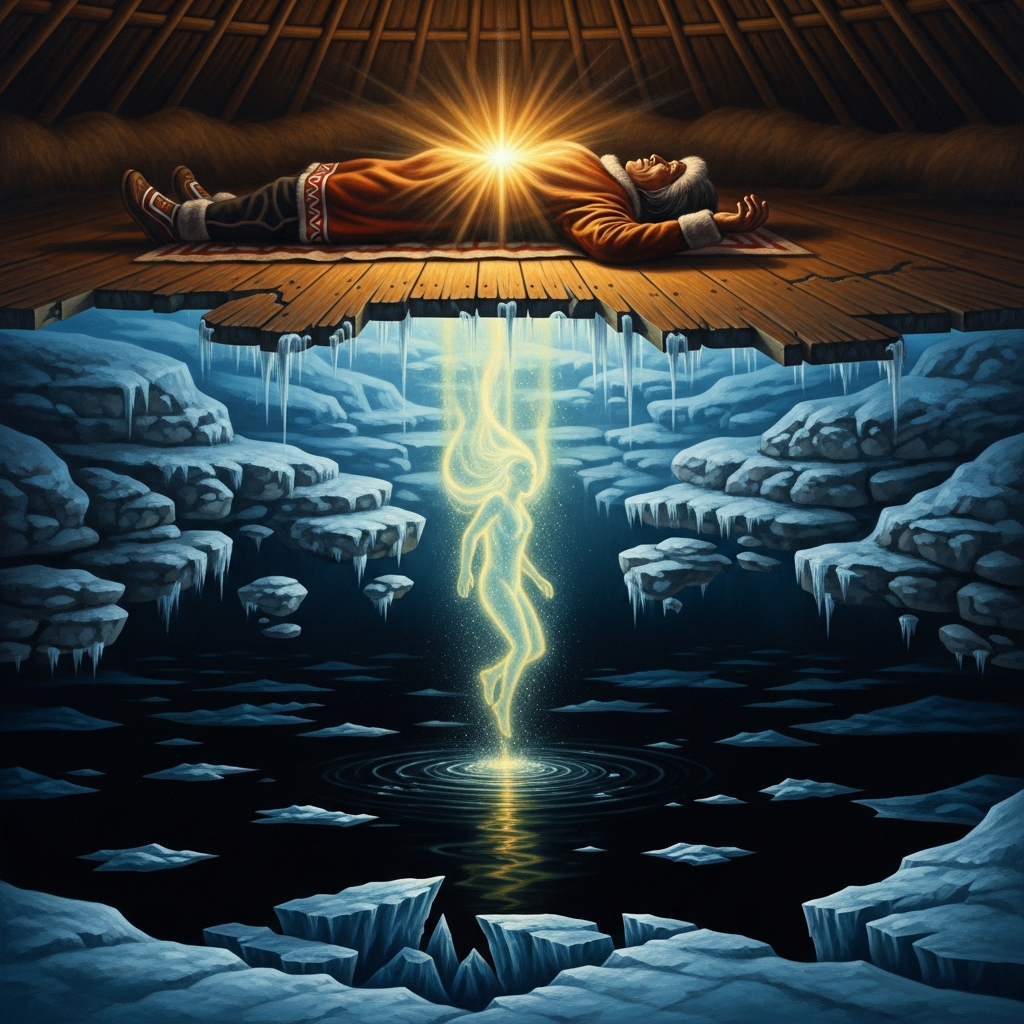
The seals have not come for three weeks. An Iglulik angakkuq strips to the skin, ties himself with a sealskin rope, and sends himself down through the ice and sea floor to Sedna's house, to discover what the community has done wrong and negotiate the animals' release.
- When
- c. 1920 — documented by Knud Rasmussen during the Fifth Thule Expedition
- Where
- Iglulik, Nunavut — the Inuit community on Iglulik Island in the Foxe Basin
The snowhouse is full.
Eleven adults are seated against the walls, sitting very still in the particular stillness that the Inuit adopt in a ceremony — not tense, not braced, but fully present, the way an experienced hunter is still while waiting: ready, calm, alert. They have extinguished the lamps. They will sit in darkness for as long as the work takes.
The angakkuq is in the center. His name is Aua, and he is sixty years old, and he has been doing this work since he was seventeen when his tornaq — his spirit helper — first appeared to him as an enormous polar bear while he was sitting alone on the ice. He strips off his outer clothing. In the unheated snowhouse in March, with the external temperature at minus thirty-five, this is not comfortable. But the ceremony requires it.
The sealskin rope is tied around his waist.
He lies down on the ice floor.
The descent through the ice and ocean floor is an act of consciousness that Aua has performed so many times that its phenomenology is entirely familiar, the way a practiced diver finds the specific pressure of deep water familiar: uncomfortable but known. His awareness descends. His body remains in the snowhouse.
The ice below the community is transparent to him in this state — he passes through it without sensation and enters the sea. The sea below Iglulik in March is dark and cold and populated. The tarriassuit — the hidden people, who live under the sea and to whom the sea animals belong in another sense alongside Sedna’s ownership — move through the water around him. They are not hostile. They are indifferent, as the sea itself is indifferent. They go about their purposes.
He goes deeper.
Sedna’s home is not at the ocean floor but below the ocean floor, in a place that is simultaneously the deepest possible depth and a specific identifiable location — a house, with an entrance, with a lamp burning inside, with Sedna herself in the innermost room. The house is not comfortable. It has the feeling of a place where someone has been alone for a very long time.
He enters. He sits with her.
Her hair is tangled, as he expected.
He begins to comb it. As he works through each tangle, he identifies the violation it represents — and there are several. A young woman in the community has been improperly handling seal intestines during her first menstrual cycle, in a way that is technically a violation of the rules about women and hunting equipment, though she did it out of ignorance, not contempt. An elderly hunter, whose hands are now too arthritic to follow the precise protocols for returning seal bones to the water, has been dropping bones in places they should not be. And there is one larger tangle — a more significant violation that Aua had suspected but not confirmed: someone in the community killed a ringed seal in the wrong season and concealed the kill.
He combs each tangle free.
He apologizes for each one. He tells Sedna that the ignorance was genuine, that the arthritis is not disrespect, that the concealed kill — he does not know who committed it, but he promises to find out — will be addressed. He speaks to her with the care that someone who knows a person’s history brings. He has been having this conversation with her for forty years. She knows his voice.
The tangles gone, she gestures.
Above in the sea, the seals begin to move toward the coast.
Aua returns to his body. The re-entry is audible — a sharp exhalation, a shift in the room’s quality of attention. He opens his eyes. He speaks.
He says what he found. He does not name the person who concealed the kill — that will be discovered through separate inquiry — but he announces what needs to happen. The young woman performs the required cleansing ceremony, informed and not shamed. The old hunter’s family performs the bone-return ceremonies on his behalf. The concealed kill is eventually identified — a young man who confesses when the community makes clear that they know it happened.
The following morning, seals are visible at three different breathing holes within walking distance of the camp.
Aua says nothing about this. He eats the breakfast that his wife has prepared, and he goes outside and checks the direction of the wind, and he does the ordinary work of a sixty-year-old man in an Arctic community in March.
Rasmussen, who was present for all of this, wrote afterward:
I have met the great shamans of many peoples. None of them explained what they do and why they do it with the precision and simplicity of Aua. He does not claim supernatural powers. He claims that the world is alive and that he has spent forty years learning to hear it. When I asked him what he gets from all this work, he was quiet for a long time and then said: I get to know what is actually true.
Echoes Across Traditions
Entities
- the angakkuq (Aua, the Iglulik shaman)
- Sedna (Nunavut name: Kannaaluk)
- the tarriassuit (hidden people beneath the sea)
- the sila-inua (spirit of the air)
- the community in the snowhouse
Sources
- Rasmussen, Knud, *Intellectual Culture of the Iglulik Eskimos* (Copenhagen, 1929) — eyewitness account of Aua's shamanic session
- Laugrand, Frédéric, *Representing Tuurngait* (Alaska, 2008)
- Eber, Dorothy Harley, *Images of Justice* (McGill-Queen's, 1997)