Fionn and the Giant's Causeway
mythic time — the folk tradition of the Giant's Causeway, County Antrim · The Giant's Causeway, County Antrim, and across the narrow sea to Fingal's Cave, Staffa, Scotland
Contents
When the Scottish giant Benandonner challenges Fionn Mac Cumhaill across the narrow sea, Fionn's wife Oonagh dresses the enormous warrior as a baby — and Benandonner flees so fast he tears up the causeway behind him.
- When
- mythic time — the folk tradition of the Giant's Causeway, County Antrim
- Where
- The Giant's Causeway, County Antrim, and across the narrow sea to Fingal's Cave, Staffa, Scotland
Fionn builds the causeway in a fit of enthusiasm he will regret.
The challenge comes from across the water: Benandonner, the Scottish giant, largest creature in the British Isles, who has been shouting across the North Channel for weeks that he could beat Fionn in a fight, that Fionn is not as large as people say, that the whole reputation of the Fianna is exaggerated. Fionn, who genuinely is as large as people say — large enough to carry a sod of Ulster earth in his hand that became an island in the Irish Sea, large enough that his thumb pressed to his lips can access all knowledge — takes this personally.
He builds a road of hexagonal basalt columns across the twelve miles of water between Antrim and Scotland, each column fitted precisely to the next, and when it is done he walks across it toward Benandonner’s island.
The problem is that Benandonner, seen at close range on his own island, is significantly larger than rumor suggested.
Fionn walks back across the causeway somewhat faster than he walked out, which is still very fast for a man who can carry a lough in his hand. He arrives home and tells his wife Oonagh that he needs to think. Oonagh listens to the full story, considers it for approximately thirty seconds, and says: “Go to bed. I’ll handle it.”
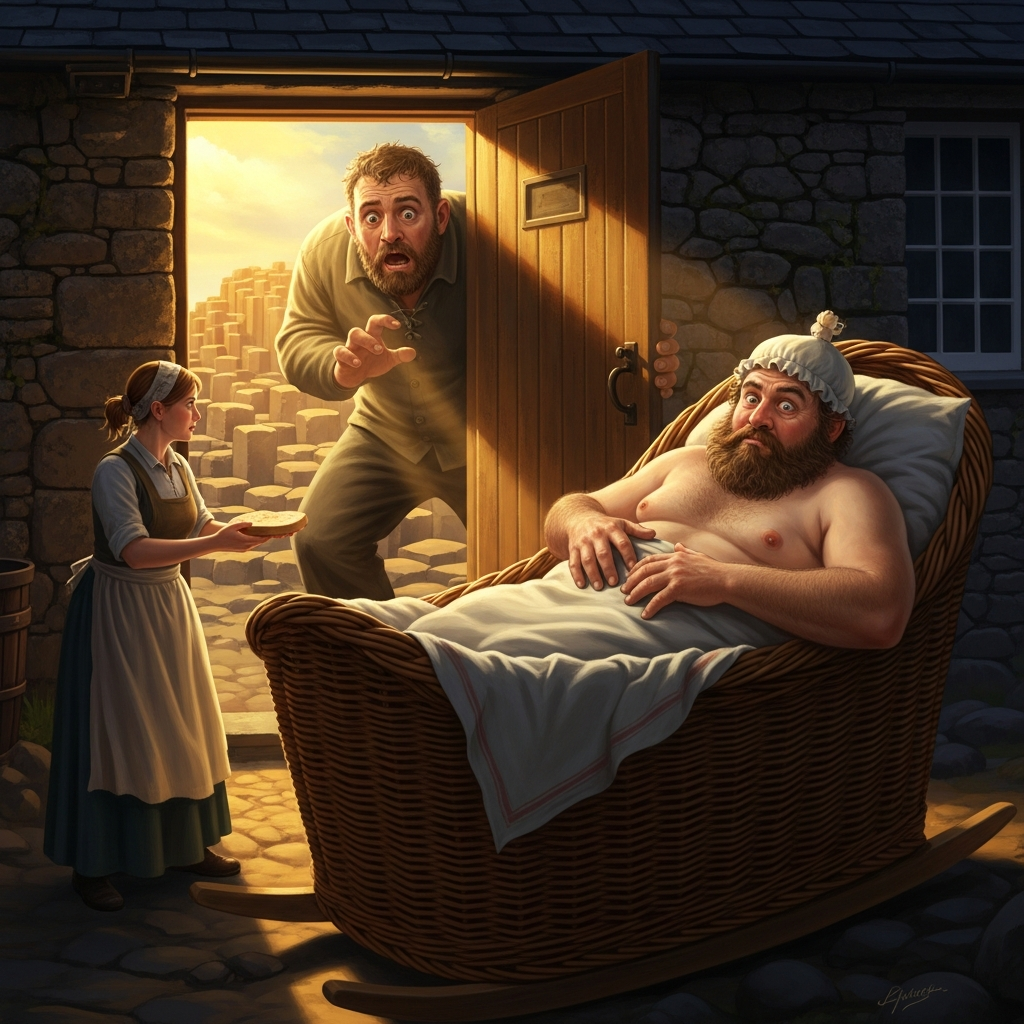
She wraps her enormous husband in a huge sheet and ties a bonnet on his head and arranges him in a crib she has improvised from a large basket. She bakes a batch of bread-loaves with cast-iron griddles baked into the center of most of them, but several perfectly soft loaves without the metal.
When Benandonner arrives, having crossed the new causeway with ground-trembling footfalls, Oonagh opens the door.
She is polite. She invites him in. She is very sorry — Fionn is out at the moment, but he should be back soon. Would Benandonner like to wait? She offers bread.
The Scottish giant eats one of the iron-cored loaves and breaks two teeth. He is too proud to mention it.
There is something in the crib. The largest crib he has ever seen. The largest baby he has ever seen, wrapped in swaddling cloth, wearing a bonnet, apparently asleep.
“Is that —” Benandonner starts.
“Oh, that’s the baby,” Oonagh says. “Fionn’s youngest.”
Benandonner looks at the size of the child. The baby’s hand, even in sleep, is the size of a normal man’s shield. The baby’s fist, loosely curled, could close around a horse’s head.
He offers the baby one of the soft loaves to gnaw on. The baby — Fionn, suppressing the need to sneeze — bites through the soft loaf with the satisfaction of a man who has just confirmed what he needed to confirm. Oonagh talks pleasantly about how Fionn will be glad to see Benandonner when he returns, about how much Fionn has been looking forward to the fight, about how Fionn does so enjoy a challenge —
Benandonner leaves. Quickly.
The calculation he performs on the way out the door is simple: if the baby is this size, the father must be inconceivably larger. Whatever fight Benandonner came here for, he does not want it.
He tears up the causeway behind him as he runs, so that Fionn cannot follow, destroying most of the road except the parts along both coastlines that couldn’t be torn up fast enough — the stumps of basalt columns that tourists still walk on today in County Antrim, and the cave on the island of Staffa where the other end began.
Fionn pulls off the bonnet and climbs out of the basket. He looks at Oonagh.
“That was undignified,” he says.
“You’re alive,” she says. “Go chop some wood.”
He goes to chop wood. This is, in most important respects, the most successful campaign of his long career.
Echoes Across Traditions
Entities
- Fionn Mac Cumhaill
- Oonagh
- Benandonner
Sources
- Lady Augusta Gregory, *Gods and Fighting Men* (John Murray, 1904)
- Dáithí Ó hÓgáin, *Myth, Legend and Romance: An Encyclopaedia of the Irish Folk Tradition* (Prentice Hall, 1990)
- Michael Scott, *Irish Folk and Fairy Tales* (Sphere Books, 1983)