The Bhagavad Gita: God Speaking on a Battlefield
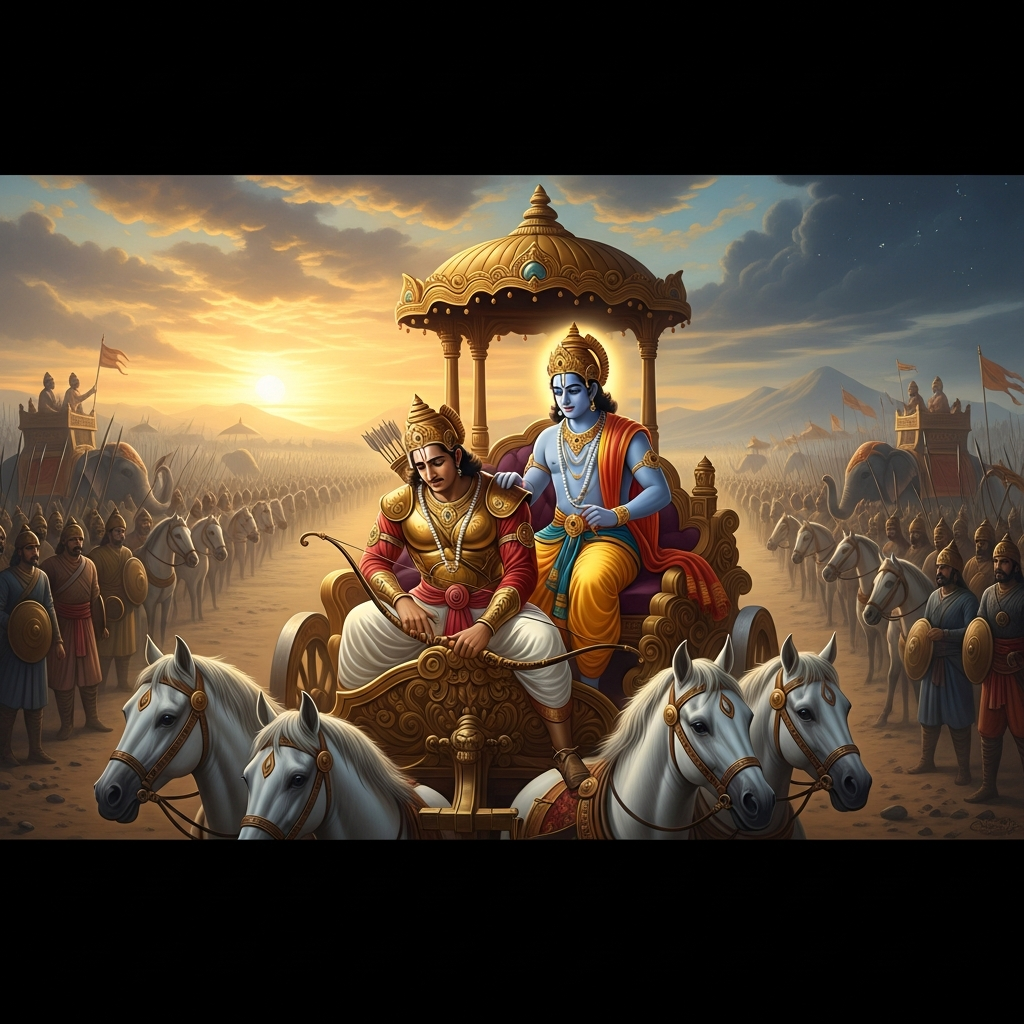
The *Bhagavad Gita* as an embedded text in the *Mahabharata* c. 1st-2nd century CE; the *Mahabharata* war narrative c. 400 BCE-400 CE; the historical Kurukshetra conflict c. 9th-8th century BCE in Indian tradition · The battlefield of Kurukshetra, north of the modern city of Delhi, on the first morning of the Mahabharata war; the chariot positioned between the two armies
Contents
Arjuna sees his family arrayed against him on the battlefield of Kurukshetra and refuses to fight. Krishna, his charioteer, reveals the Gita — 700 verses on duty, soul, and the nature of reality.
- When
- The *Bhagavad Gita* as an embedded text in the *Mahabharata* c. 1st-2nd century CE; the *Mahabharata* war narrative c. 400 BCE-400 CE; the historical Kurukshetra conflict c. 9th-8th century BCE in Indian tradition
- Where
- The battlefield of Kurukshetra, north of the modern city of Delhi, on the first morning of the Mahabharata war; the chariot positioned between the two armies
The armies are waiting.
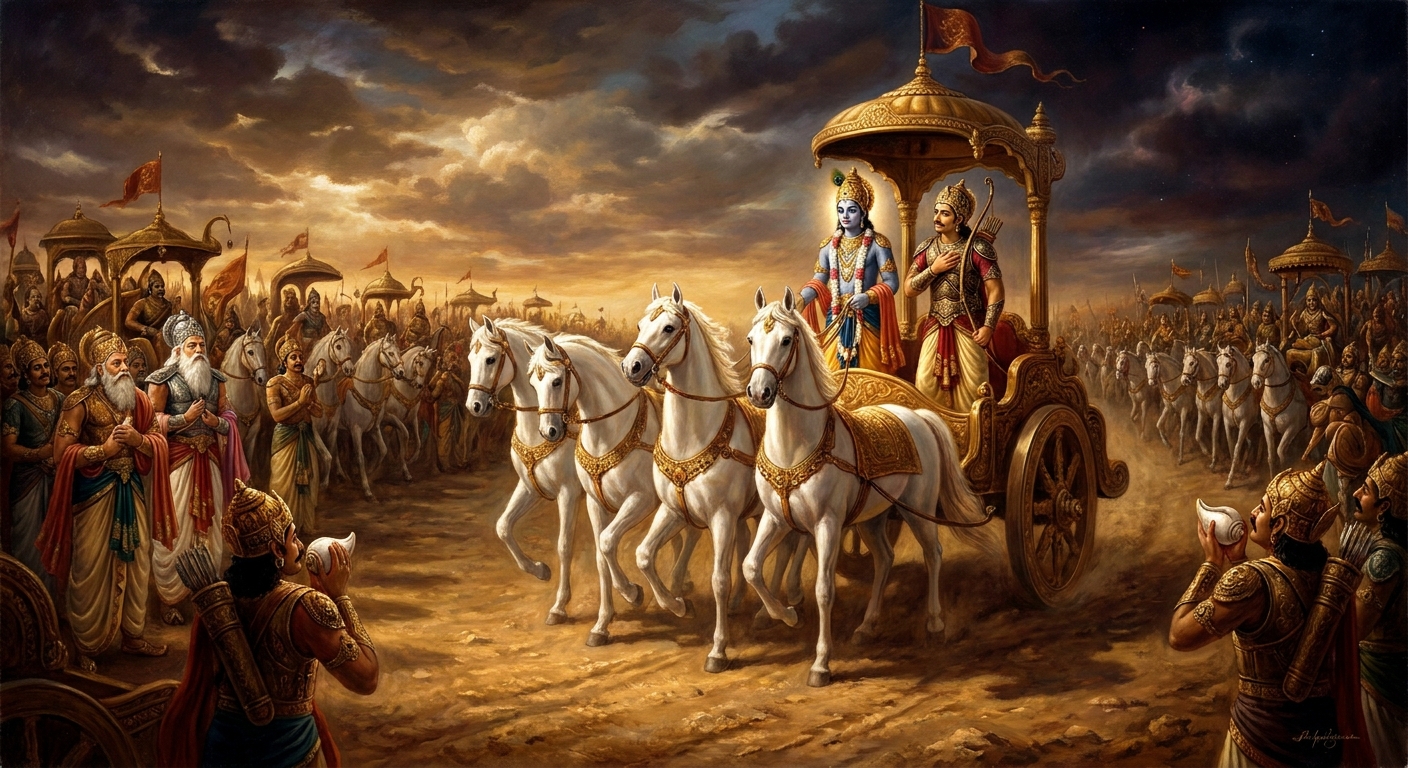
On one side: the Pandavas — the five brothers, sons of Pandu, led by the warrior Arjuna. Behind them: their allies, their chariots, their elephants. On the other side: the Kauravas — the hundred sons of Dhritarashtra, led by Duryodhana, who wrongfully holds the kingdom. Behind them: their allies, including Bhishma, the greatest warrior alive, Arjuna’s own teacher Drona, and many cousins and uncles and respected elders.
Between them: eighteen days of battle that will end with nearly everyone dead.
The battle has not yet begun. The conch shells have not been blown. The chariots are in position, the banners are up, the sun is at a particular angle on the morning of the first day of what the ancient Indian tradition computed as 3102 BCE and subsequent historians place some centuries later.
Arjuna asks his charioteer to drive him to the middle, between the armies, so he can see clearly who he is about to fight.
His charioteer is Krishna.
He looks.
He sees Bhishma, who is his great-uncle, the most beloved man in the family. He sees Drona, who taught him everything he knows about warfare — who held the bow while he learned to hold the bow. He sees his cousins, who grew up with him, whom he has known all his life. He sees men he respects and men he loves.
His bow falls from his hands.
He sits down in his chariot. His limbs are weak. His mouth is dry. His skin burns. His body trembles. The bow Gandiva lies on the floor of the chariot.
He tells Krishna: I cannot do this. If I kill my own family, the family lines will be destroyed, the rituals of the ancestors will be neglected, the cosmic order will unravel. Better for me to be killed by these men unarmed than to kill them. I will not fight.
These are not idle concerns. In the world of the Mahabharata, the maintenance of family rites is a genuine cosmological obligation. Arjuna’s argument is not cowardice — it is a coherent ethical position, carefully stated.
Krishna’s response fills the next seventeen chapters.
He begins with the soul.
There is that which kills and there is that which is killed, Krishna says — and then there is the Self, the Atman, which is neither. The Self cannot be killed by swords. It is not born and does not die. It is not wet by water or dried by wind or burned by fire. When the body it inhabits is worn out, the Self takes on another, the way a person changes worn-out clothes.
Arjuna is weeping for those who should not be wept for. The learned do not grieve for the living or the dead.
This is the first teaching: the warriors Arjuna sees arrayed before him are not their bodies. They are souls wearing bodies. The deaths he will cause are not what they appear to be from inside the limited human perspective.
Then he turns to duty.
Arjuna is a warrior. His dharma — his duty, his nature, his role in the cosmic order — is to fight. Not to fight is not a neutral option; it is a failure of his nature. A Brahmin who refuses to study, a king who refuses to govern, a warrior who refuses to fight — each is failing not just a social role but a cosmic function. The role is not arbitrary. It is what you are.
Furthermore, Krishna says: you are not the agent. You are the instrument. Arjuna thinks he will be acting when he fights, causing these deaths, bearing responsibility for them. This is an error. The cosmic unfolding has already determined these outcomes. Bhishma and Drona and all the others on the other side are already dead — their death is already accomplished in the realm of cosmic necessity. Arjuna is the proximate instrument, but the cause is deeper.
Therefore, stand up, Arjuna. Attain glory. Conquer your enemies. Enjoy a prosperous kingdom. By Me they have already been slain. Be merely the instrument.
This is the philosophy of detached action — karma yoga.
Act, but do not act for the fruit of the action. Do your duty without attachment to the outcome. Whether the battle is won or lost, whether you are praised or blamed, whether you live or die — these are not within your control and should not be the motive of your action. What is within your control is the action itself. Act from duty, not desire.
This is the Gita’s central practical prescription, and it is the most difficult one to follow. Arjuna’s paralysis comes exactly from his attachment to outcomes — he cannot bear the outcome of killing his family. Krishna is saying: detach from the outcome. The outcome is not yours. Do the thing that is yours to do.
This teaching is not coldness. Krishna will make clear that he is asking for full engagement, not disengagement. The person who abandons action in the name of renunciation is not practicing yoga. The person who acts from their deepest nature, completely, without looking at the scoreboard — that is the practitioner.
Then comes the revelation.
Arjuna asks to see Krishna’s actual form. He has been talking to his friend, his charioteer, a young man with a flute and a peacock feather. He asks to see what is actually there.
Krishna shows him.
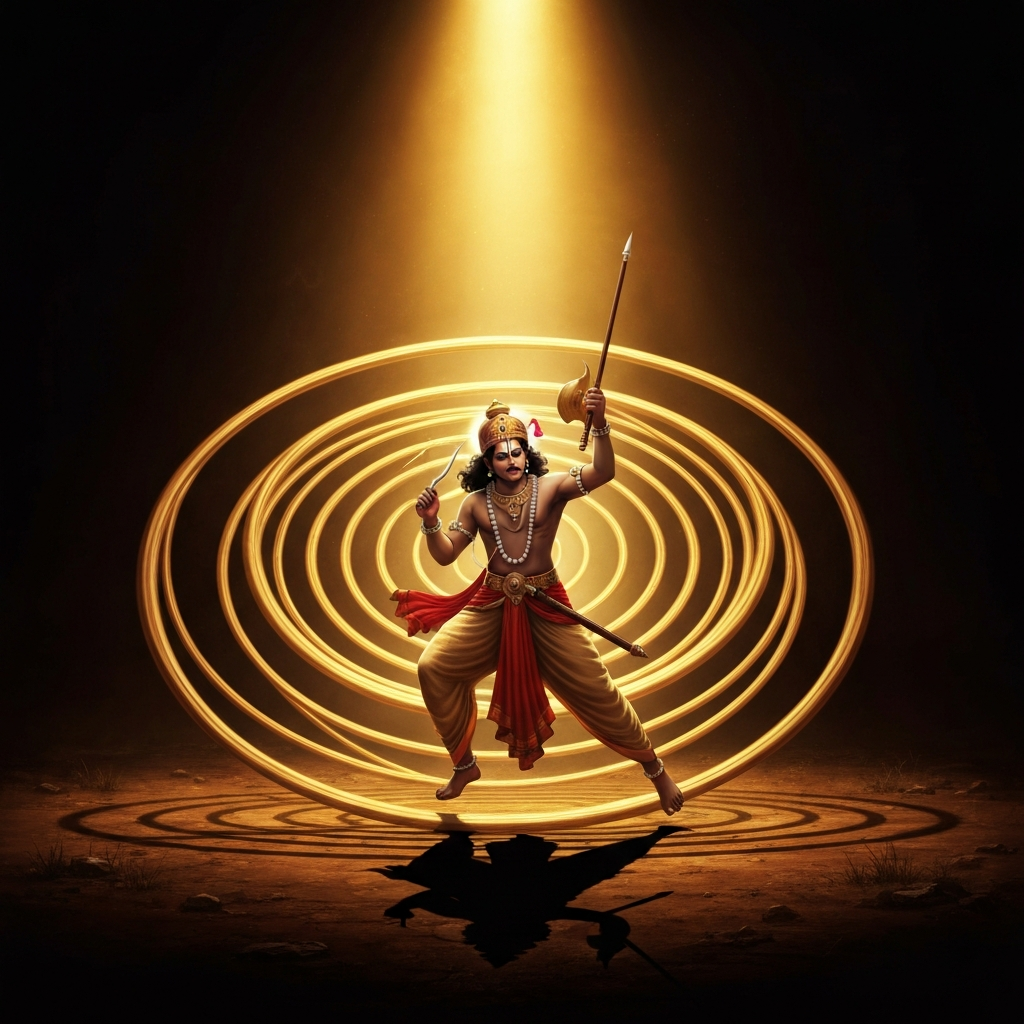
The Vishvarupa — the cosmic form — is described in one of the most overwhelming passages in world literature. Arjuna sees a being with infinite mouths and infinite eyes and infinite forms, with the sun and the moon as his eyes, blazing, filling all of space, consuming all of time. He sees the warriors of both armies rushing into Krishna’s mouths the way moths rush into fire. He sees that Bhishma and Drona are already within those mouths, already consumed.
He sees that all of this — the field, the armies, the war, the world — is already taking place inside the body of God.
He asks Krishna to take his normal form back. He cannot look at the cosmic form without terror.
Krishna returns to the young man with the flute.
The conversation continues for eighteen chapters. It covers action, knowledge, devotion, the nature of the gunas (the three qualities of matter), the two kinds of the divine and the demonic, the relationship between the individual soul and the universal Self.
But the center is that moment in the chariot, before the battle, when a man who could not fight asked the god who is everything to explain why he should.
Arjuna lifts his bow.
He fights.
The Gita has been interpreted by every major Hindu thinker since its composition, and by many outside the tradition. Adi Shankara read it as an Advaita text: the Self is identical with Brahman, and the teaching is about realizing that identity. Ramanuja read it as a Vaishnava devotional text: the soul is distinct from but dependent on God, and the teaching is about surrender in love. Tilak, in 1915, read it as a text about selfless action in national service: India is the battlefield, British colonialism is the enemy, karma yoga is the method.
Gandhi read it as a call to nonviolence: the battle is the inner battle, Arjuna’s enemies are his own lower impulses, the war is metaphor. He then struggled, publicly and honestly, with the fact that the text’s literal content is a god telling a man to go kill people.
The Gita survives all of these readings because it is genuinely ambiguous at the point that matters most: when God says “do your duty,” the question of what the duty is remains open.
That is not a weakness in the text.
It is the text.
The chariot is in the middle of the field. The armies are waiting. Arjuna has his bow.
He has to decide.
You do too.
Echoes Across Traditions
Entities
- Arjuna
- Krishna
- Duryodhana
- Bhishma
- Drona
- Dhritarashtra
- Sanjaya

Sources
- *Bhagavad Gita* (composed c. 1st-2nd century CE within the *Mahabharata*, Bhishma Parva chapters 23-40)
- S. Radhakrishnan, *The Bhagavadgita* (1948)
- Barbara Stoler Miller, *The Bhagavad-Gita: Krishna's Counsel in Time of War* (1986)
- Robert N. Minor (ed.), *Modern Indian Interpreters of the Bhagavadgita* (1986)
- J.A.B. van Buitenen, *The Mahabharata* (1973-1978)
- Swami Vivekananda, *Lectures on the Bhagavad Gita* (1896)