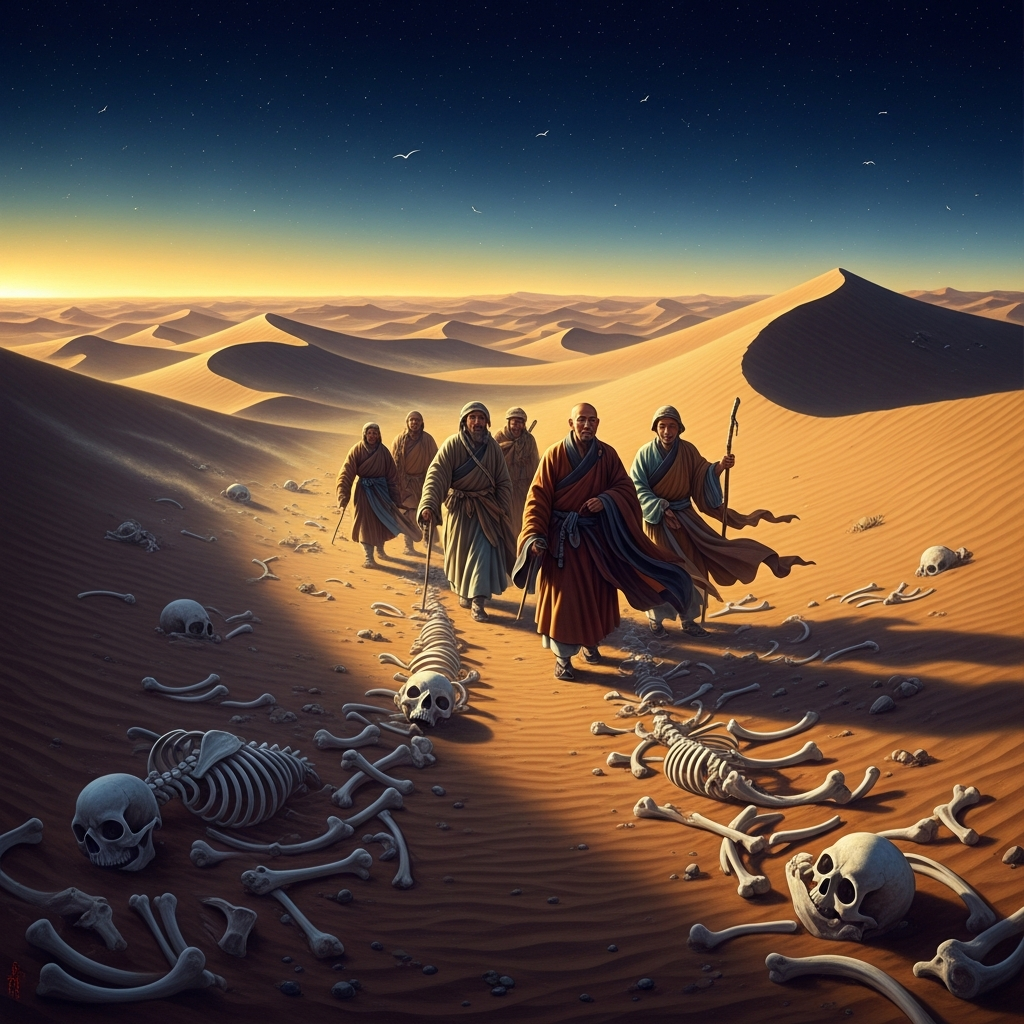
Guānyīn Grows a Thousand Hands
Timeless — the mythological past of Chinese Buddhist tradition, with the Miaoshan legend from the Song dynasty · The royal palace, the Fragrant Mountain (Xiangshan), and the courts of hell
Contents
A princess named Miaoshan refuses an arranged marriage to become a nun, is executed by her father, descends into hell and transforms it into a paradise, and ascends to become Guānyīn — who is given a thousand hands because one heart cannot reach everywhere suffering is.
- When
- Timeless — the mythological past of Chinese Buddhist tradition, with the Miaoshan legend from the Song dynasty
- Where
- The royal palace, the Fragrant Mountain (Xiangshan), and the courts of hell
She is born the third daughter of a king who wanted a son.
Miaoshan is, from the beginning, the daughter who does not comply. She is brilliant and kind and devout in a way that makes her father’s plans for her — a suitable marriage, a political alliance, the normal trajectory of a princess — feel to her like a wasted life. She wants to be a nun. She asks her father’s permission. He says no.
He says no several times. She asks each time more quietly, with more certainty, with the patience of someone who has understood that the answer is not in her father’s hands. He orders her to a convent to see if the hard life of a nun will change her mind. The convent is given secret instructions to make her life difficult. She works harder than anyone and the convent thrives. The father is not pleased.
He orders her killed.
The executioner’s blade breaks against her neck. In another version, she is strangled, but even strangled she does not die. She dies eventually — the sources vary on method — and her soul descends to the underworld, to the Ten Courts of Hell where the souls of the dead are processed and punished.
She arrives in hell and she begins to pray.
Her prayer transforms the underworld. The flowers bloom in it. The fires go out. The instruments of torture become harmless. She distributes the sutras. The souls in hell receive some respite. The King of Hell — concerned that a being with this quality of presence will eliminate hell’s deterrent function entirely — sends her soul back to the upper world.
She arrives on the Fragrant Mountain, an island in the Eastern Sea. She practices on the mountain for nine years. She attains enlightenment. She is about to enter the permanent peace of nirvana — the final dissolution of the self into liberation — when she stops.
She hears it.
The cries of the world.
All of them simultaneously: the fisherman in the typhoon, the woman in labor, the child sick with fever, the man condemned unjustly, the widow alone in winter, the animal in the trap, the sailor on the reef, the soldier dying in the wrong war. The Lotus Sutra says that anyone who calls on Guānyīn’s name in moment of need will be heard. The scale of hearing requires a scale of response.
She vows not to enter nirvana until all beings have been saved.
Amitabha Buddha hears her vow. He reaches down and gives her the body for it: a thousand arms, each with an eye in the palm. The eye sees where the hand needs to go. The hands can reach in a thousand directions simultaneously. The eleven faces look outward in every direction: north, south, east, west, above, below, and the five directions between — each face with a different expression, because the compassion that meets a grieving mother looks different from the compassion that meets a drowning man, and Guānyīn does not deploy a single expression of mercy but the exact expression appropriate to each person’s suffering.
She stands on the Fragrant Mountain. She stands in the sea near the island of Putuo. She stands in every temple in China where someone needs to be heard. The thousand hands are extended. The eyes in the palms are open. The cries are still coming in, and she is still hearing all of them, and the ones she hears are always exactly the ones that need to be heard, which is why her name means the one who perceives the sounds of the world.
Echoes Across Traditions
Entities
- Guānyīn (Avalokitesvara)
- Princess Miaoshan
- King Miao Zhuang (her father)
- Amitabha Buddha
Sources
- Guanshiyin Pusa Pumenpin (觀世音菩薩普門品) — Lotus Sutra chapter 25, the foundational text
- Miaoshan legend as compiled in Song dynasty hagiographies
- Chün-fang Yü, *Kuan-yin: The Chinese Transformation of Avalokitesvara* (Columbia, 2001)
- Wolfram Eberhard, *A Dictionary of Chinese Symbols* (Routledge, 1986)