Contents
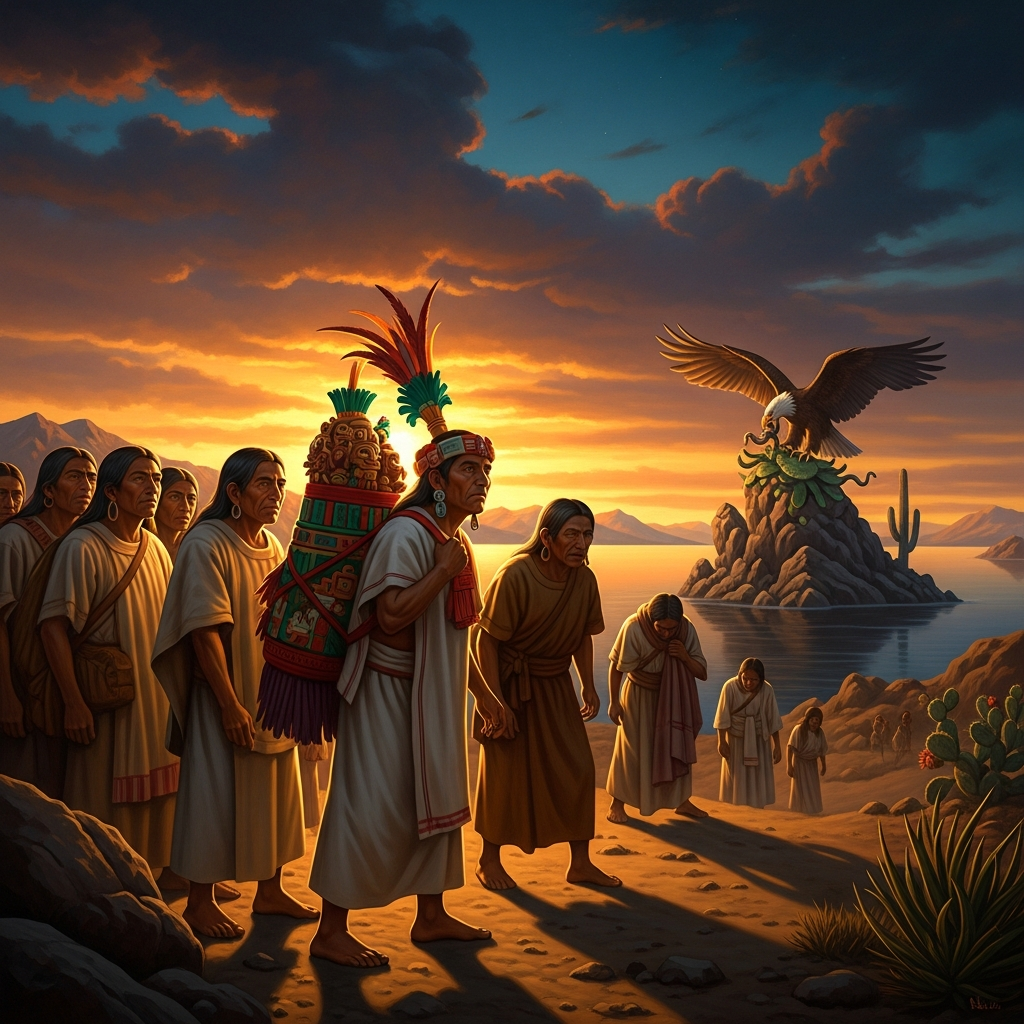
For two centuries the Mexica wandered the northern deserts, carrying their god Huitzilopochtli as a sacred bundle on the shoulders of priests. He spoke to them at night and told them where to walk. The journey ended on a marshy island in a lake, where they saw an eagle on a cactus eating a serpent — and knew.
- When
- ca. 1100–1325 CE, ending in the founding of Tenochtitlan
- Where
- From mythical Aztlan, through the deserts of the north, to Lake Texcoco in the Valley of Mexico
The Mexica were not always Mexica. They began as a small, nondescript people of the northern deserts, one tribe among many that the great civilizations of central Mexico called Chichimeca, “people of the dog lineage,” meaning barbarians. They lived in a place called Aztlan, “the place of whiteness” — possibly an island in a lake somewhere far to the north, possibly a memory, possibly a metaphor. From Aztlan they began to walk.
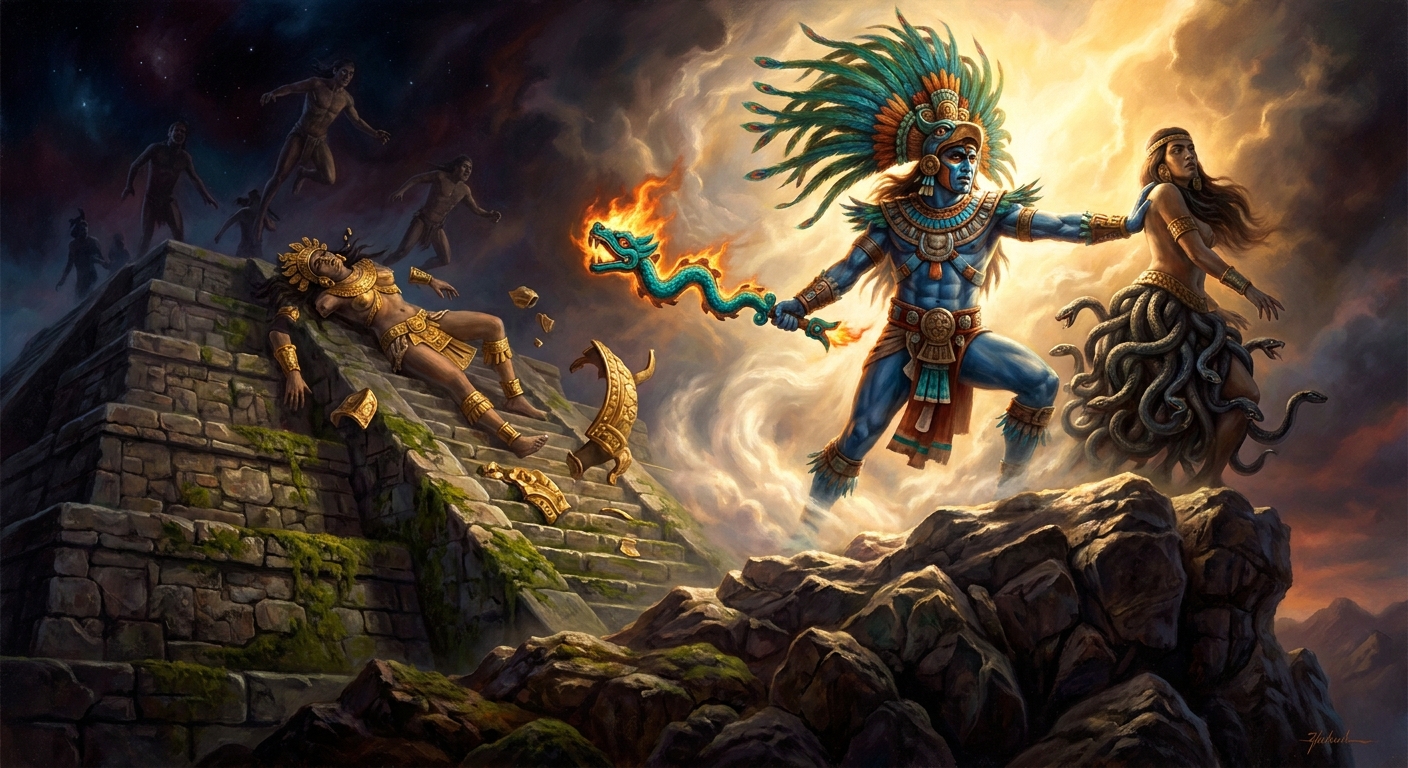
They did not walk alone. They carried with them the teomama, “god-bearer” — a priest, often four priests in rotation, whose work was to bear on his back the tlaquimilolli, the sacred bundle, which contained the body of their god. Huitzilopochtli, the Hummingbird of the South, the war-god born fully armed from the breast of Coatlicue at Coatepec, was small enough to be carried in a wrapping of jaguar skin and quetzal feathers. But he was heavy with destiny, and at night he spoke.
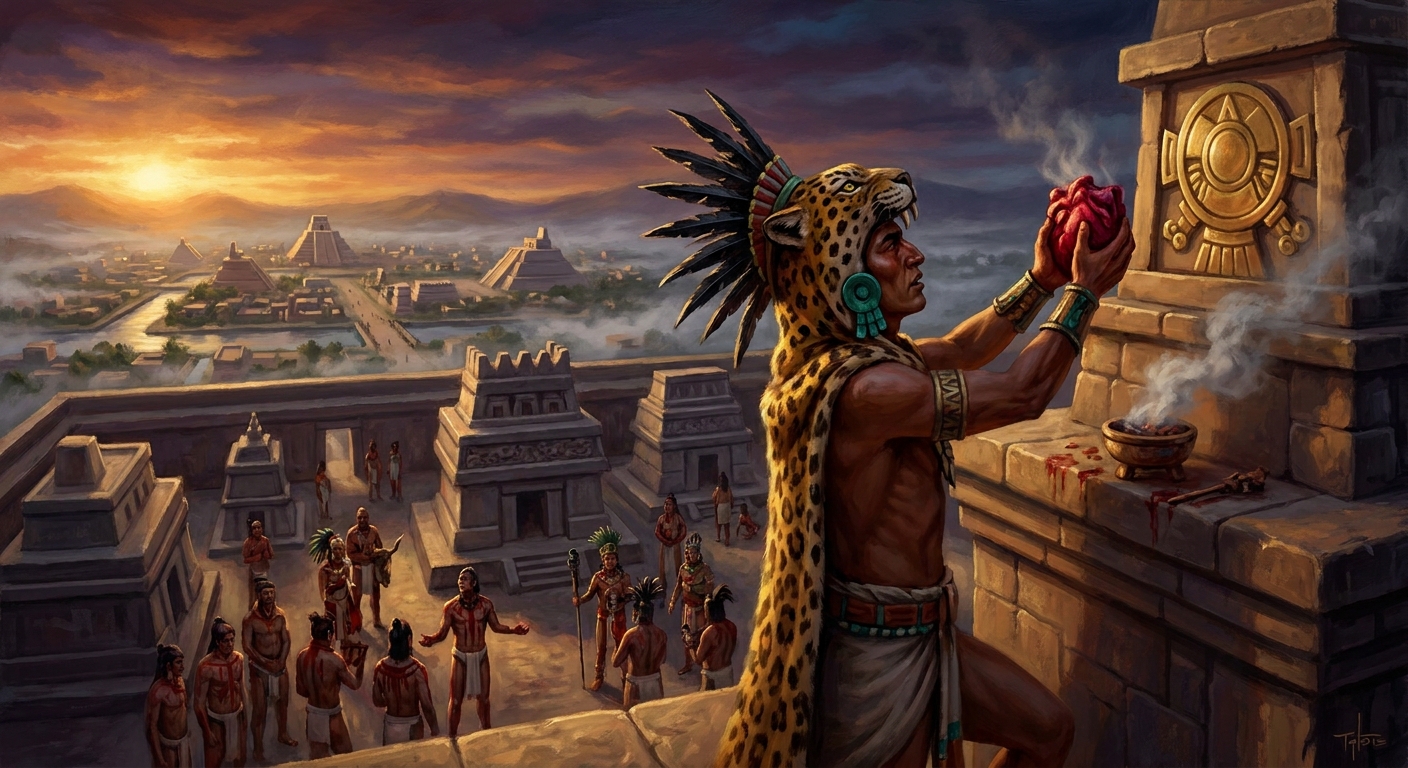
He spoke into the ear of the head priest while the people slept. He said: Walk further. There is no home for you here. He said: I will give you a sign. Until you see the sign, do not stop. He said: You are not Aztec; you are Mexica, and your name will be the name of a city. He told them to mortify themselves with maguey thorns. He told them to take a captive at every encampment. He told them that he was hungry and would be hungrier, and that he must always be fed, because he was the sun, and the sun is a warrior who fights every night against the darkness and must be given strength.
The walk was two hundred years long. The codices show it as a string of footprints across the page, with each stop drawn as a small glyph: a hill, a cave, a tree split by lightning. They settled, sometimes for decades. They were driven out, sometimes after one season. Other peoples — the Toltecs in their decline, the Tepanecs of Azcapotzalco — took them in as mercenaries and then expelled them as troublemakers. The Mexica practiced the customs Huitzilopochtli had given them, which were strange and bloody, and they were not popular.
In 1323 they came to Lake Texcoco in the great valley, and the lord of Culhuacan let them settle on the southern shore on the condition they fight his wars. They fought well, perhaps too well. They asked the lord for his daughter to make her queen — and then, following an instruction from Huitzilopochtli that no one has ever been able to soften, they sacrificed her and a priest wore her skin to a feast. The lord of Culhuacan, when the priest emerged in his daughter’s flayed face, drove them into the marshes of the lake, into the worst land, the swamp islands no one wanted.
It was on one of those islands, on a morning the chronicles place in 1325, that the head priest looked up and saw it. A great eagle was perched on a nopal, a prickly-pear cactus, growing from a stone that rose out of the marsh. In its beak the eagle held a serpent. The eagle was eating the serpent. The priest fell to his knees. The Mexica fell to their knees. This is the place, Huitzilopochtli said inside their heads. This is what I promised. Build your city here on this stone.
They built it on the marsh, on platforms driven into the mud, on chinampa-gardens dredged from the lake. They called it Tenochtitlan, “the place of the cactus on the stone.” Within two centuries it would be one of the largest cities on earth, with three causeways crossing the water, with a great pyramid where they kept Huitzilopochtli’s bundle, with markets and aqueducts and a hundred thousand inhabitants. The Spaniards who saw it in 1519 thought they were dreaming. But the Aztecs remembered the marsh. They remembered the long walk. They remembered the priest with his back bent under the bundle, and the voice in his ear, and the eagle on the cactus on the stone. They knew exactly how they had gotten there, and they knew exactly what they owed.
Echoes Across Traditions
Entities
- Huitzilopochtli
- Coyolxauhqui
- Coatlicue


Sources
- Crónica Mexicayotl (Tezozómoc)
- Florentine Codex, Books 1, 3, 12 (Sahagún)
- Codex Boturini (Tira de la Peregrinación)