The Ten Courts of Hell
The eternal present of judgment — each soul passes through at death · The underworld beneath the earth — the Yellow Springs and the ten courts below them
Contents
After death, every soul passes through ten courts presided over by ten kings who weigh each life against the Mirror of Karma — and the punishments designed for the wicked are so precisely calibrated to the crime that the system is less a threat than a cosmological account of how actions and consequences are connected.
- When
- The eternal present of judgment — each soul passes through at death
- Where
- The underworld beneath the earth — the Yellow Springs and the ten courts below them
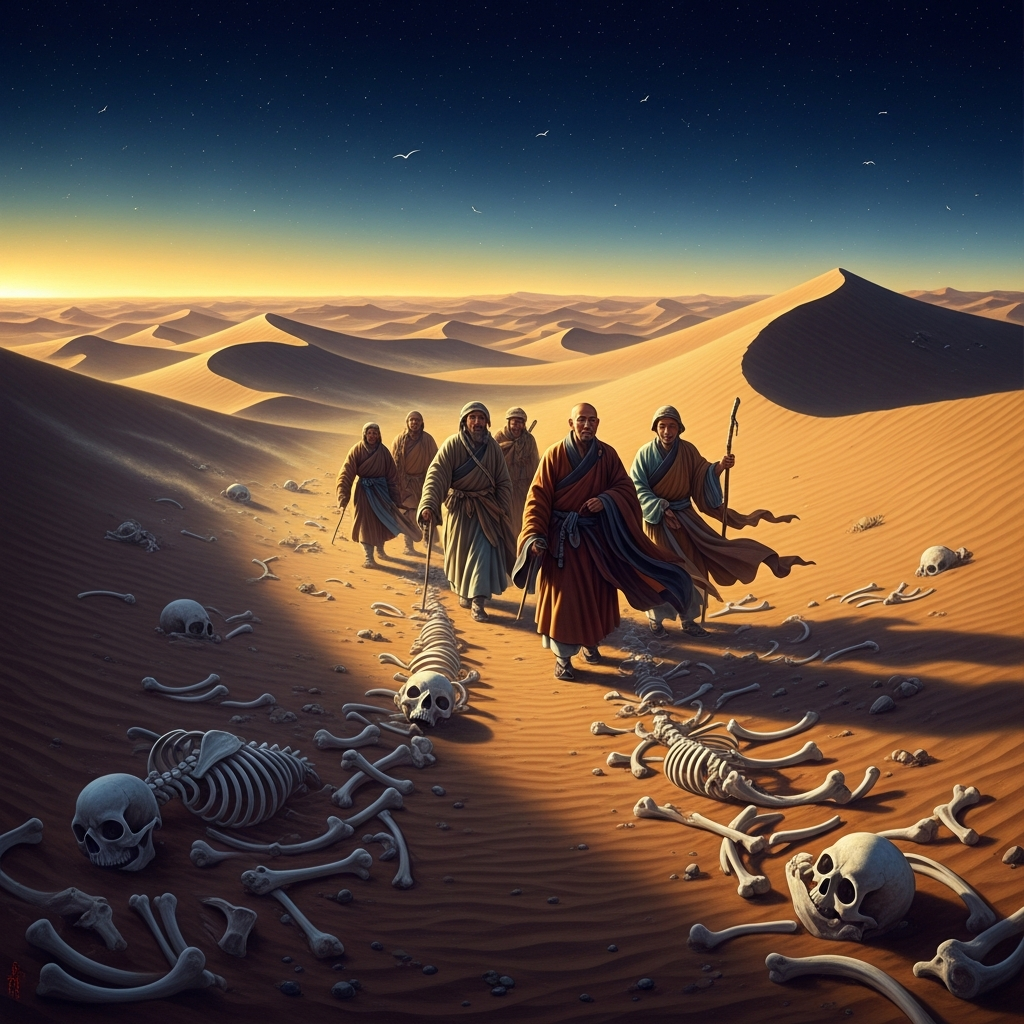
After death, the soul sets out on the road to the Yellow Springs.
The road is well-traveled. There is an escort — the soul does not go alone, the Chinese tradition is specific about this, there are guides and demons depending on the moral state of the soul and the circumstances of death. The Yellow Springs is the first underworld — the misty gray realm that the ancient Chinese imagined as the destination of all souls, before the Buddhist influence elaborated it into the Ten Courts.
With the Buddhist courts, the underworld becomes administrative.
The First Court is presided over by Qin Guang Wang. He receives the newly dead and examines their lives in the Mirror of Karma — a mirror that shows not what the soul wishes to present but what the soul has actually done. Every action, every thought that produced action, every relationship and its quality. The mirror does not forgive, does not prosecute — it reflects. Souls whose lives show sufficient merit are sent directly to the highest heavens or reborn in good circumstances. Souls who are complicated — which is most souls — proceed to the further courts.
The further courts are specialized. Each King of Hell handles specific categories: the court for those who did not honor their parents, the court for those who exploited the vulnerable, the court for those who cheated in their business dealings, the court for those who were cruel to animals, the court for those who used words to destroy the innocent. The punishments are famous in Chinese popular religion and are depicted in the illustrated scrolls hung in temples precisely so that the living can contemplate what the dead experience: the tongue-pulling for liars, the mirror-gazing for the vain, the grinding-stone for the exploitative merchants.
The punishments are not eternal. This is the crucial distinction between the Chinese hell and the Christian one: the Buddhist hell is a purgatory of calibrated duration. You suffer the consequence of your actions in precise proportion to what you did, and then you are released for rebirth. The hell is the educational institution of consequence, not the permanent prison of damnation.
The Tenth Court is the exit.
Yama — Yanluowang, the King of Hell in Chinese form, the transformation of the Hindu Yama through a thousand years of Buddhist transmission — presides over the final assignment. He reviews the soul’s record of birth, death, and the purgation of the courts. He assigns the soul its next form: human, animal, ghost, or deity, based on the remaining karma after all the courts have done their work.
Before rebirth, the soul reaches the Bridge of Forgetfulness, where Meng Po waits with her broth. Meng Po has been at her station since the beginning of the current cycle of the universe. She is old and patient and entirely impartial. Her broth — the Soup of Forgetfulness — erases the memory of the previous life, of the courts, of the judgment and the suffering and the lessons of the underworld. The soul drinks, crosses the bridge, and is born again: clean, empty of memory, carrying only the karma that could not be erased, the accumulated inclinations of a character shaped by lifetimes no one can remember.
This is the circuit: life, death, judgment, purification, forgetting, life again. The Ten Courts are the mechanism of moral consequence built into the universe’s structure. The Mirror of Karma does not lie. The Kings of Hell do not negotiate. Meng Po does not let anyone keep their memories.
What carries forward is not knowledge but character — the shape the soul has taken through all its choices, which cannot be forgotten because it was never stored as a memory but as a disposition, as the thing the soul is after everything it has been through. That is what gets reborn.
Echoes Across Traditions
Entities
- Yama (King of Hell, Yanluowang)
- the Ten Kings of Hell
- Judge Cui (the Record Keeper)
- Meng Po (the Lady of Forgetfulness)
- the Mirror of Karma
Sources
- Yuli Baochao (玉曆寶鈔) / Jade Register — popular Chinese account of the ten courts
- Teiser, Stephen, *The Scripture on the Ten Kings* (Hawaii, 1994)
- Wolfram Eberhard, *A Dictionary of Chinese Symbols* (Routledge, 1986)
- Valerie Hansen, *Changing Gods in Medieval China* (Princeton, 1990)