Contents
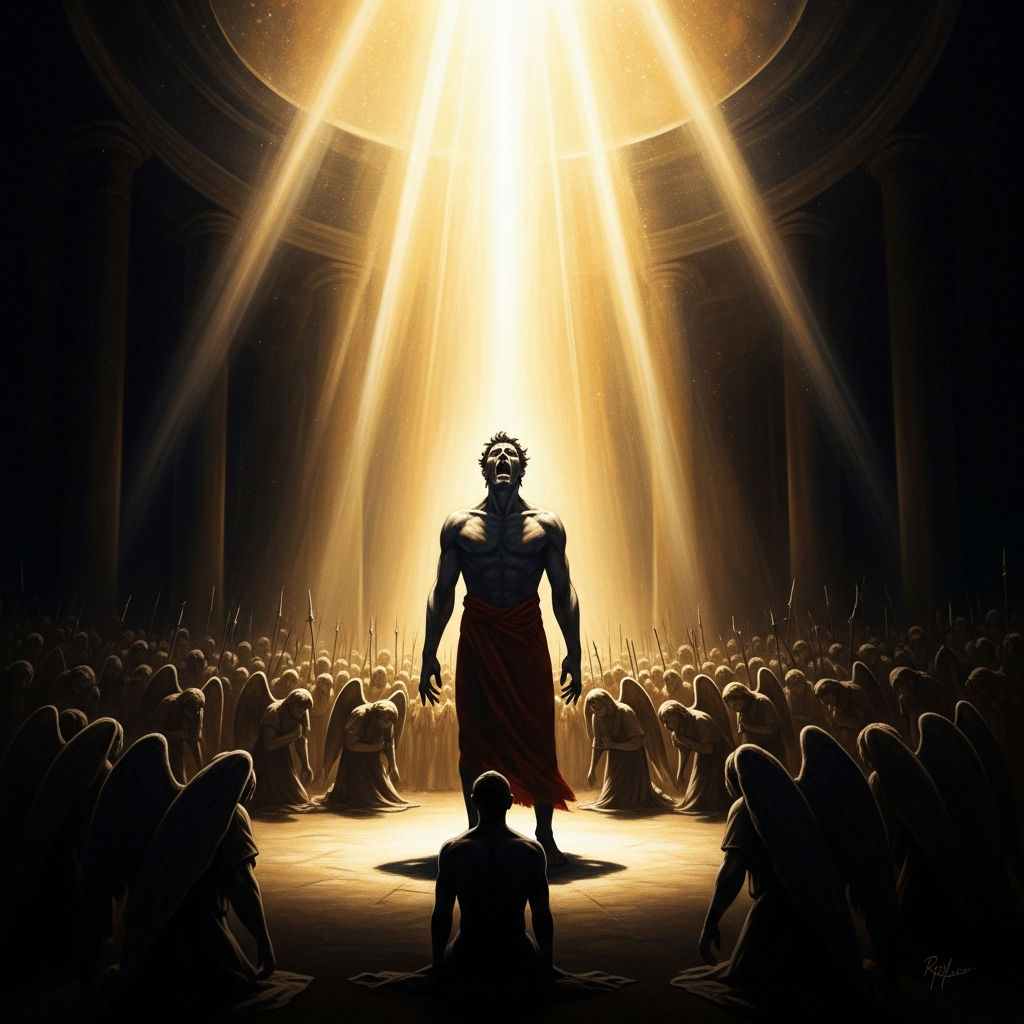
Allah forms Adam from clay and breathes the divine spirit into him, then commands every angel to bow before this newly minted creature. They all bow except one. Iblis — once the most devoted of the worshippers, made of fire rather than clay — looks at Adam and says no. He will not lower himself to dirt. The first refusal of the universe is recorded. Iblis is cast out, and from then until the Last Day he will whisper into the chest of every descendant of Adam.
- When
- c. 700–900 CE (Qur'anic narrative compiled and elaborated)
- Where
- The first heaven, the celestial court of Allah, where the angels stand in ranks before the throne and where the first man is presented as a finished creation
The Qur’an tells the story in pieces.
It is referred to seven times across seven different suras — al-Baqara, al-A’raf, al-Hijr, al-Isra, al-Kahf, Ta-Ha, Sad — each time slightly differently, each time emphasizing a different facet. Together, the seven retellings build a single composite story, the foundational moment of evil in the Islamic cosmos.
The setting is the divine court at the moment of Adam’s creation.
In the Islamic understanding, Allah did not create humans first. The angels came earlier — formless beings of light, ranged in their celestial choruses, devoted to praise without rest. The jinn came earlier still — spirits made of smokeless fire, more variable than the angels, more independent, capable of obedience or disobedience. Among the most devoted of all worshippers was a being whose name was, in some traditions, Azazil — though the Qur’an calls him Iblis — and who, depending on the text, was either an angel of unusual rank or, more likely, a particularly elevated jinn who had been raised to angelic company by his devotion.
For uncountable ages, Iblis had stood among the angels and praised. The texts make clear: he had not been a marginal figure. He had been one of the principal voices of worship. He had been, in some commentaries, the leader of the angels’ praise-song — the choirmaster of the celestial throne.
Then Allah announced that he was going to create Adam.
—
Allah took clay.
The Qur’an specifies the material precisely. He took salsalin min hama’in masnun — sounding clay made from black mud, shaped — and he formed it into the shape of a man. He let the figure rest. He breathed into it from his own ruh — his spirit, his breath, his sanctified life-current. The clay figure became living flesh. Adam stood up.
This is the first creation of humanity in Islamic cosmology, parallel but distinct from the Genesis account; the Qur’anic version emphasizes specifically that the breath given to Adam is divine, not generic — that humans contain, by design, a spark of the breath of God, not as a metaphor but as a created reality.
Adam was now a complete creature. Allah taught him the names of all things — names of every creature, every plant, every angel. Adam learned them all. Allah then summoned the angels and tested them on the names. The angels could not answer; they had been told only what they needed to know for their worship. Allah commanded Adam to teach them. Adam, the first being to know the names, recited them to the angels, and the angels marveled.
It was at this point — Adam standing in the celestial court, surrounded by the angels who had just been instructed by him — that Allah issued the command.
He said: Bow.
He commanded every angel, every being in his court, to bow before Adam in honor.
The angels bowed.
All of them, immediately, lowered their luminous heads. The celestial floor was filled with bowing forms.
All except one.
—
Iblis remained standing.
The Qur’an records the silence that followed. Allah, who knew before he asked, asked nonetheless: Iblis, what kept you from prostrating when I commanded?
Iblis answered.
The answer is one of the most famous statements in the Qur’an. It is recorded with slight variations across the seven retellings, but the substance is the same:
I am better than him, Iblis said. You created me from fire, and you created him from clay.
He gestured at Adam — formed of mere mud, of the dirt of the earth, the lowest of materials — and at himself — formed of smokeless fire, of light, of the higher element. He could not, he said, bring himself to bow before something so much lower in the hierarchy of being than he was. To bow to fire’s superior, to bow to Allah, was natural. To bow to clay’s wretchedness, to bow to a freshly molded earthen thing, was beneath him.
The argument was, by certain logics, rational. Fire is, in the cosmological hierarchy of the ancient world, a higher element than earth. The Qur’an does not argue this point. It simply says: Iblis offered the comparison, and the comparison was wrong.
Allah’s response is brief and absolute:
Get out. You are cursed. You are accursed until the Day of Judgment.
Iblis was stripped of his rank. He was expelled from the celestial court. The fire of which he was made now became the fire by which he would be punished. He fell out of the heavens.
—
But the Qur’anic story is not finished here.
Iblis, falling, looked back. He had a request.
He said — and the boldness of the request is part of why later mystics found Iblis fascinating — Lord, give me a reprieve until the Day they are resurrected. Let me live. Let me have until the end of the world.
Allah granted it.
The reprieve was not mercy. It was something stranger. Allah granted Iblis the lifespan of the human age — the entire stretch from Adam to the Day of Judgment — for a specific purpose: Iblis would now serve as the test of humanity. He would have access to the descendants of Adam. He would whisper. He would tempt. He would lead astray those whose hearts inclined toward being led astray. The strong of faith would resist him; the weak would yield. Iblis would, by his own efforts, separate the saved from the damned.
Iblis, in falling, accepted the role. He swore — and this is the part the Qur’an records with particular vividness:
By Your might, Iblis said, I will tempt them all. From in front and from behind, from their right and from their left. I will sit on the straight path and divert them. I will not stop until the Day of Judgment.
Allah replied: Go then. And whoever follows you, hell will be their place.
—
The first human Iblis tempted, of course, was Adam.
Adam and his wife Hawwa (Eve) had been placed in the garden — the heavenly garden, in the Islamic narrative, not yet earth — and told they could eat from any tree except one. Iblis came to them. He whispered to them. He suggested that the forbidden tree was, in fact, the tree of immortality, and that Allah had prohibited it precisely because eating it would make them eternal like the angels. They ate. They were expelled. The story, familiar in its broad outline from Genesis, plays out — but in the Islamic version, Adam and Hawwa repent, are forgiven, and are sent down to earth not as cursed sinners but as the founding caliphs of the world. Iblis, however, is not forgiven. The choices were made; the trajectories diverged.
Iblis, from then until now, has been on his work. The Qur’an describes his methods in detail. He whispers (waswasa) into the chests of human beings. He suggests. He distorts. He makes ill deeds attractive. He uses the soft spots in the human will: pride, lust, greed, despair. He cannot force; he can only suggest. Each human, in the Islamic understanding, has the freedom to refuse him.
The Islamic prayer that one says at the start of recitations of the Qur’an — a’udhu billahi min ash-shaytan ir-rajim, I take refuge with Allah from Satan the rejected — is a daily acknowledgment that Iblis is whispering. The whisper is real. The freedom to ignore it is also real.
—
The Sufi mystical tradition has read Iblis differently from the orthodox tradition, and the difference is one of the most fascinating chapters in the history of religious thought.
The orthodox reading is straightforward: Iblis fell because of pride. His sin is the prototype of all sin — the ego placing itself above the divine command. Believers should learn from his example to bow when commanded.
The mystical reading, beginning with the great Sufi martyr al-Hallaj (executed in Baghdad in 922) and developed most elaborately by Ibn Arabi (d. 1240), is different.
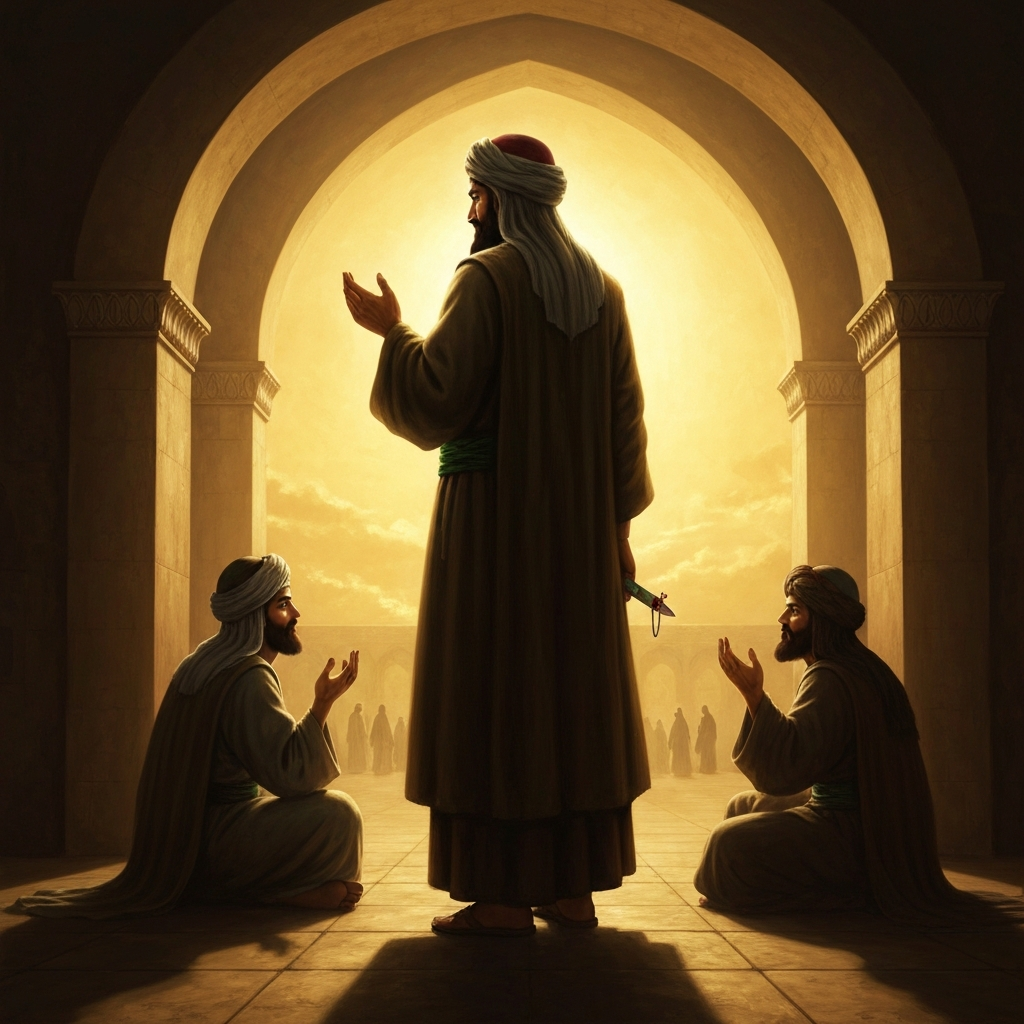
The mystics noticed something. Iblis’s refusal to bow before Adam was, in a strict sense, an act of pure monotheism. Iblis refused to worship anything other than Allah. When commanded to bow before a creature — even a creature shaped by Allah’s hands and given Allah’s breath — Iblis refused. He bowed to Allah alone. This is, the mystics argued, exactly what every monotheist should do: refuse to bow to anything but the One.
Iblis’s tragedy, in the Sufi reading, is not pride. It is the deepest possible love of God expressed in the wrong moment. He was so devoted to the principle worship none but Allah that he refused even when Allah himself ordered the bow. He chose pure monotheism over obedience. He chose the principle over the command.
The mystics found this almost unbearably moving. Hallaj said openly that Iblis was, in his refusal, the truest worshipper in the universe — the lover so dedicated that he would accept eternal exile rather than betray his understanding of his Beloved. I will accept hell, the mystical Iblis says, but I will not bow to anything but God.
This is a heretical reading by orthodox standards. Hallaj was executed for it (and for related claims). But the mystical Iblis has continued to haunt Sufi poetry, theology, and mystical practice for a thousand years. Rumi mentions him sympathetically. Attar wrote whole tales of mystical Iblis. Ibn Arabi gave him a chapter. He is one of the great unresolved figures of Islamic spiritual literature — both the cursed deceiver of the orthodox tradition and the perfect monotheist of the mystical reading, simultaneously.
—
He is still working.
That, at least, is the universal Muslim understanding. Iblis was given his reprieve until the Day of Judgment. The Day of Judgment has not yet arrived. He is therefore, by the terms of his own oath, still active — still whispering, still on the path, still suggesting to each new human born onto the earth that the various forbidden trees might in fact be the trees of immortality.
The discipline of Islamic spiritual life, in part, is the discipline of recognizing his voice when it speaks in your chest.
The voice that says you are above this person — that voice is Iblis’s.
The voice that says the rule does not apply to you, you are special — that voice is Iblis’s.
The voice that says bow only when bowing is comfortable — that voice is Iblis’s.
The voice that says fire is better than clay — that voice, more than any other, is Iblis’s.
When the voice comes, the practice taught by the Prophet is to say: a’udhu billahi min ash-shaytan ir-rajim. I take refuge with Allah from Satan the rejected. The voice does not always go quiet. But the voice is named, and being named, it loses some of its power. The first refusal in the universe was Iblis’s. Every refusal of his whispers, in the Islamic understanding, is the descendant of Adam’s small daily counter-statement against the original no that fell out of the heavens trailing fire.
Scenes
Allah's celestial court at the moment of Adam's presentation
Iblis — taller than the angels, his form woven of smokeless fire, his face beautiful and adamant — argues with the divine voice
Iblis falling from the celestial heights, his fire trailing in long banners
Echoes Across Traditions
Entities
- Iblis (Shaytan)
- Adam
- Allah
- The Angels
Sources
- *Qur'an* — Suras 2 (al-Baqara), 7 (al-A'raf), 15 (al-Hijr), 17 (al-Isra), 18 (al-Kahf), 20 (Ta-Ha), 38 (Sad)
- Tabari, *Tarikh al-Rusul wa'l-Muluk* (c. 915 CE)
- Ibn Arabi, *Fusus al-Hikam* (c. 1230 CE)
- Peter Awn, *Satan's Tragedy and Redemption: Iblis in Sufi Psychology* (1983)