Contents
Indra has just rebuilt his palace in the heavens — gilt towers, jeweled gates, gardens that change at his thought — and he keeps demanding new wings, new annexes, more grandeur. The architect Vishvakarma, exhausted, complains to Brahma. A small boy appears at the gate. He looks at Indra's palace, smiles, and asks how many Indras have built it before.
- When
- c. 800 CE (Brahmavaivarta Purana; mythic time)
- Where
- Indra's palace Amaravati, in the heavens of Hindu cosmology, on the slopes of Mount Meru
Indra has been busy.
He is the king of the gods of the Vedic pantheon — wielder of the thunderbolt, slayer of Vritra, the dragon who held back the rivers, the lord of storms and rain and the heavens. He has just emerged from a major victory, killed the world-eating serpent, freed the waters, restored cosmic order. He is, in his own assessment, the most successful Indra there has ever been.
To celebrate, he has commissioned a new palace.
The architect is Vishvakarma — the divine craftsman, the engineer of the gods, the one who built Indra’s previous palaces and the chariots of the sun and most of the great cosmic apparatus. Vishvakarma is the only craftsman in the universe equal to Indra’s appetites.
The palace begins simply. Indra describes a hall. Vishvakarma builds it. Indra is delighted.
Then Indra has a thought.
The hall is beautiful, yes — but a hall this beautiful needs an antechamber to match. Vishvakarma builds the antechamber. Indra is pleased.
But of course, an antechamber leads onto a courtyard, and a courtyard requires a fountain, and the fountain requires a garden, and the garden requires a flower-house with hummingbirds, and the flower-house requires a balcony with a view of the seven peaks of Mount Meru, and the balcony requires a tower, and the tower requires —
Vishvakarma builds it all. He works for years. Months pass into years. He sleeps less. He grows thin. His wife begins to forget what he looks like.
Every time he comes to Indra to announce that the palace is finished — here is the final wing, my lord, the work is complete — Indra walks through it, admires, frowns, and begins to describe a new wing he has just thought of. Beside the eastern garden, he says. I want a hall of mirrors that reflect every age. I want a chamber where the seasons all coexist. I want a roof that opens to whichever constellation is overhead.
Vishvakarma builds it.
This goes on. And on. The palace grows into something so vast and intricate that not even the gods themselves can map it any longer; entire wings exist that no one has visited; the kitchens have kitchens.
Vishvakarma reaches the end of what a single craftsman can do. He goes to Brahma — the creator god, who is supposed to know how to handle situations like this — and he kneels and begs for relief.
Lord, my king’s appetite has no end. He thinks of new towers in his sleep. I cannot keep building. I cannot stop. He will not let me retire. Please, do something.
Brahma considers. He says he will see to it.
—
Brahma goes to Vishnu — the preserver, the one who steps in when cosmic balance has tilted — and lays out the situation. Vishnu listens, smiles slightly, says he will handle it personally.
Vishnu does not arrive in glory. He does not arrive on his eagle Garuda or in his blue-skinned, four-armed cosmic form. He arrives, instead, as a small boy.
He is dark-skinned. He wears a simple yellow loincloth. He has the soft round belly and the slow walk of a child of seven or eight. He carries nothing. He simply appears, one morning, at the gate of Indra’s new palace, and asks the guards if he might speak with the king of the gods.
The guards, accustomed to processions of dignitaries, are baffled. They report it. Indra, intrigued by the audacity of a single child arriving alone, agrees to see him.
The boy is brought into the throne room. He looks around without much interest. He looks up at the gilded ceiling, at the lapis throne, at Indra in full regalia. He smiles a small private smile, as if a joke he has been told privately has just become more amusing.
Indra, somewhat charmed, asks the boy his business.
The boy says, in a voice that is not quite a child’s voice, I have heard, lord of the gods, that you are building a palace. I wanted to come and see it. I wanted to ask: how does it compare to the palaces built by previous Indras?
Indra blinks.
Previous Indras?
Yes, the boy says, still smiling. You are not the first Indra. You are not the second. You are not even close to the most recent. There have been many Indras. There will be many more. Each one builds a palace. I am told yours is shaping up to be impressive. I wanted to see how it stacks up against the others.
Indra has begun to feel something cold in his chest.
He says, carefully, What do you mean, child? I am Indra. There is one Indra.
The boy laughs softly.
You are this Indra. The current Indra. There have been an unimaginable number before you. Each one believed, as you do, that he was the only one. Each one built a palace, sometimes finer than yours, sometimes less. Then his kalpa ended. The universe dissolved into the body of Vishnu. Vishnu slept on the cosmic ocean. Eventually he dreamed a new lotus from his navel. Brahma was born from the lotus. Brahma created a new universe. A new Indra rose to be its king. A new palace was built.
This has happened, the boy says, more times than there are grains of sand on a long beach.
Indra is no longer breathing easily.
—
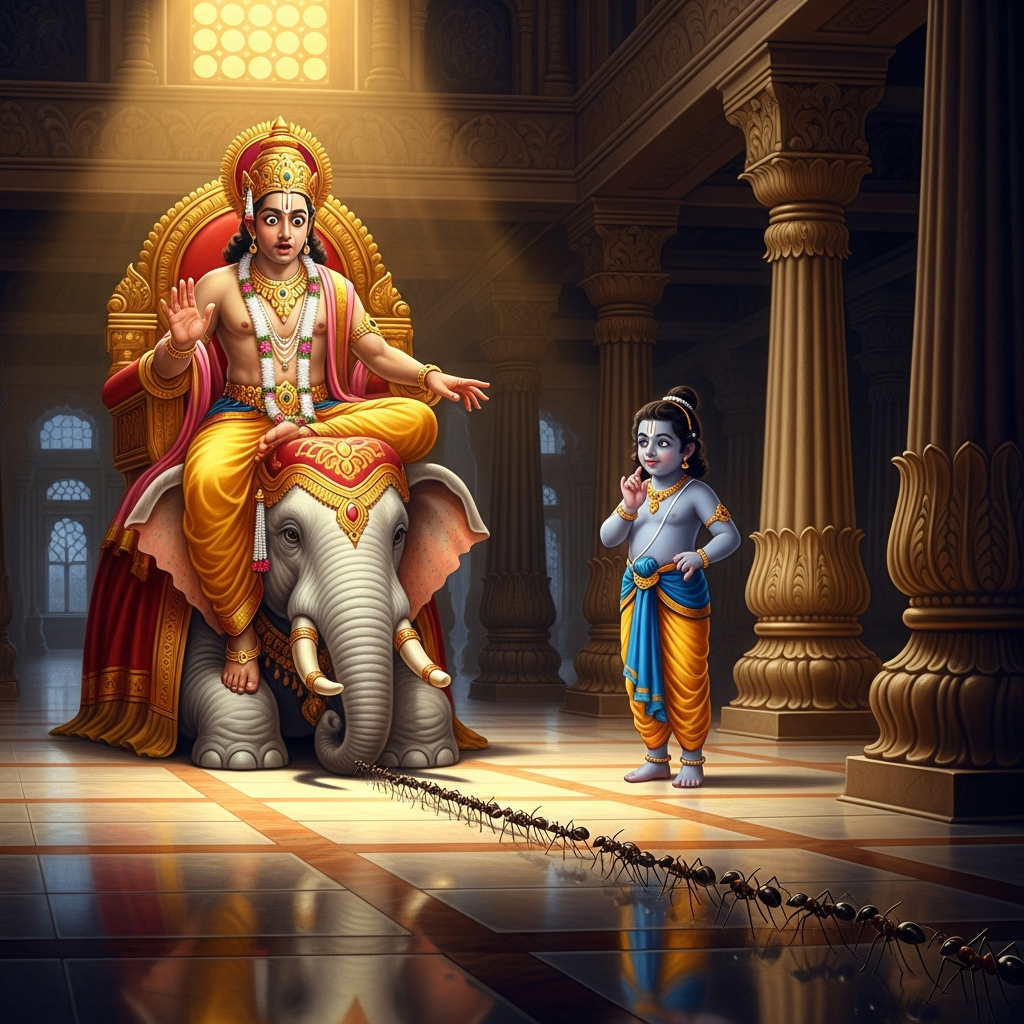
At that moment, a parade of ants begins to cross the marble floor of the throne room.
They emerge from a crack at the base of one wall. They march in a long single column across the polished stone — thousands of them, tens of thousands, an unbroken line — toward a crack in the opposite wall. They are in no hurry. They are not aware they are crossing a throne room.
The boy points.
Indra looks down. He sees the ants. He sees the column. He looks back at the boy.
The boy says, gently:
Each of those ants, lord, was once an Indra.
Indra cannot speak.
Each of them, the boy continues, ruled the heavens for the duration of his kalpa. Each built a palace. Each thought himself supreme. Each, when his time was over, was reborn — sometimes as a king, sometimes as a god, sometimes as an animal, sometimes, eventually, as an ant. They are walking across your floor. They do not know who you are. You do not know who they were. The wheel turns.
Indra sits very still on his throne.
The boy is no longer there.
In his place, for a flickering moment, stands Vishnu — dark blue, four-armed, smiling — and then the throne room is empty of him too, and only the ants remain, marching their long line across the lapis floor, none of them looking up.
—
Indra stops the construction.
He calls Vishvakarma in. He thanks him. He releases him. He tells him to go home, sleep, return to his wife, build no more palaces.
Indra himself becomes, for a long while, quiet. The Puranas say he meditates. He thinks about the parade of ants. He thinks about the kalpas. He thinks about his own palace and how very much it had begun to feel like the only palace, when in fact it was one in a line he could not see the beginning or end of.
He does not stop being Indra. He does not abdicate. The myth is not about renunciation. He returns to ruling, but with the weight of the ant-parade behind his eyes — knowing that one day his column will cross another god’s floor, and another small boy will lean over and explain to that god what his own walking line is.
This is the gift the Hindus gave the world: not the end of pride, but the cosmic context for pride. The palace is real. The palace is also a temporary structure on a floor that has been crossed by a great many palaces and will be crossed by many more. The trick is to keep building — Indra is still the king of the gods, after all, and rain still has to come — without forgetting which floor you are standing on.
Scenes
Indra on his lapis throne in Amaravati, gesturing impatiently at architectural plans while the haggard architect Vishvakarma stands holding a scroll
A small dark-skinned boy in a yellow loincloth stands at the threshold of the throne room, smiling faintly
On the marble floor of the throne room, a long line of ants marches across the polished stone — thousands of them, in a column that disappears under one door and emerges under another
Echoes Across Traditions
Entities


Sources
- *Brahmavaivarta Purana* (Krishna-janma Khanda)
- Heinrich Zimmer, *Myths and Symbols in Indian Art and Civilization* (1946) — the canonical retelling
- Joseph Campbell, *The Hero with a Thousand Faces* (1949)
- Wendy Doniger, *Hindu Myths* (1975)