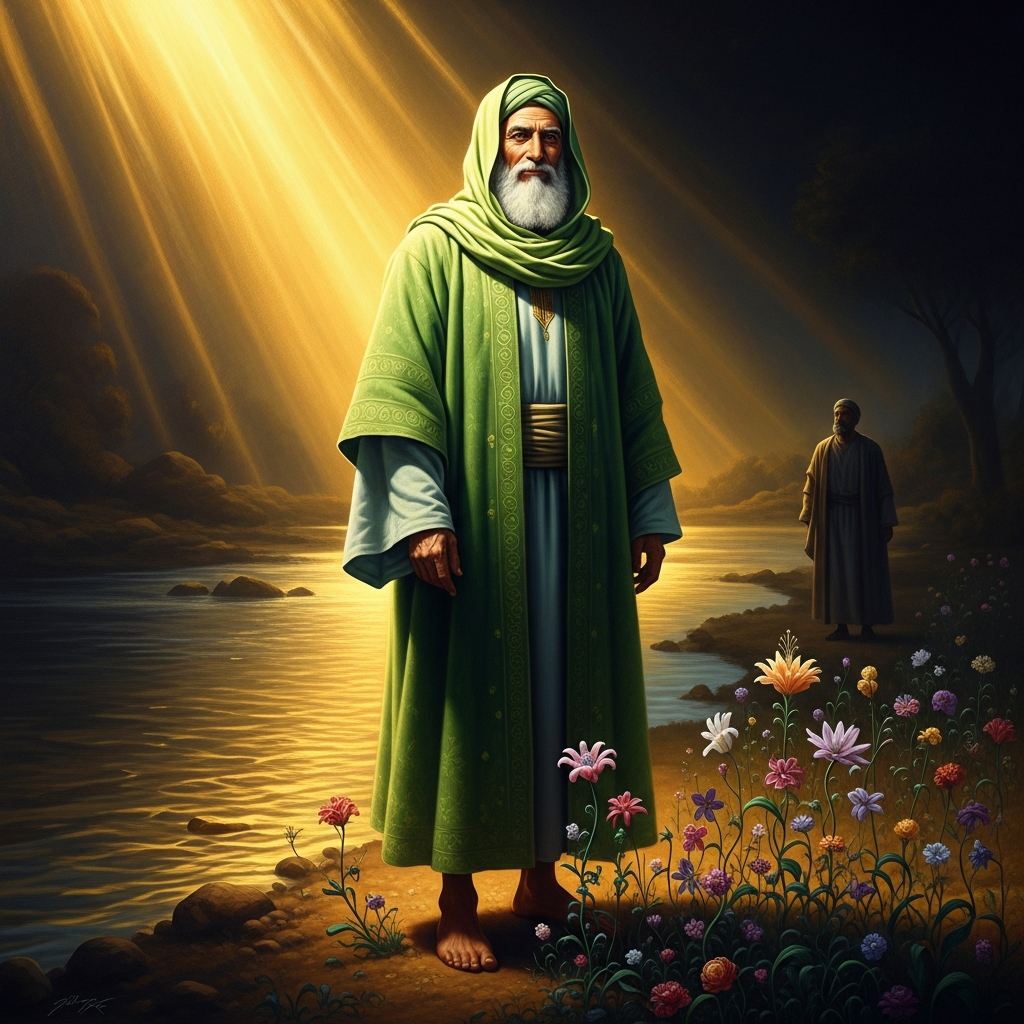
Khidr and the Three Strange Acts
c. 700–900 CE (Qur'anic narrative; Sufi elaboration) · The shore where two seas meet (the Mediterranean and the Red Sea, in some traditions); a fishing village; the wilderness; a town that refuses hospitality
Contents
Moses, the lawgiver, asks God to send him a teacher wiser than himself. He is told to seek a man at the meeting of two seas. He finds him — Khidr, the Green One, immortal, unpredictable. Khidr accepts him as a student on one condition: ask no questions until I explain. Then Khidr proceeds to scuttle a poor man's boat, kill an apparently innocent boy, and rebuild a wall in a town that has refused them hospitality. Moses cannot stop himself from asking why.
- When
- c. 700–900 CE (Qur'anic narrative; Sufi elaboration)
- Where
- The shore where two seas meet (the Mediterranean and the Red Sea, in some traditions); a fishing village; the wilderness; a town that refuses hospitality
Moses had reached, in his own estimation, the limit of his learning.
He had stood at the burning bush. He had returned to Egypt and confronted Pharaoh. He had brought the plagues. He had led the Israelites out of slavery. He had crossed the Red Sea on dry land. He had stood on Sinai and received the Law from God’s own hand. He was, by any reasonable measure, the greatest teacher of his age, and he knew it.
One day, addressing his people, he was asked: Teacher, who is the wisest man in the world?
Moses answered without hesitation: I am.
The answer, the Qur’an implies, was technically true. Moses was the wisest among the people he was leading. But he had said it without qualification. He had said it as if no greater wisdom existed in the world than his own. He had not said Allah is the source of all wisdom; among men, Allah has given me a portion. He had said I am the wisest, and the angels in heaven, hearing, were displeased.
A revelation came to Moses. There is one wiser than you, the voice said. Go and find him. He waits for you at the meeting of two seas.
—
Moses, properly humbled, set out.
He took with him his servant Joshua bin Nun, who would in later books succeed him. They traveled. They walked for what is described, in the various traditional commentaries, as a long time — possibly years. They were looking for the meeting of two seas, which the texts variously identify as the place where the Mediterranean meets the Red Sea via the Sinai peninsula, or where the Indian Ocean meets the Persian Gulf, or, in mystical readings, an entirely metaphysical location not on any earthly map.
They carried, as their food, a salted fish in a basket. The Qur’an specifies this detail because it becomes the marker.
They had been told: when the fish disappears from your basket, you are at the place.
They walked on. The fish was preserved with salt. They expected it to stay where it was. But one day, while they rested at a flat stone by the sea-shore — Joshua holding the basket, Moses asleep beside it — Joshua looked down and saw the fish slip out of the basket of its own accord, hop along the rocks, and slide into the sea. It swam away, alive, as if it had never been salted.
Joshua was astonished but did not, the texts say, wake Moses. He was too tired and possibly too startled. He simply repacked the basket and waited for Moses to wake.
When Moses woke, they continued walking. They walked all day. By evening Moses was hungry. He asked for the fish. Joshua, suddenly remembering, struck his head and said: Master, the fish — at the rock where we rested earlier — the fish came back to life and slipped away into the sea. I forgot to tell you. Satan made me forget.
Moses recognized the sign immediately. That is the place we were sent to, he said. We have passed it.
They turned back.
They retraced their steps to the flat stone by the shore. When they arrived, they found a man sitting there.
—
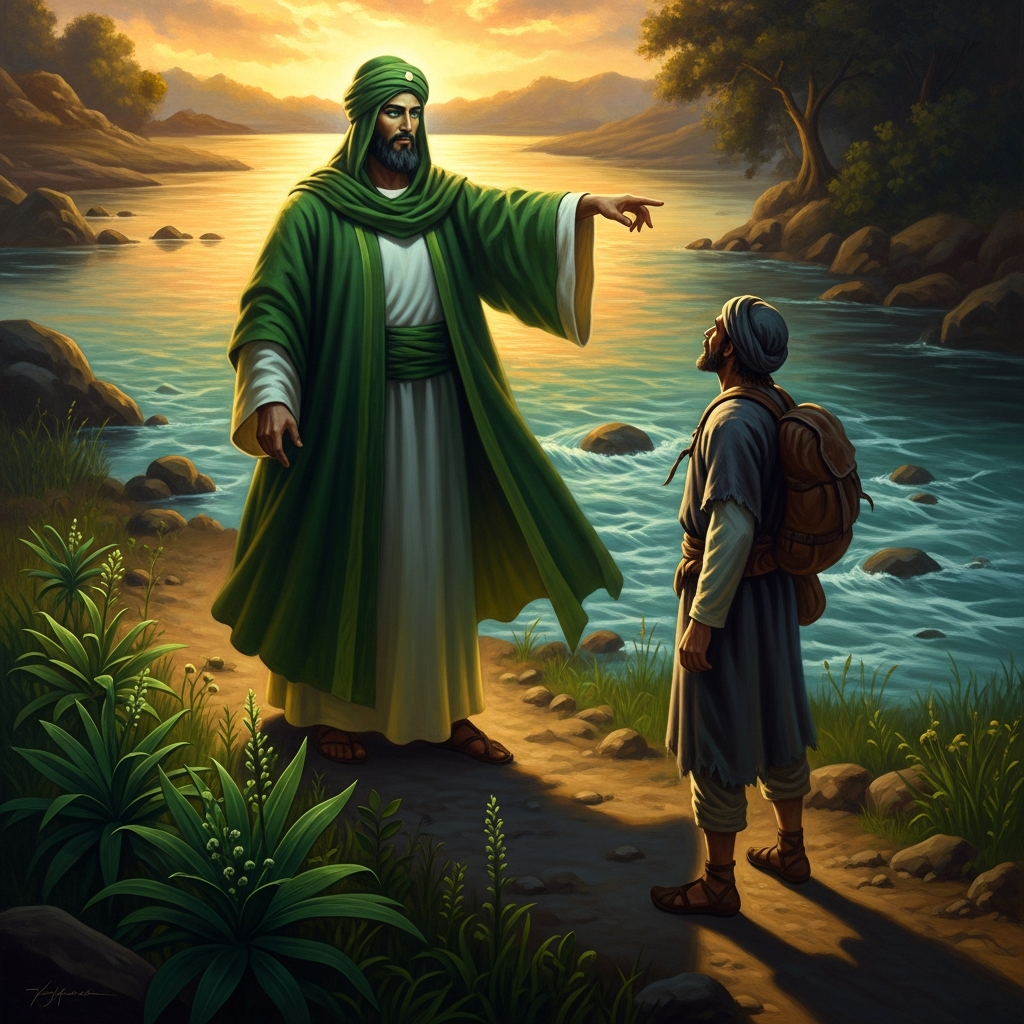
He was an older man — older than Moses, but in a way Moses could not exactly date. His skin was weathered. His eyes were calm. He wore a long green robe — the color from which his name comes, al-Khadir, the Green One, sometimes spelled Khidr — and he was barefoot, with his ankles in the surf. The texts say that wherever Khidr sat for any length of time, green grass and wildflowers sprang up around him, even in the desert; this is one of the reliable signs by which he is recognized.
Moses approached him with respect.
He said, Salaam, may peace be upon you. I have been told to come to you, that you are wiser than I. May I follow you and learn?
Khidr looked at him.
He said, No. You will not be able to bear it.
Moses, with a humility that the Qur’an emphasizes — this was not a Moses puffed up; this was a Moses ready to be a student — answered: You will find me, by the will of Allah, patient. I will not disobey you in any matter.
Khidr considered.
He said, If you follow me, ask me no questions. Whatever I do, do not ask why. Wait until I explain. If you ask before I explain, our companionship will end.
Moses agreed.
—
They walked on together. Joshua, in some commentaries, was sent home; in others, he traveled silently behind them. The story belongs to Moses and Khidr.
The first thing happened on a boat.
They had come to a small harbor. Khidr asked to be taken across a strait of water. The fishermen, recognizing him as a holy man, offered passage for free. They climbed into a small wooden fishing boat. Five people in total — the fisherman, his apprentice, Khidr, Moses, and a sleeping passenger — set out into the strait.
When they were halfway across, in the middle of the open water, Khidr stood up. He took a small hand-axe from his belt. He drove it down into the planking of the boat near the bow. Once. Twice. Three times. The boards splintered. Water began to seep in.
The fisherman shouted. Moses, who had promised silence, could not contain himself.
He said, What are you doing? You have damaged the boat that just took us aboard for free. The owner has shown us kindness, and you sink his livelihood. This is wrong!
Khidr looked at him.
He said, I told you, you would not be able to bear it.
Moses bit his tongue. He apologized. He begged Khidr to continue. Khidr, after a long pause, agreed — but warned him: One more question and we part.
The boat, miraculously, did not fully sink. The damage was bad enough to slow it, leaky enough to require beaching for repair, but the small crew got it to shore. Khidr and Moses left them and walked on.
—
The second thing happened in a town.
They came to a small market square. Children were playing in the street. One of the children — a boy of perhaps ten, by some accounts, well-dressed, the son of a prosperous family — was running with the others, laughing.
Khidr crossed the square to him. He took the boy by the arm. He led him aside, behind a wall, where no one could see. Moses, watching from a distance, did not understand what was happening. Khidr drew a small knife. He killed the boy.
Just like that. Without explanation. Without confrontation. The boy was alive; Khidr’s hand moved; the boy was dead.
Moses ran forward. He could not stop himself. He cried out, What have you done? You have killed an innocent child! He had committed no crime! This is murder! This is —
Khidr looked at him.
He said, I told you, you would not be able to bear it.
Moses fell silent. Khidr added: This is the second question. One more, and we part.
Moses, deeply shaken, agreed to be more disciplined. They walked on.
—
The third thing happened at a town’s gate.
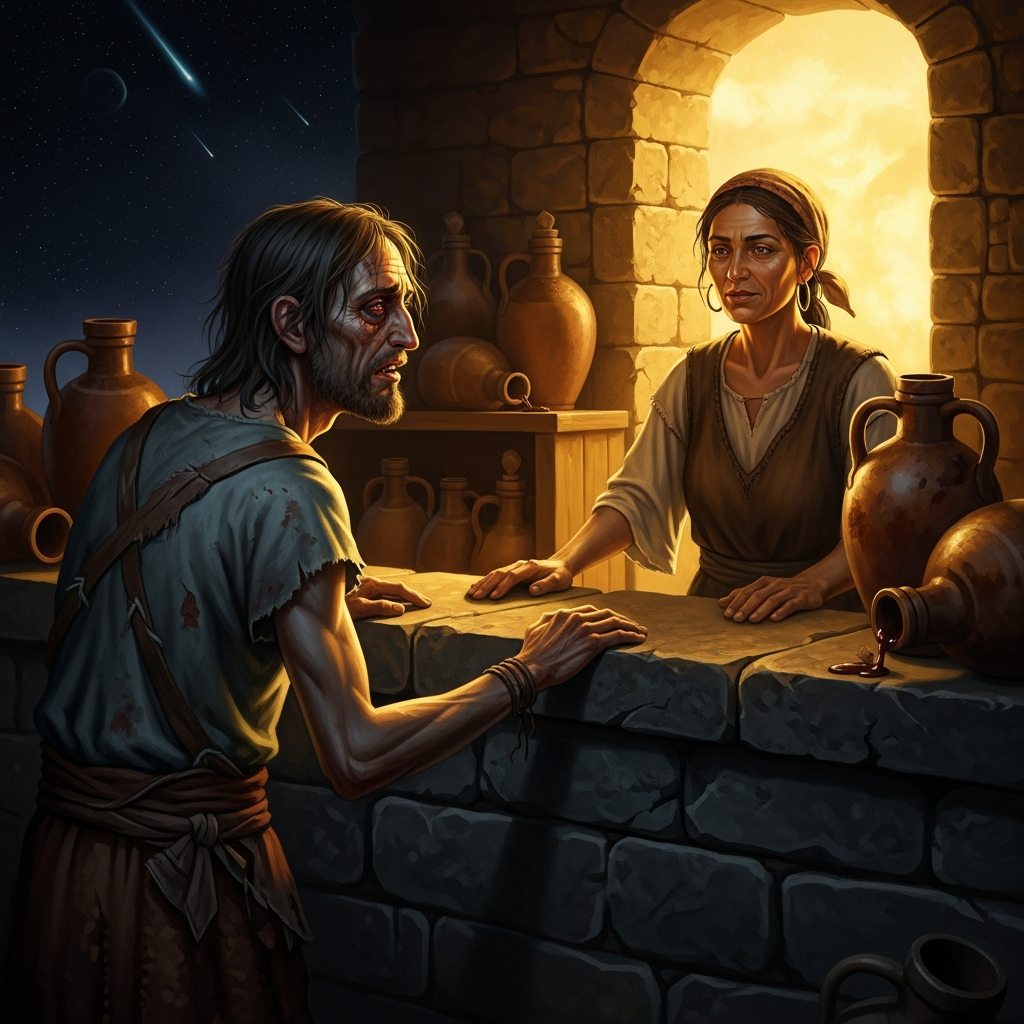
They had been walking for a long time. They were hungry. They reached a town. They asked, at the gate, for hospitality — the basic Middle Eastern ethic of the period required any town to feed wandering travelers, even strangers, and to offer them a place to sleep.
The townspeople refused.
They turned the two travelers away from every door. They were rude. They mocked them. They went back inside and shut the gates.
Khidr and Moses stood outside the town in the dust, hungry, tired, ungiven. Moses was, the Qur’an notes, particularly resentful at this point. He felt the injustice of their treatment.
Khidr looked at the town wall. There was a section that was leaning, half-collapsed. It would, within a season or two, fall over.
Khidr stopped. He took off his outer robe. He said to Moses, Help me rebuild this wall.
Moses, baffled, asked: Why? They have refused us food. They have refused us hospitality. We owe them nothing. Why would we labor for them?
Khidr looked at him.
He said: This is the third question. Now we part.
—
Moses stood there. He understood, finally, that he had failed the test. He had agreed not to ask questions, and he had asked three. The companionship was over.
But before they parted, Khidr explained.
The Qur’an gives the explanations briefly; the Sufi commentators have spent fifteen hundred years amplifying them. Here are the three explanations:
The boat. The boat belonged to a poor fisherman who had a family to support. There was, downstream, a tyrannical king who had been seizing every seaworthy boat he could find for his own purposes — confiscating them by force, paying nothing, leaving the owners destitute. The king’s officers were, at that very moment, traveling along the coast inspecting boats. By damaging the planking, Khidr had made the boat appear unseaworthy. The officers would pass it by. The fisherman would, after a small repair, have his livelihood back. The boat was sabotaged because it was the only way to save it.
The boy. The boy had been growing into something Moses could not see. He had been on a path that, by Khidr’s foreknowledge, would lead him to become a tyrant himself — a future oppressor, a man who would in his maturity kill many. His parents, who were good and pious, would in time have despaired of him; his mother would have been broken by what he became. By taking him while he was still innocent, Khidr had — by the divine plan — preserved him from the sin he was going to commit, preserved his parents from the suffering of watching him commit it, and granted them the consolation of being able to mourn a son who died good rather than to mourn a son who had become a monster. Allah, Khidr explained, would also give the parents another child — a daughter, in some commentaries, who would be a great blessing.
The wall. Beneath the foundation of the leaning wall was buried a chest. The chest contained gold coins — the inheritance of two orphan boys who lived in the town. Their father had been a righteous man who, before dying, had buried the wealth with the intention that it would be discovered when his sons came of age. If the wall had collapsed in its current state, the chest would have been exposed, and the unscrupulous townspeople — who had just refused hospitality to two wanderers and who were, Khidr implied, generally of poor character — would have stolen the gold and the orphans would have been left in poverty. By rebuilding the wall, Khidr had bought time: the wall would now stand long enough for the orphans to grow up and discover the inheritance themselves.
—
Each of the three acts had appeared, on the surface, to be a violation of basic morality — destruction of property, murder of a child, labor for ungrateful people. Moses, the lawgiver, the man whose entire career was built on the proposition that right and wrong are knowable rules, had reacted with the appropriate moral outrage in each case. He had been, in every reaction, completely correct by the standards of the law he had received on Sinai.
He had also been, in every case, wrong about what was actually happening.
This is the foundational Sufi reading of the parable. The zahir — the outer surface, the apparent meaning, the law — is one thing. The batin — the inner truth, the hidden purpose, the level at which divine plans operate — is something else. Moses sees the zahir and reacts properly. Khidr sees the batin and acts according to it. Both are necessary; neither is sufficient. The law is not wrong, and Khidr’s hidden actions are not arbitrary; they are simply operating on different planes.
Khidr departs. He tells Moses, Now you have seen what I see. Now go back. Teach your people. Lead them by the law I cannot use.
Moses returns to his people. He never speaks of Khidr’s three acts in public. The story is told privately, to one or two students. It enters the oral tradition. Centuries later, the Qur’an records it.
—
Khidr, the tradition holds, did not die.
He drank, in some accounts, from the Fountain of Life — the same fountain Alexander the Great is said to have sought and missed. Khidr is one of the four prophets, in Islamic tradition, who are still alive: Idris, Elijah, Jesus, and Khidr. He walks the world. He appears, occasionally, to the truly devout — to Sufis in remote places, to travelers in deserts, to seekers at moments of need. He is recognized by the green: green that springs up where he sits, green clothes, green light around his hands. The Sufi orders have whole literatures of encounters with Khidr. Some of the great Sufi masters claim him as their direct teacher, even though he had been dead, by orthodox reckoning, for two thousand years.
He is the patron of all teachers who must work outside the visible law. He is the patron of all travelers who get lost and meet a stranger who points the way. He is the patron of all moments in which what looks like wrongdoing turns out, decades later, to have been a hidden mercy.
He is also, the texts say, somewhere in the world right now. If you are walking on a beach where two seas meet, and you see a man in a green robe sitting on a flat stone with his ankles in the water and wildflowers growing out of the dry rock around him — be careful with your questions. He may agree to teach you. The law you carry may not survive the curriculum. But the things that look like wounds in your life may turn out, in the end, to have been the small axe-blows that kept the boat from being seized.
Scenes
On the rocky shore where two seas meet, a barefoot stranger in green robes sits on a flat stone, ankle-deep in water
On a small fishing boat at sea, Khidr drives a hand-axe through the planking near the bow
Outside a town's gates at sunset, Khidr and Moses rebuild a collapsed wall stone by stone
Echoes Across Traditions
Entities
- Khidr (al-Khadir)
- Moses (Musa)
- Joshua (Yusha bin Nun)
- The Boy
- The Two Orphans
Sources
- *Qur'an*, Sura 18 (al-Kahf), verses 60–82
- Tabari, *Tarikh* — extended commentary on the Khidr-Moses encounter
- Ibn Arabi, *Fusus al-Hikam* (c. 1230 CE)
- Henry Corbin, *Creative Imagination in the Sufism of Ibn Arabi* (1969)
- Patrick Franke, *Begegnung mit Khidr* (2000)