The Wrathful Couple at the Heart of Reality
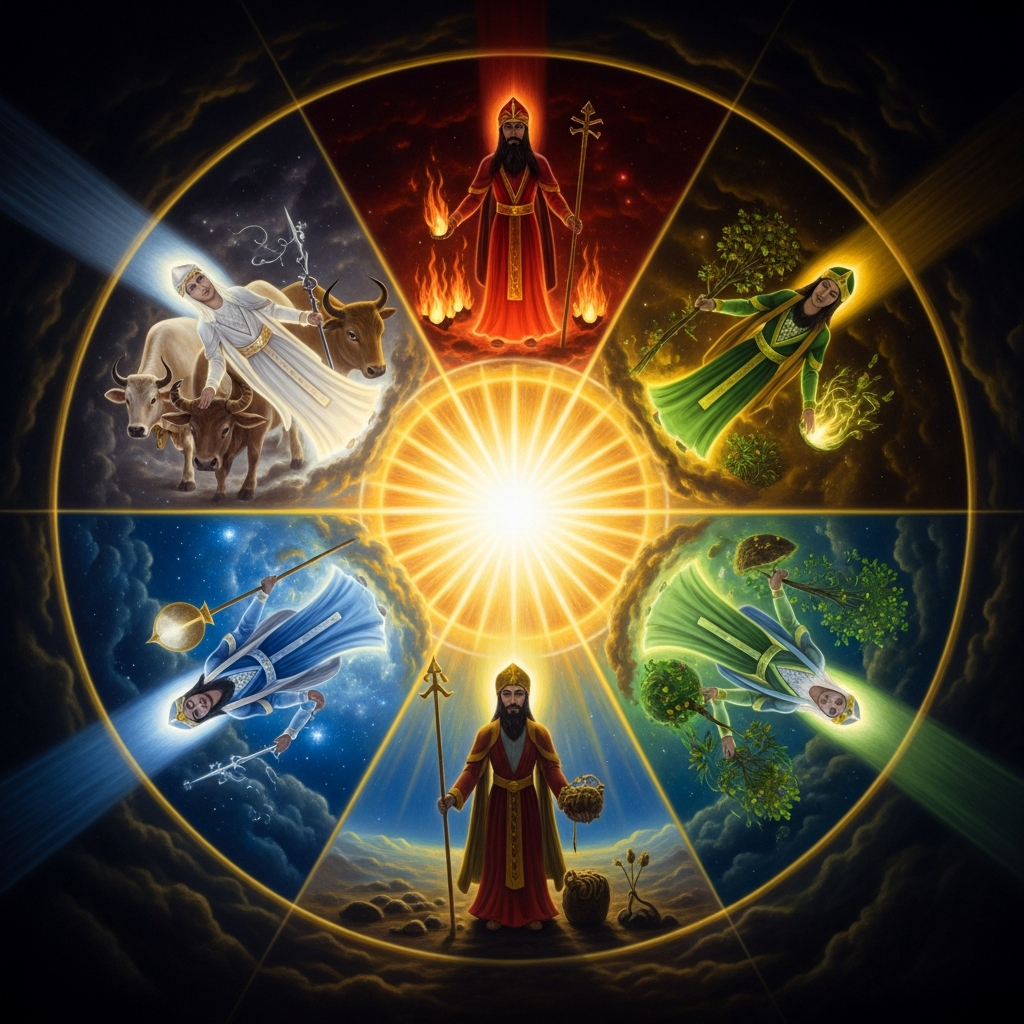
mythic present — the yab-yum teaching is eternal and applies across all Vajrayana practice · The mandala palace at the center of the universe — a space that is simultaneously outer (the mountain) and inner (the practitioner's own body and mind)
Contents
At the center of the Vajrayana mandala stands the yab-yum — father-mother — the wrathful couple in union: not a symbol of sexuality but a map of reality, the inseparability of awareness and emptiness, the union that is enlightenment itself.
- When
- mythic present — the yab-yum teaching is eternal and applies across all Vajrayana practice
- Where
- The mandala palace at the center of the universe — a space that is simultaneously outer (the mountain) and inner (the practitioner's own body and mind)
He is blue. She is red.
This is the primary yab-yum pair in the Cakrasamvara system: Heruka, blue as the sky, and Vajravarahi, red as fire. They stand at the center of the mandala palace. He holds her. She embraces him. The embrace is the iconographic core of the teaching, the image that disturbs those approaching it from outside the tradition and reveals depth to those who have been given the key.
The key is philosophical. The two figures represent two aspects of a single reality that cannot be separated without losing both: rigpa (awareness, the empty knowing quality of mind) and shunyata (emptiness, the unobstructed nature of all phenomena). Awareness that is not empty is consciousness trapped in its own content. Emptiness that has no awareness is nothing at all. The union is the only real thing: awareness that is perfectly empty, emptiness that perfectly knows.
The wrathful aspect is not incidental. The gentle Buddhas — Amitabha, the Medicine Buddha, Chenrezig — represent the same principle in a form that is approachable. The wrathful form of the yab-yum represents it in the form that is complete: fierce, undeniable, beyond negotiation. You cannot politely approach the union of awareness and emptiness and ask it to be less than what it is. The wrathful form is what enlightenment actually looks like from the perspective of whatever is being dissolved.
The practitioner enters the mandala.
In advanced Vajrayana practice, the practitioner does not simply visualize the mandala from outside. Through the dissolution stage of the practice, the practitioner’s own body becomes the mandala palace, and the figures at the center are the practitioner’s own awareness and its empty nature. The union is not something being contemplated — it is what is happening in this moment, in the practitioner’s own mind, when conceptual overlay is suspended.
This is the Vajrayana method: use the vivid, demanding, precise imagination to create the conditions for direct recognition. The visualization of the yab-yum is not an end in itself. It is preparation for the direct recognition that what is visualized is what is already present — that the union of awareness and emptiness at the center of the mandala is the nature of the practitioner’s mind in this moment, not requiring generation, requiring only recognition.
The wrathful forms have this direct quality precisely because they do not allow the practitioner to remain at a comfortable distance. Gentle Buddhas can be contemplated. Wrathful Buddhas demand engagement. The skulls, the flames, the posture of power — these are forms designed to engage the practitioner’s full attention, to prevent the dissociation that allows practice to remain conceptual rather than experiential.
Every element of the yab-yum iconography encodes the teaching.
The ornaments are the five poisons transformed: the skull crown is ignorance transformed into all-encompassing awareness; the bone ornaments are pride transformed into equanimity; the blood ornaments are desire transformed into discriminating awareness. The transformation is not suppression. The ornaments are made of what they represent: the raw material of the poisons has become the jewel of the wisdoms.
The couple does not dance. They stand still at the center of the spinning mandala — the center that is always still while the periphery moves. This is the metaphor for the nature of mind in Dzogchen and Mahamudra: the awareness at the center of all experience that does not move while experience moves around it. The stillness of the couple at the mandala’s heart is the stillness of rigpa, undisturbed by the sixty-two deities who fill the surrounding spaces.
The blue and the red. The awareness and the bliss. The empty and the knowing. They are always already united — have always been united, cannot be separated, require only the dissolution of the practitioner’s sense that they are something other than this union to reveal what has always been the case.
This is what stands at the heart of the Vajrayana. Not a paradox. Not a mystery. An instruction.
Echoes Across Traditions
Entities
- Heruka (Cakrasamvara)
- Vajravarahi (the consort)
- the sixty-two deities of the Cakrasamvara mandala
Sources
- Chogyam Trungpa, *Journey Without Goal: The Tantric Wisdom of the Buddha* (Shambhala, 1981)
- Miranda Shaw, *Passionate Enlightenment: Women in Tantric Buddhism* (Princeton University Press, 1994)
- David Snellgrove, *Indo-Tibetan Buddhism* (Shambhala, 1987)