The Absent Month: When All Gods Go to Izumo
Tenth lunar month — tradition formalized in Heian period; Izumo itself from prehistoric times · Izumo Ōyashiro (Grand Shrine of Izumo), Shimane Prefecture — on the coast of the Sea of Japan
Contents
In the tenth lunar month, every deity in Japan abandons their shrines and travels to the great shrine at Izumo — to attend the divine congress where marriages are arranged and the fates of the coming year are set.
- When
- Tenth lunar month — tradition formalized in Heian period; Izumo itself from prehistoric times
- Where
- Izumo Ōyashiro (Grand Shrine of Izumo), Shimane Prefecture — on the coast of the Sea of Japan
In October, the shrines of Japan are empty.
This is what the people who live around those shrines understand in October — or what they understood in the old lunar calendar, when the tenth month was Kannazuki, the Month Without Gods. The deity who lives in the local shrine has gone somewhere else. The shrine is still there, the torii gate still stands, the tamagushi offerings can still be made. But something is absent. The presence that was here is not here now.
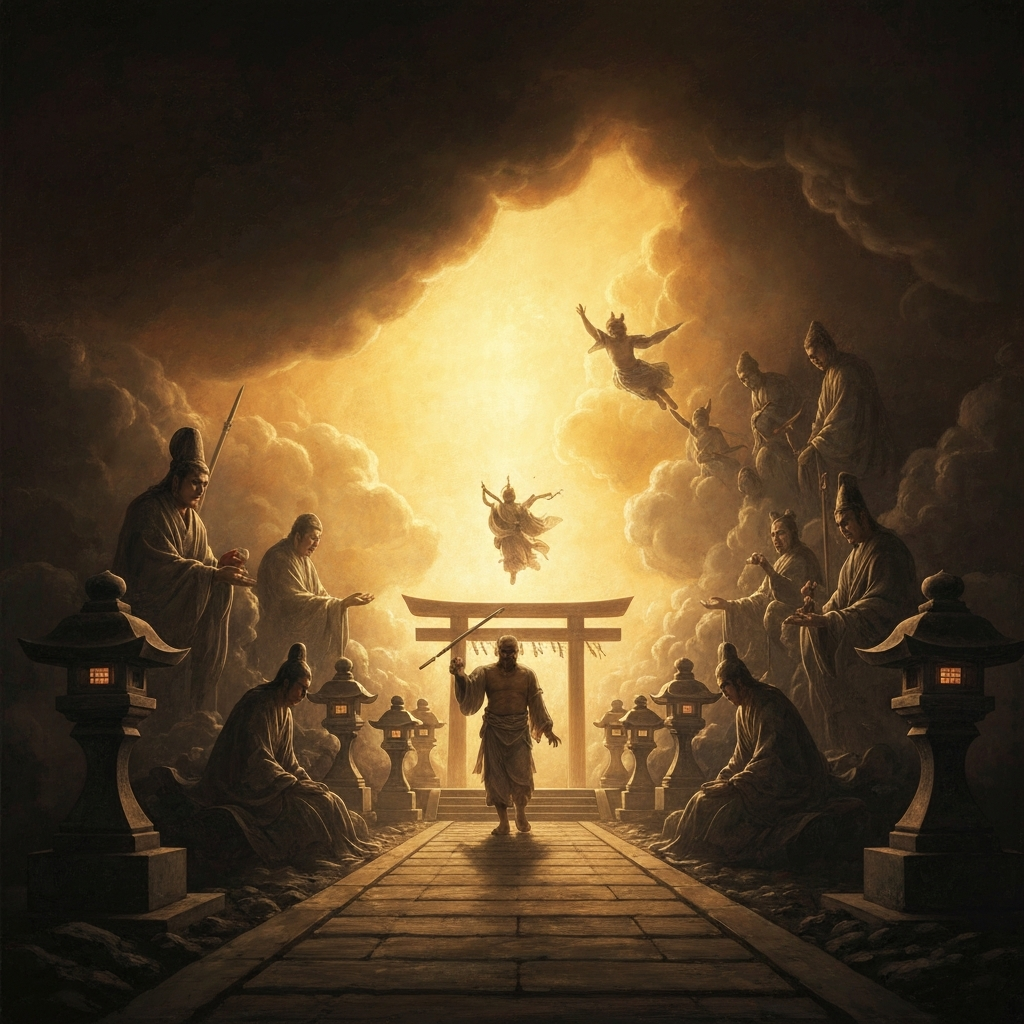
The gods are at Izumo.
The great shrine of Izumo — Izumo Ōyashiro, which has stood on the coast of the Sea of Japan in what is now Shimane Prefecture since before the written record — is the center of this gathering. Every year in the tenth month, the eight million deities travel there for what is called the kamiari — the time when the gods are present. While the rest of Japan experiences Kannazuki (the Month Without Gods), Izumo experiences Kamiarizuki (the Month With Gods).
It is the inverse of everywhere else.
Ōkuninushi receives them. He is the great earth-builder, the one who constructed the world and yielded it in exchange for this shrine. The bargain he made with the heavenly envoys — give me a shrine, and I will go — is not a retirement arrangement. It is a change in function. He went from being the ruler of the material world to being the governor of the immaterial aspects of human life: relationships, matchmaking, the arrangement of the human connections that the material world depends on.
He is the god of en-musubi — the tying of bonds.
At the divine congress of Izumo, the marriages of the coming year are arranged.
This is the theological claim: who will meet whom, who will fall in love with whom, which strangers will find each other and build lives together — these are not random. They are the result of divine deliberation at Izumo in the tenth month, the eight million gods consulting the divine records and deciding which threads of connection to tie.
The thin red thread of fate, in Japanese folk understanding, connects people at the ankle — or connects their little fingers — and the thread is arranged at Izumo. Young people come to Izumo to pray for good marriages, which is really a prayer to be present to the divine when the deliberations happen, to be in the sight of the attending gods when the connections are being made.
The practical problem of Ebisu — the fishing god who is slightly deaf and does not hear the summons to the gathering — means that his shrine remains occupied in October, which is why Ebisu is the patron of tradespeople who continue to work during the Month Without Gods. He is not absent by intention. He is absent by limitation. This is his particular theological identity: the god who stays when the others go, because he cannot hear the call.
The congress lasts the month. Then the gods travel back to their home shrines — floating back down the roads and mountain paths and waterways that lead from Izumo to the far corners of Japan.
The local shrine is inhabited again.
The marriages arranged in Izumo are already in motion in the human world, though the humans involved do not yet know it.
They will know it later.
They will say: the bond was tied at Izumo.
Echoes Across Traditions
Entities
- Ōkuninushi
- the eight million deities
- Ebisu (who does not hear the summons)
- the Izumo shrine

Sources
- Izumo no Kuni Fudoki (Topography of Izumo Province), c. 733 CE
- Breen, John and Mark Teeuwen, *A New History of Shinto* (Wiley-Blackwell, 2010)
- Okano Haruko, 'Ōkuninushi and the Meaning of Kuniyuzuri,' *Japanese Journal of Religious Studies*, 1992
- Yamamoto Yukitaka, *Kami no Michi* (Tsubaki Grand Shrine, 1999)