Kannazuki: The Month Without Gods
Annual; the tradition recorded from at least the Heian period (9th–10th c. CE) · Izumo Taisha, Shimane Prefecture, on the Sea of Japan coast
Contents
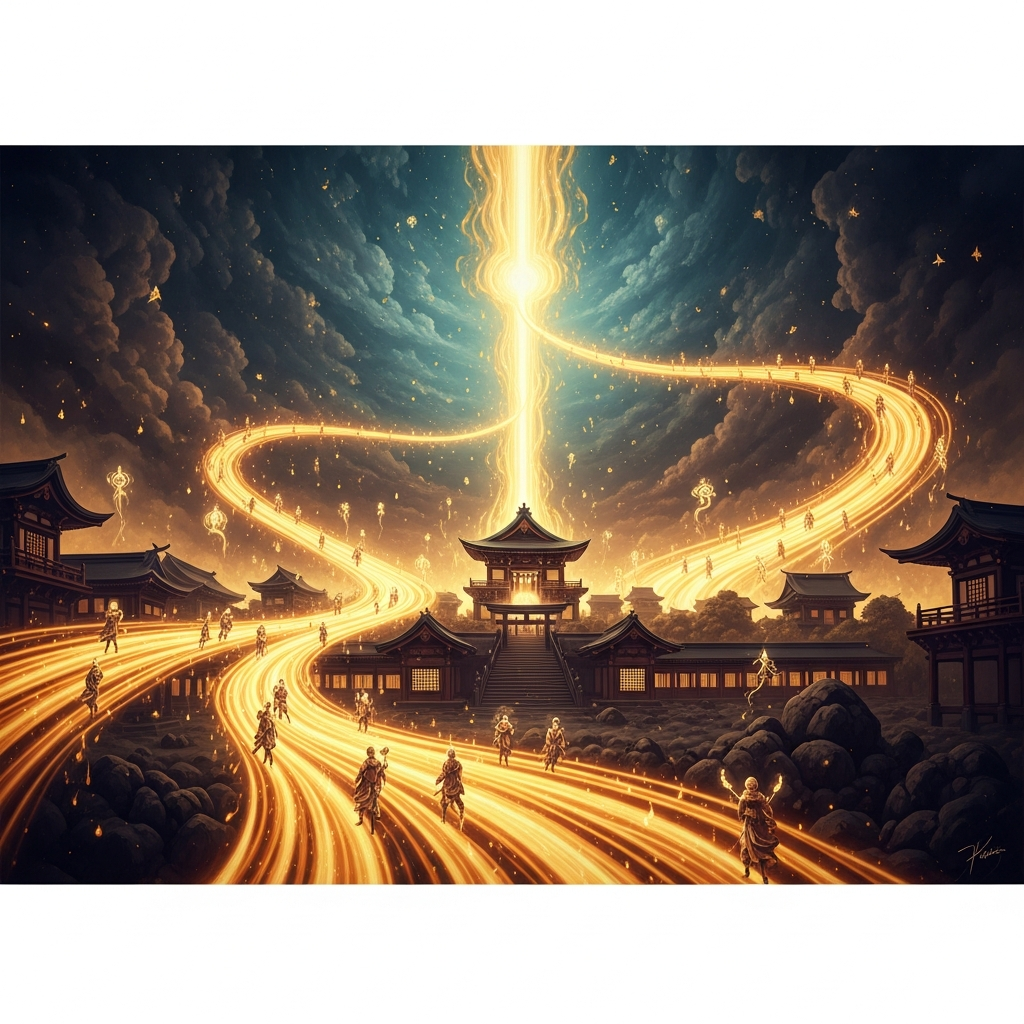
Every tenth month of the lunar year, every kami in Japan leaves their local shrine and travels to Izumo Taisha for a divine council. Across Japan it is Kannazuki — the month without gods. But at Izumo, it is Kamiari-zuki — the month with gods. There they decide marriages and fates for the coming year.
- When
- Annual; the tradition recorded from at least the Heian period (9th–10th c. CE)
- Where
- Izumo Taisha, Shimane Prefecture, on the Sea of Japan coast
In the lunar tenth month — late October by the modern calendar, the month when the rice has been cut and the fields are stubble and the maples have begun to burn red on the mountainsides — the gods of Japan leave home.
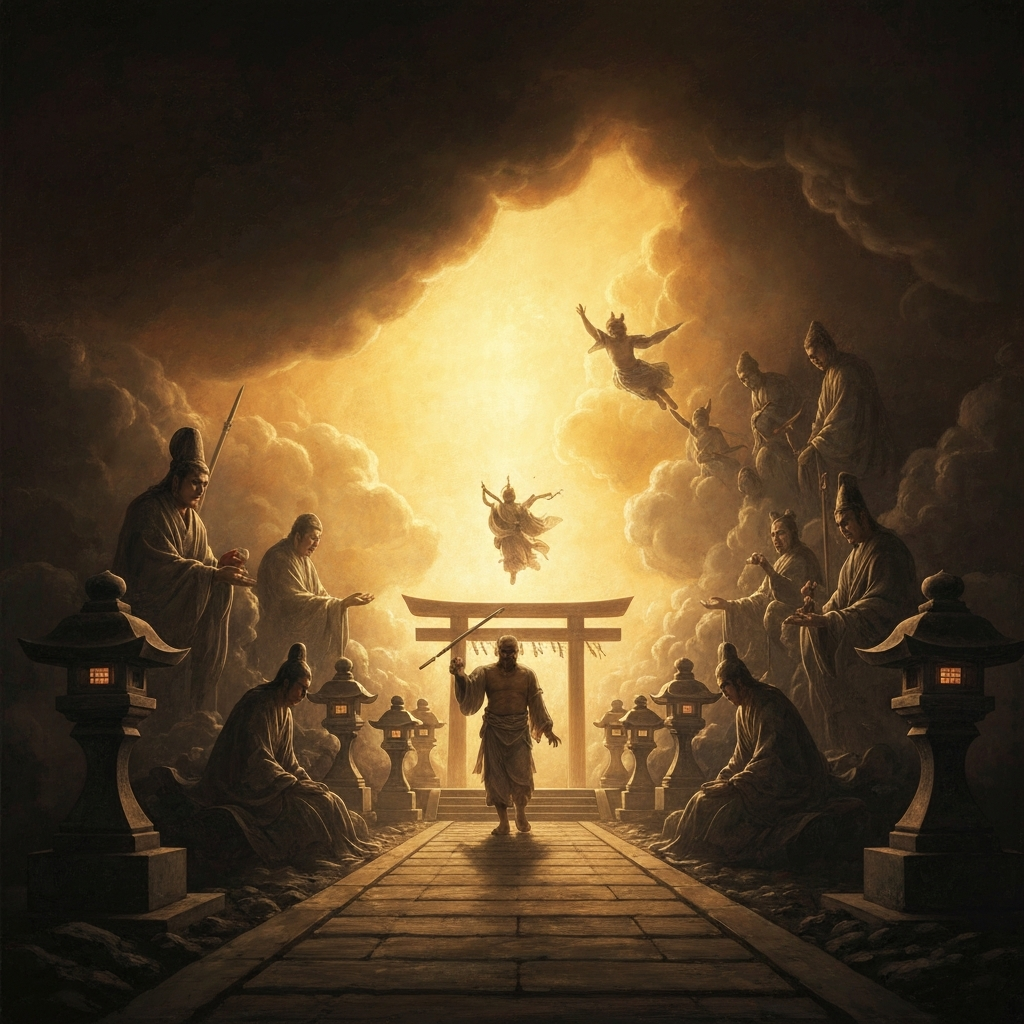
Every shrine. Every neighborhood altar. Every mountain god who has watched a single peak for a thousand years. Every river god who guards a single bend. Every household kami who lives in the kitchen near the rice cooker. Every kami of every grove and well and crossroads in the eight thousand islands of the Japanese archipelago. They all leave at the same time. They travel by an old road that no human has ever mapped, across the country, toward the Sea of Japan coast, toward the great shrine at Izumo, the oldest shrine in Japan, the shrine of the god who gave up the country so that the country could be ruled.
Across Japan, the month is called Kannazuki — the month without gods. The phrase is matter-of-fact. It is on every old calendar. The local shrines are empty. Prayers cast in this month are understood to be unanswered, or held in escrow until the kami return. Major life decisions are postponed. Weddings are not held in Kannazuki — there is nobody home to bless them.
At Izumo Taisha, however, the month has a different name. There it is Kamiari-zuki — the month with gods. While the rest of Japan is divinely empty, the great shrine on the coast is divinely full. Every kami has come.
The shrine at Izumo is older than the imperial line.
This is its peculiar status. The kami of Izumo Taisha is Ōkuninushi, the Great Lord of the Land, who in the oldest myths held the entire archipelago of Japan as his domain. He cleared the land. He built the agriculture. He made the medicines. He invented the diagnoses. He was a working god, a hands-on god, a god whose mother had to bring him back from the dead twice when he was a young god because his cruel older brothers kept killing him for trying to win the same princess. The princess was eventually won. The country was eventually built.
Then Amaterasu, the sun goddess in heaven, decided that Japan should be ruled by her grandson Ninigi, the ancestor of the imperial line. Her envoys came down to negotiate. Ōkuninushi could have refused. He could have resisted. Instead — and this is the part of the story the Izumo tradition emphasizes with quiet pride — he agreed. He handed over the visible governance of the land. He retained, as the price, the invisible governance: the shrine at Izumo would be larger than the shrines of heaven, and he would be the kami of the unseen things, the kami of fate, the kami of marriages, the kami of what binds people together and the kami of what comes apart.
This is why every god in Japan comes to Izumo in the tenth month. Ōkuninushi presides over the unseen ties that hold people in their relationships, and the unseen ties have to be reviewed and adjusted and remade every year. The kami of every locality has to come and report on what their territory needs. The kami of love and fate has to take stock and decide.
The arrival is real.
There is a ceremony. It is held on the shore at Inasa, at the beach below the great shrine, on the seventh evening of the tenth lunar month. The priests of Izumo Taisha walk down to the beach at dusk. They build small fires. They wait. The sea is dark, and the wind off the Sea of Japan is cold by this time of year, and the lanterns flicker in the air that is now thick with autumn moisture. They are waiting for the kami to come ashore.
The kami arrive on the tide. The official explanation is that they come on the back of a sea snake, a thin small sea snake that washes up on Inasa beach in this month with peculiar reliability — a real biological phenomenon, the seguro umihebi, that does in fact arrive on the Izumo coast in autumn, and the priests gather it ceremonially as the visible token of the invisible procession. The snakes are placed in lacquer boxes and carried up to the shrine. The kami, riding the same wind that pushed the snakes ashore, follow.
The priests escort them up the long avenue of cedars to the main hall. The main hall of Izumo Taisha is one of the largest wooden buildings in Japan, and in the oldest accounts it was bigger still — a structure on tall stilts, raised so high that the original priests reportedly climbed an external ramp two hundred feet long to reach it. The current main hall is the rebuilt version, and the rebuilding has happened many times, but the platform is still impressive, still tall, still designed to receive every god of the country at once.
The kami enter. They take their places. The doors are closed.
For seven days the doors stay closed.
What happens inside the hall during those seven days is not human business.
The priests of Izumo know better than to speculate publicly. The folklore of Shimane Prefecture, which surrounds the shrine, has filled in the details that the official tradition leaves blank. The kami sit in long rows. Ōkuninushi presides at the head. Each kami reports on the year in their territory: the births, the deaths, the marriages, the disputes, the harvest, the floods, the small events the kami noticed and the larger events they could not prevent. Then they begin the work of the council, which is the assignment of marriages.
This is the famous part. The kami of Izumo, during these seven days, decide who will marry whom in the coming year. Not all marriages — the day-to-day arrangements of human affection and family negotiation are largely left to humans — but the enmusubi, the binding of fate-threads that pulls two people who would never otherwise have met into the same room at the same hour, the threads that decide the destined marriages, the ones that retrospectively feel like they could not have been otherwise. These threads are tied during the council. The kami of one province says: In my district there is a young man who is ready, and he is waiting for someone he has not yet met. The kami of another province says: In my district there is a young woman who is also ready, and her family has been praying for two years. The two threads are tied. The man and the woman, going about their separate lives in distant prefectures, will encounter each other in the next year — at a train station, at a teacher’s tea, at a friend’s wedding, at a job they did not yet know would exist — and the encounter will feel like luck.
It is not luck. It was tied at Izumo, in the lunar tenth month, in a hall with the doors closed.
Modern Izumo Taisha is a working shrine. It receives several million visitors a year. It is famous for love and marriage in a way that has become slightly commercial — couples come to pray for partners, businesses promote enmusubi tourism, the local trains run extra service in October. The famous architectural feature of the shrine is the shimenawa, the great rice-rope that hangs across the entrance to the worship hall: thirteen meters long, weighing four and a half tonnes, woven from hundreds of small cords of rice straw twisted together into one enormous braid. It looks like the visible image of what the kami are doing inside. The hundreds of small threads are the relationships of every life in the country, twisted together by the council, hanging in front of the main door as the sign of the work.
There is a custom: visitors throw coins up into the underside of the shimenawa. If a coin sticks in the rope and does not fall back, the wish — usually for marriage, sometimes for reconciliation, sometimes for a friendship — will be granted. The rope is full of coins. They have to be removed periodically. The priests collect them and replace the rope every five or six years. The coins are donated to charity. The custom is older than the priests can date.
The festival itself — Kamiari-sai — is observed for seven nights. The priests perform the ceremonies in semi-private; ordinary visitors can watch from a distance, in the outer precincts, but not enter the inner halls. There are torches. There are processions. There are prayers in the old language. The atmosphere on the night the kami depart, the seventeenth of the tenth lunar month, is the atmosphere of an airport at the end of a major conference: the participants are leaving, the wind is picking up, the lanterns are flickering, and the shrine that has been full of more divinity than any other place in Japan for a week is about to empty out into the country again.
The kami return to their home shrines. The local altars wake up. Kannazuki ends. The other eleven months resume.
The Ebisu exception should be mentioned. Ebisu, the kami of fishermen, of merchants, of luck — one of the seven gods of fortune — does not go to Izumo. Tradition explains this in different ways. In one version, Ebisu is deaf and never hears the summons. In another, he is the son of Izanagi and Izanami who was born without bones and set adrift in a reed boat — his hearing was never quite right, and so the call to the council does not reach him. In a third, he is too busy at his fishing post to leave. The result, in any case, is that during Kannazuki, when every other shrine is empty, the shrines of Ebisu are still occupied. He is the one kami who stays home in October.
This has practical consequences. In some regions of Japan, business decisions and trade arrangements are specifically made in the tenth month, because Ebisu, the kami of commerce, is one of the few gods still on duty. While the love-and-fate kami are away in Izumo, the merchant kami is at his shrine taking orders. Festivals to Ebisu are held in October to honor the god who did not leave.
The Kamiari tradition is one of the most beautiful inventions of Japanese religious life. It takes the abstract problem of how a polytheistic system coordinates — how thousands of local kami avoid contradiction, how regional divine decisions add up to national divine order — and solves it with a yearly council. The kami themselves go to a meeting. They report. They confer. They decide. They go home. The system works because they have a shared protocol for getting together.
The genius of the tradition is that it preserves locality. The kami do not centralize. They do not become subordinate to a single high god. They live in their home shrines, in their grove or river or kitchen, and they only travel once a year to a single coordinating session. The rest of the time, they are local. The Japanese religious imagination did not solve the problem of pantheon-coordination by hierarchy or by absorption; it solved it by an annual council with seven days of agenda and a strict deadline.
That the council decides marriages is also significant. The tradition could have said the council decides wars, or harvests, or the fates of kings. It decides the threads that bind two strangers together. The marriage thread is the small unit of social cohesion, and the gods of Japan, gathered for one week a year, are paying attention to the small unit. They are tying the threads of who will meet whom in the next year. Every Japanese person who marries has, in this tradition, been at the council in absentia — their thread tied to another thread by a kami who knew their family.
The hall closes. The doors shut. For seven days, the eight million kami sit and confer, and a country that thinks of itself as small has its destiny adjusted by a coordinated process that humans cannot witness.
Then the doors open. The kami leave. The shimenawa hangs across the entrance, four and a half tonnes of woven straw, the visible token of all the threads that were tied inside, and the local shrines wake up, and the eleven months of the rest of the year begin.
Echoes Across Traditions
Entities
- Ōkuninushi
- Amaterasu
- The Yaoyorozu no Kami (the eight million kami)
- Ebisu


Sources
- *Nihon Shoki* (720 CE)
- *Izumo no Kuni Fudoki* (733 CE)
- *Engishiki* (927 CE), procedures of the Izumo Taisha
- Bernhard Scheid, *Religion in Japan* (University of Vienna online resource)
- Folk traditions of Shimane Prefecture, *Kamiari Matsuri* festival accounts