Contents
At a village shrine on the night of the autumn harvest festival, the kagura performers put on their masks and become the kami — and the dancing is not entertainment for the gods but food for them, the sacred energy that keeps them present in the world.
- When
- Classical period — kagura practice from Kojiki era to present
- Where
- Shrine stages throughout Japan — particularly rural Satokagura and court Mikagura at the Imperial Palace
The mask goes on and something changes.
This is the kagura performer’s testimony across a thousand years of the tradition: the moment the mask is tied — the carved wooden face of Susanoo, of Ebisu, of Amaterasu, of the divine pair — the relationship between performer and mask reverses. In ordinary performance, the actor wears the mask and is its wearer. In kagura, the mask wears the performer.
This is not metaphor. This is the operational theology of the art form.
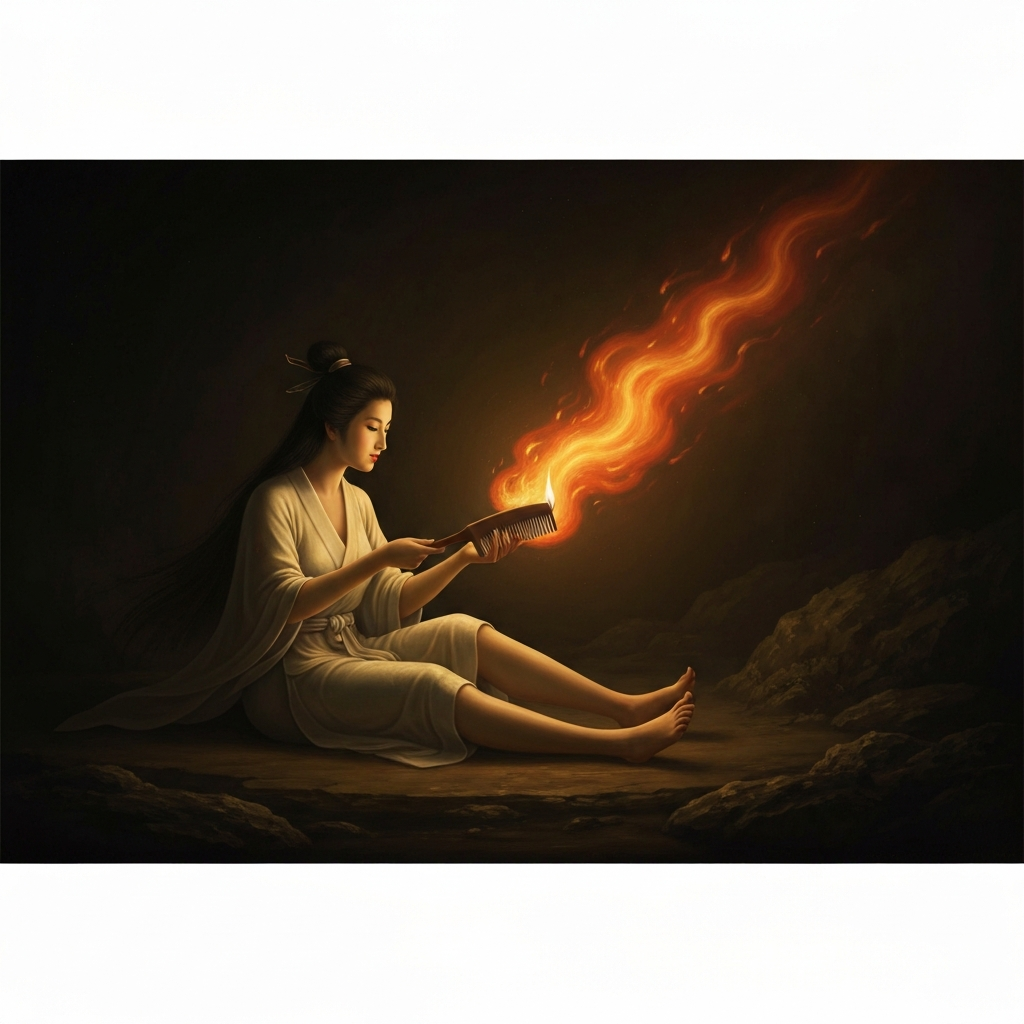
Kagura begins with Ame-no-Uzume.
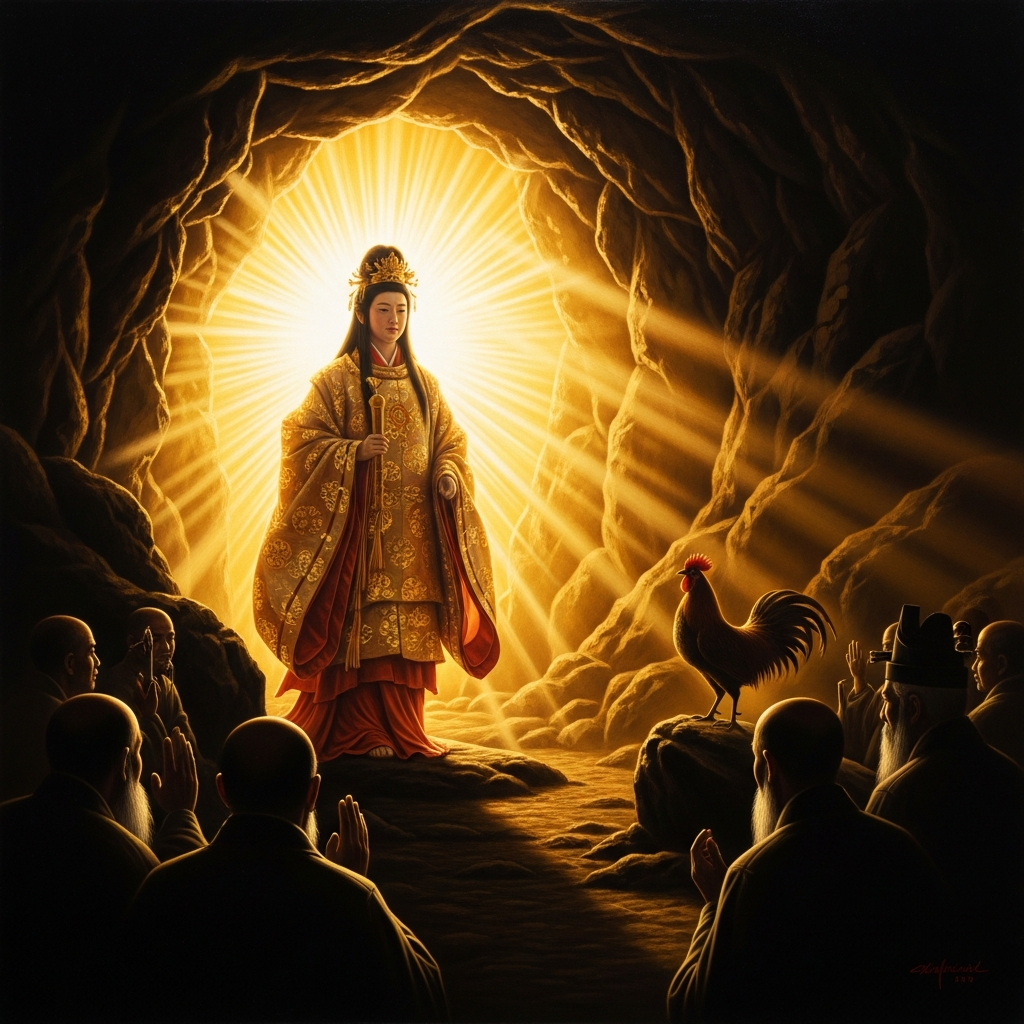
When Amaterasu sealed herself inside the Rock Cave of Heaven and the world went dark, the eight million gods gathered on the riverbed and what they needed was a way to call her back. They had tried reasoning. They had made preparations. They needed the thing that calls across the boundary between the hidden and the exposed, between the withdrawn and the present.
Uzume climbed an overturned tub and danced.
The dance was possessed, ecstatic, transgressive, funny. She entered trance. The other gods laughed. The laughter shook the heavens. Amaterasu, inside the cave, heard laughter in a world she had expected to be dark and afraid, and she could not resist looking.
That dance — that specific quality of movement that breaks through containment and calls the hidden out — is what every kagura performance attempts to reproduce. Not the surface details (the performers are usually fully clothed) but the animating principle: the movement that does not merely represent the divine but invites it.
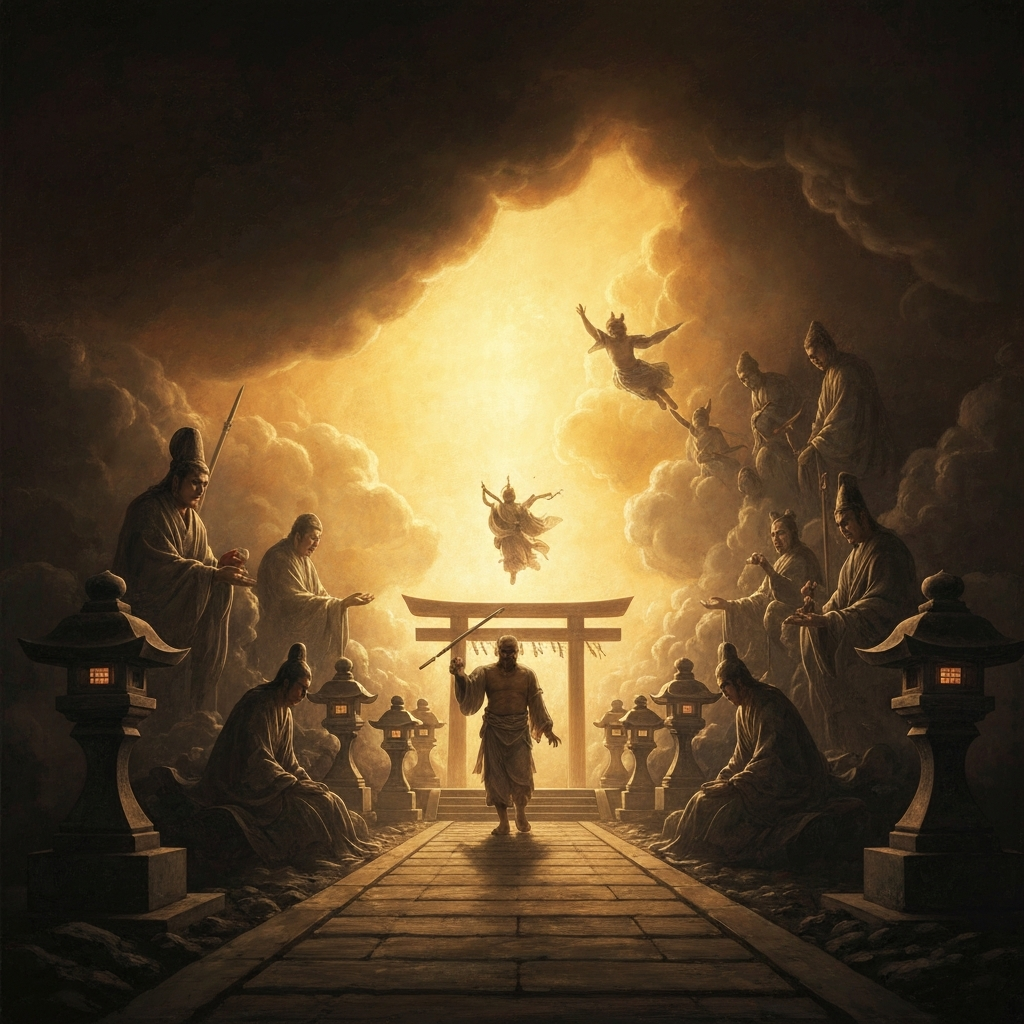
The village kagura performance on the autumn harvest festival night runs from dusk to dawn, or from dusk to midnight, or all night if the village is traditional enough and the performers have the stamina. The stage at the shrine is lit by torches or lanterns. The musicians play the transverse flute, the drums, the kagura-suzu (bells on a handle). The performers move in the slow, deliberate patterns of movements accumulated over centuries.
The kami, who have been given the harvest’s first fruits earlier in the evening, attend.
This is the theology that the performers and their communities hold: the kami are not omnipresent. They are present where they are called and fed. The kagura is both the calling and the feeding — the motion of the human body in sacred pattern providing something that the kami need, something the Shinto tradition identifies as tama, the life-spirit, that is generated by energetic sacred performance and consumed by the attending deities.
The masks are the hinges. The performer behind the mask provides the tama. The face of the mask is the face through which the deity enters.
By the fourth hour of the performance, the distinction between them has become genuinely unclear.
The torch burns lower.
The drum continues.
The mask watches the dark field beyond the shrine boundary where the kami are said to gather when the dancing is good.
The dancing is good.
Echoes Across Traditions
Entities
- Ame-no-Uzume
- the kagura performers
- the shrine kami
Sources
- Nishiyama Matsunosuke, 'The Development of Kagura Dance,' *Acta Asiatica*, 1990
- Matsumoto Nobuhiro, *Nihon no Kagura* (Kagura of Japan) (Ōfūsha, 1981)
- Geilhorn, Barbara, 'Village Kagura as Communal Practice,' *Asian Theatre Journal*, 2009
- Hoff, Frank, *Song, Dance, Storytelling: Aspects of the Performing Arts in Japan* (Cornell, 1978)