The Jain Universe: Concentric Rings of the World
Jain cosmological tradition codified in the *Tattvarthasutra*, c. 2nd–5th century CE; elaborated through 11th century CE in the *Trilokasara* · The entire Jain universe — an infinite but precisely mapped cosmos with a specifically located center
Contents
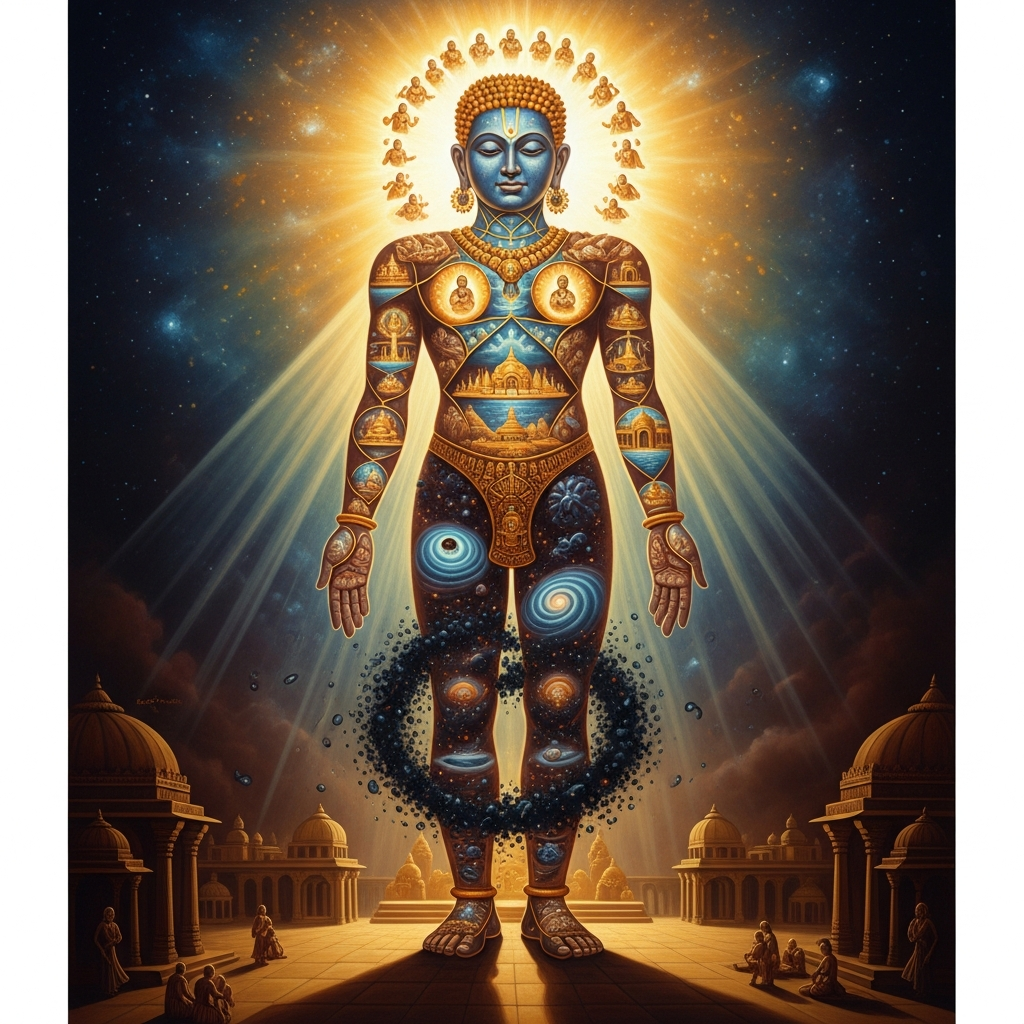
The Jain cosmos is not created — it has always existed and will always exist. It is shaped like a standing human figure. At the waist is the inhabited world: concentric ring-continents separated by concentric ring-oceans, each named for a substance — Lavana (salt), Kalodadhi (black water), Svayambhu (self-existing). At the top are the heavens. At the bottom, hells. Jain monks have mapped this system with mathematical precision for two thousand years. It is the most detailed cosmology in any religion.
- When
- Jain cosmological tradition codified in the *Tattvarthasutra*, c. 2nd–5th century CE; elaborated through 11th century CE in the *Trilokasara*
- Where
- The entire Jain universe — an infinite but precisely mapped cosmos with a specifically located center
The universe is shaped like a person standing with their hands pressed against their hips.
This is not a metaphor. Jain cosmologists are specific: the loka — the inhabited cosmos — has the profile of a human being standing at rest, narrower at the top, widest at the waist, the feet slightly spread. The widest point, at the waist of this cosmic figure, is where humans live. Above are the heavens, narrowing as they rise toward the apex where the liberated souls dwell. Below are the seven hells, also narrowing as they descend toward the base, where the coldest and most compressed darkness houses souls so laden with karma that they will not be born as anything other than cold and dark for millions of years.
It has always existed. It will always exist. No god created it; no apocalypse will end it. It runs, by itself, on the mechanics of karma and liberation, the way a clockwork mechanism runs on the mechanics of gears and springs — except that no one wound it and no one can stop it.
At the waist of the cosmic person is the inhabited world, and at the center of the inhabited world is Jambudvipa.
Jambudvipa is a circular continent, two times two times two times… the Jain mathematicians give it a diameter of one hundred thousand yojanas — a unit of measure whose exact conversion is disputed but whose scale is not — and in the absolute center of Jambudvipa is Mount Meru: the world-axis, the cosmic mountain, eighty-four thousand yojanas tall and one thousand yojanas deep in the earth, its peak so high that the sun and moon orbit around it rather than above it.
The southern half of Jambudvipa is Bharatavarsha. This is where we live. It is the smallest habitable region of the inhabited continent — a sliver at the southern edge of an enormous disk — and the texts are precise about why: Bharatavarsha is the karma-bhumi, the action-land, the only region in the entire cosmos where liberation is actually possible. Everywhere else — the other six regions of Jambudvipa, the farther continents, the heaven-realms — souls experience their karma without generating new karma, like travelers spending down a currency they cannot replenish. Only in Bharatavarsha do souls generate karma in real time, which means only here can they make the choices that lead to burning it off.
We live in the worst neighborhood in the cosmos. The texts consider this a privilege.
Around Jambudvipa is the first ring-ocean: Lavana Samudra, the Salt Ocean. Its width equals the diameter of Jambudvipa. Around Lavana Samudra is the ring-continent Dhatakikhanda. Around Dhatakikhanda is Kalodadhi — the Black Water Ocean. And so it continues outward: continent, ocean, continent, ocean, each pair doubling the radius of the previous pair, out to the second ring-continent, the third, the fourth, reaching the impassable ocean at the edge of the human cosmos where the water is sweet and the souls are too full of previous-life merit to liberate.
The ocean names encode cosmological theology. Salt, because the first ocean around our world is the mundane substance we know. Black water, because the second is already beyond ordinary perception. Svayambhuramana — “that which roams on its own” — for the seventh and outermost ocean, because by then you are describing a substance that has no human analogy and the only honest name is the one that admits you have run out of names.
The Jain mathematicians of the medieval period — Nemichandra in the eleventh century is the great systematizer, working in what is now Karnataka — calculated the dimensions of these oceans not in approximate round numbers but with the precision of astronomers. They worked in palya and sagara, units of time measured by the number of individual hairs it would take to fill a pit of certain dimensions, removed one by one at set intervals. They described the population of each hell-level. They gave velocity figures for the celestial bodies. The Trilokasara is a mathematical treatise as much as a cosmological text — three thousand verses of calculation — and the calculations are, in their own terms, coherent.
Above the inhabited world the heavens rise in vertical tiers.
There are twelve heaven-levels, each more refined than the last, each hosting gods whose lifespan and capacity for pleasure increases in proportion to the merit-karma they accumulated in a previous life as a human. The gods of the first heaven live for a million years and experience pleasure the way a child experiences a sweet. The gods of the twelfth heaven live for astronomical spans and experience pleasure the way a philosopher experiences a proof — refined, subtle, nearly incorporeal.
But the gods are not liberated. This is the crucial Jain point, the one that separates it from every theistic cosmology: the heavens are not the destination. The gods are souls in a very comfortable holding pattern, burning down their merit-karma in comfort the way a debtor pays off a balance by spending it down. When the merit runs out they will be reborn — in Bharatavarsha if they are lucky, in the ring-continents if they are not. They will have to do the hard work of liberation the way every soul must: in a body, in the karma-generating world, making real decisions with real consequences.
Above the twelfth heaven is the isatpragbhara — the slightly curved surface, like the top of an umbrella, that marks the boundary of the inhabited cosmos. And above that, adhering to the very ceiling of the cosmos, are the siddhas: the liberated souls.
The siddhas have no bodies.
They have burned away every karma-particle through austerity, truthfulness, non-violence, and the final achievement of kevala-jnana, omniscience. Having no body and no karma, they cannot fall. They are weightless in the literal sense — weight is karma, karma is matter, the liberated soul has no matter left. So they rise, all the way to the top of the cosmos, and adhere to the ceiling like drops of water on the underside of a leaf, and remain there for the rest of eternity, experiencing pure consciousness without any object.
The siddhas do not hear prayers. They do not grant wishes. They do not intervene. They exist in a state of pure bliss — ananta sukha, infinite happiness — that is completely self-contained, requiring nothing from the cosmos below them. Jain temple liturgy addresses them and honors them, but knows they cannot answer, and addresses them anyway, because the point of the liturgy is not petition but aspiration. The worshipper is not asking the siddha for help. The worshipper is imagining what the siddha is, and using that imagining to orient the self.
The ceiling of the cosmos is the address of every being who has ever achieved liberation. Some traditions locate paradise as a place administered by God, full of rewards distributed according to divine generosity. The Jain cosmos locates it as a permanent state achieved by souls who completed the work themselves — a city with no streets, no movement, no administration, no time, inhabited only by pure awareness that has nothing left to be aware of except itself.
The cosmos runs on a clock.
The clock is the kalchakra — the wheel of time — which rotates through ascending and descending phases in each half of each inhabited region. In the ascending phase (utsarpini), the age slowly improves: lifespans lengthen, people grow taller, virtue becomes easier, the wish-fulfilling trees return. In the descending phase (avasarpini), the age deteriorates: lifespans shorten, people shrink, the trees wither, liberation becomes harder. Each phase has six sub-ages, each sub-age lasting incomprehensible spans of time.
We are in the fifth sub-age of the descending phase. The Jain texts are specific about this, and not optimistic. The fifth sub-age is when the last tirthankaras walk — Parshva, Mahavira — and after them the age becomes too dark for omniscience. The sixth sub-age will be so degraded that no liberation will be possible at all. Then the wheel will turn and the ascending phase will begin again, slowly, over millions of years, until the trees return and the next set of tirthankaras are born and the path reopens.
This is not pessimism. The Jain cosmos does not punish or threaten. It describes a mechanism, the way an engineer describes a mechanism, and asks the soul to consult the mechanism’s current position before making plans.
The Jain universe is the most thoroughly mapped cosmos in any religious tradition, and the mapping is inseparable from the theology. In a cosmos created by a god, the map is the god’s architecture — to describe it is to praise the designer. In the Jain cosmos, no designer exists, and the map is a moral instrument: if you know where the liberated souls live and what they are, and if you know where you are on the wheel of time, and if you know that the karma-bhumi where liberation is possible is this specific sliver of the inhabited continent, in this specific downward phase of the cycle, then you know why the moment matters and what to do with it.
The monks of the Digambara and Shvetambara traditions have carried these maps in their minds for two thousand years. They are drawn on temple walls, printed in sacred calendars, traced in ritual diagrams on the floors of assembly halls. They are not decorative. They are the most serious thing in the building.
Echoes Across Traditions
Entities
- Jambudvipa (the central continent)
- Mount Meru
- the fourteen lokas (world levels)
- the jivas (souls ascending and descending)
- the siddhas (liberated souls at the apex)
Sources
- Umasvati, *Tattvarthasutra* (c. 2nd–5th century CE; Nathmal Tatia trans., *That Which Is*, HarperCollins, 1994)
- *Trilokasara* (Nemichandra, c. 11th century CE) — the most complete mathematical treatment of Jain cosmology
- *Jambudvipa Prajnapti* (Jain canonical text)
- Paul Dundas, *The Jains* (Routledge, 2nd ed. 2002), ch. 4
- Padmanabh S. Jaini, *The Jaina Path of Purification* (University of California Press, 1979), ch. 4
- L. C. Jain, *Exact Sciences from Jaina Sources* (Rajasthan Prakrit Bharati Sansthan, 1982)