Manas and the Birth of the Kyrgyz Nation
mythic-historical time — approximately 9th-11th century CE, but expanded into cosmic time by the epic tradition · The Tian Shan and Pamir mountains — Kyrgyz ancestral homeland in Central Asia
Contents
The hero Manas is born amid supernatural signs to a people scattered and oppressed, unites the forty Kyrgyz tribes under the Tengrist sky-banner, and creates in his life and death the defining narrative of Kyrgyz identity — an epic so vast it takes a week to recite.
- When
- mythic-historical time — approximately 9th-11th century CE, but expanded into cosmic time by the epic tradition
- Where
- The Tian Shan and Pamir mountains — Kyrgyz ancestral homeland in Central Asia
He is born in the dark of winter, and light fills the tent.
This is how every manaschi begins the birth section, and every manaschi has their own version of what the light looked like — some say it was golden, some say it was white, some say it was the specific blue of Tengri’s heaven, some say it had no color but could not be looked at directly. What they all agree on is that it was not from a lamp. The night was moonless and the fire had not been lit yet, and when Chyiyrdy cried out in labor and the child came, the tent was full of light from nowhere.
His father names him Manas, which the manaschi interpret variously but most often as something like “the spirit” or “the mind” or “the one who wills.”
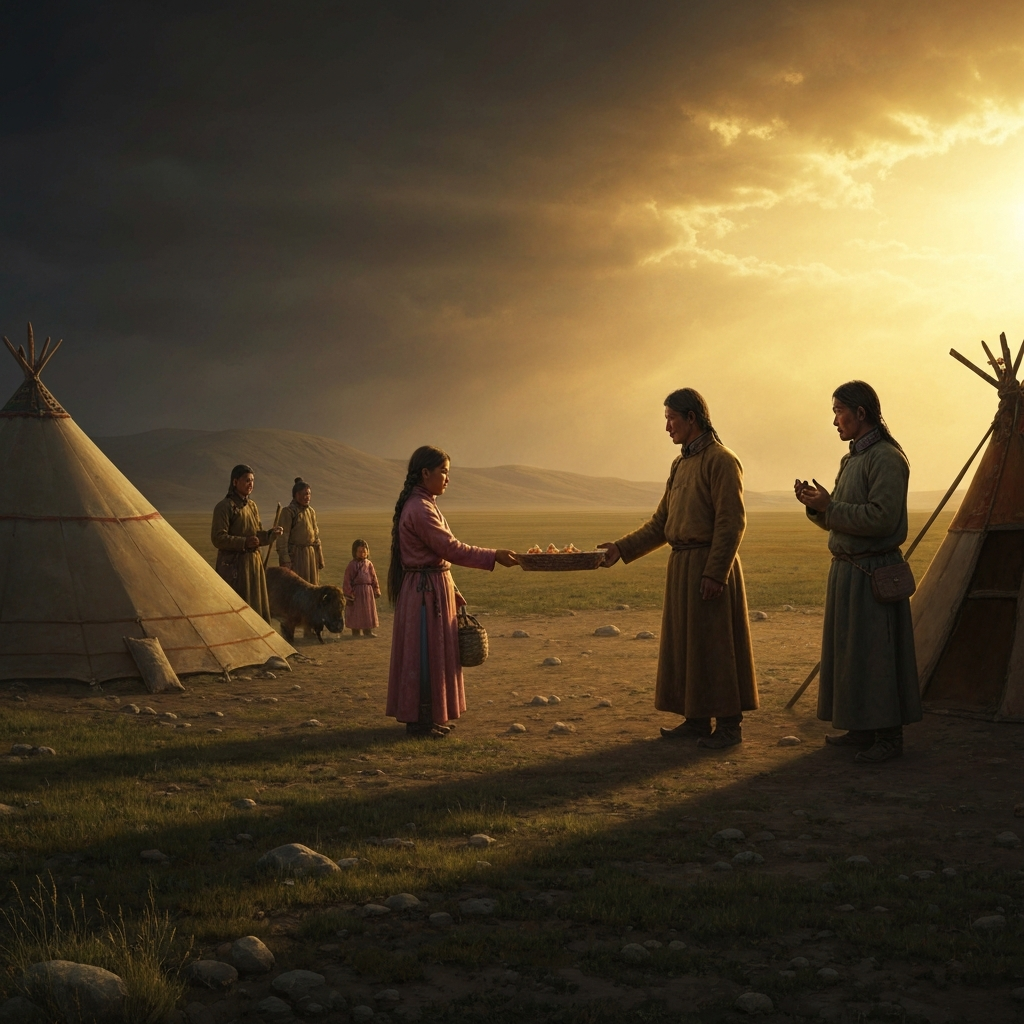
The Kyrgyz people at this time are scattered. The epic describes them as having been driven from their ancestral mountain homeland by powerful enemies and dispersed across a vast territory, each clan surviving independently, the forty tribes that once constituted a people now barely remembering their common origin. Manas is born into this dispersal. His childhood is defined by movement and hunger and the particular education of a child who grows up knowing that his people have lost something essential.
He begins fighting at eight. The manaschi are not exaggerating — the epic tradition on the steppe records child warriors who by their early teens have already accumulated the skills that in other cultures would take twenty years. He fights other children first, then young men, then the raiders who come from the east.
By fifteen he is leading men.
The horse arrives in the form of a dream.
Manas’s father sees a white horse in a dream and follows it to a specific valley where a white colt is grazing alone, clearly supernatural — its size is already immense, its hooves leave no marks in the snow, and when Manas’s father approaches it, it allows the approach with the calm of something that knows exactly what it is waiting for.
Ak-Ula. The White Stallion. The horse’s story takes nearly as long to tell as the hero’s story. The manaschi say this is because the horse is not a mount but a partner — an equal in the mission of restoring the Kyrgyz nation. Ak-Ula makes decisions. Ak-Ula warns, advises, mourns. When Manas is killed, Ak-Ula refuses to eat and is found dead beside the hero’s body.
The unification of the forty tribes occupies the middle third of the epic. Each tribe has its own territory, its own grievances, its own strong men who must be convinced or defeated before they will acknowledge Manas’s leadership. The negotiations are not all military — many are diplomatic, some are marital alliances, a few are spiritual. The shamans of each tribe must recognize Manas’s Tengrist mandate: that he is the one chosen by the sky-deity to restore the nation.
Almambet, his greatest companion, is converted from being his enemy. He is not Kyrgyz by birth — he comes from another people and crosses over to Manas because he recognizes, in Manas, something he has been looking for. The manaschi treat this relationship with the full weight of the fraternal bond in steppe culture: chosen brothers whose loyalty exceeds blood.
The great war that is the epic’s climax is against the enemies of the Kyrgyz people.
The manaschi do not dwell on atrocity. The epic tradition glorifies courage and strategic intelligence and loyalty and the specific texture of how extraordinary people move through the world. The war is real in the epic — people die, Almambet dies, the great companions fall one by one — but the emotional weight falls on the friendships and the losses rather than the victories.
Manas dies.
He dies wounded in the final battle, carried away from the field by Ak-Ula. He is brought to a valley in the mountains where he names his successor — his son, who will carry the story into the second and third parts of the epic — and then he says the last words the manaschi have debated and treasured and disputed for centuries.
He is buried in a mausoleum that is still a pilgrimage site in Kyrgyzstan.
The manaschi who carries the epic today received his first section from a dream at age thirteen. In the dream, Manas appeared to him on Ak-Ula and spoke for three hours. The manaschi woke up knowing 30,000 lines he had not known when he went to sleep.
This is how the epic has always been transmitted. Not from scroll to student but from dream to voice.
The hero is still speaking.
Echoes Across Traditions
Entities
- Manas the hero
- Chyiyrdy, his mother
- Ak-Ula, his supernatural horse
- Almambet, his greatest companion
- the manaschi (epic reciter)
Sources
- Hatto, A.T. (trans.), *The Manas of Wilhelm Radloff* (Wiesbaden, 1990)
- Reichl, Karl, *Turkic Oral Epic Poetry* (Garland, 1992)
- Sadykov, Toktosun, *Manas Eposu* (Bishkek Academy of Sciences, 1990)