The Kikimora Behind the Stove
Folk tradition; first textual records 16th c.; tradition still alive in some rural areas · Russian peasant cottages, especially behind the stove and in the cellar
Contents
She lives behind the stove or in the cellar. If the house is in order and the family hardworking, she is invisible and harmless. If not, she tangles thread, breaks pots, snarls the loom, and sits on sleeping children to give them nightmares. She was originally a child who died unbaptized, or the first wife of the house's master.
- When
- Folk tradition; first textual records 16th c.; tradition still alive in some rural areas
- Where
- Russian peasant cottages, especially behind the stove and in the cellar
She lives behind the stove.
Every Russian peasant house has a stove — the pech, the great mass of brick and clay that takes up a quarter of the room, that is used for cooking and baking and sleeping on top of in winter, that is the warmest object in any building for hundreds of versts in any direction. Behind the stove is the small dark space between the brick and the wall, where the heat seeps out and the dust collects and the spiders make webs no broom will ever reach. This space — narrow, dark, perpetually warm — is where the kikimora lives.
She is small. She is female. She is older than the house, and the house was old when the great-grandfather built it. She does not eat. She does not sleep. She watches.
If the house is well kept — if the floors are swept, if the dishes are washed, if the children are clean, if the cabbage is fermenting properly in its barrel, if the loom is running, if the bread is rising, if the husband is sober and the wife is not weeping in the cellar — the kikimora is invisible and harmless. She watches the work of the household with the silent approval of an old aunt who is glad to see things done correctly. The household never sees her. The household never hears her. The household never thinks about her. She is the tax of order: every well-run house pays her in attention to detail, and in return she does not bother them.
If the house is not well kept — if the dust accumulates in the corners, if the dishes are left dirty overnight, if the children are not bathed, if the cabbage spoils, if the loom stalls, if the bread fails to rise, if the husband drinks and the wife despairs — the kikimora intervenes.
The interventions begin small.
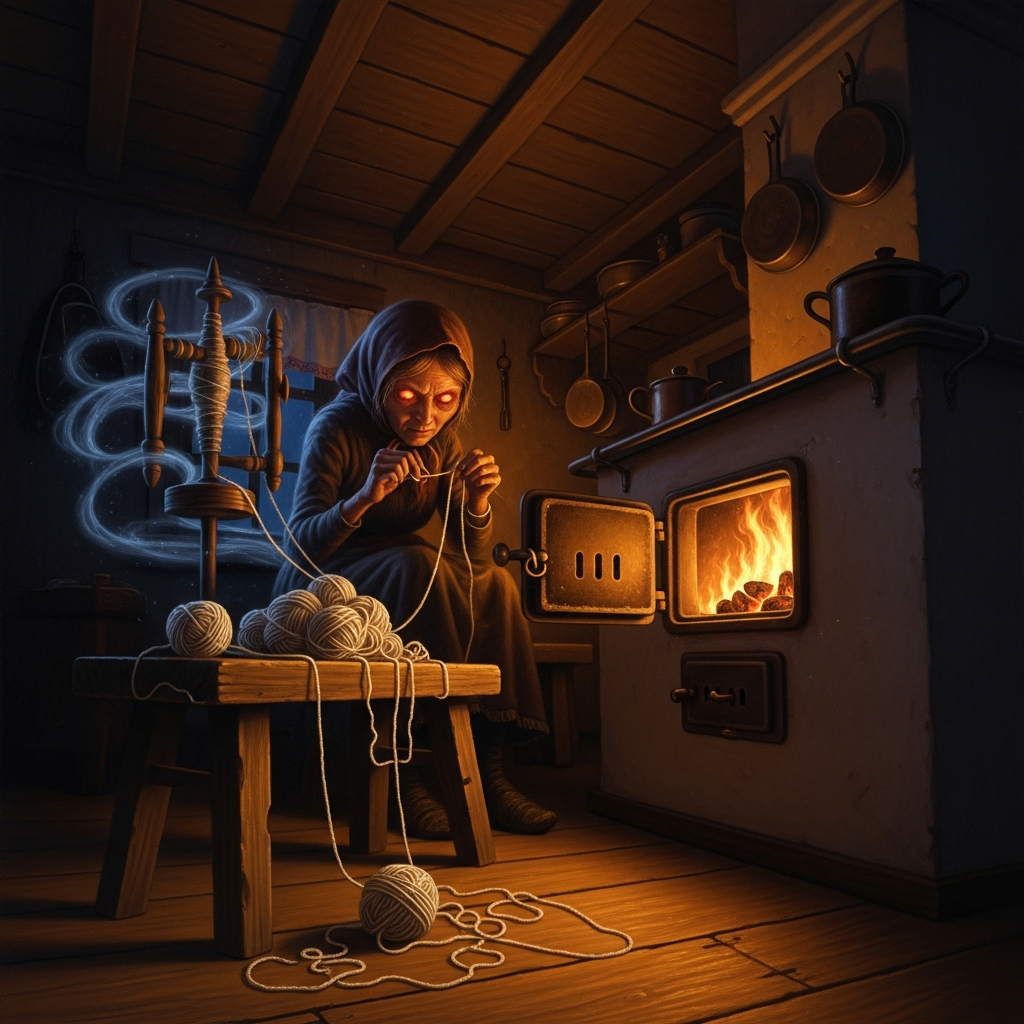
A skein of thread, left on the table, tangles itself in the night. The wife finds it in the morning, snarled into a knot that cannot be undone, and has to cut the thread to free it. She does not blame the kikimora. She blames herself for leaving the thread out. This is correct attribution: the kikimora’s first message is always put your work away properly. The skein is the mildest correction. It is the warning shot.
The corrections escalate. A pot of milk left uncovered develops an off taste. A barrel of cabbage that should have fermented properly turns sour and slimy. A loom that was working perfectly the day before will not pass the shuttle through smoothly — the threads catch on something, and the something cannot be found, and the woman of the house spends an hour disentangling what should have been a smooth pass. The dough does not rise. The chickens stop laying. The cow’s milk decreases by a third. None of these phenomena is supernatural by direct evidence; they are the kinds of small failures that any household might experience, and that the household, if they are paying attention, can interpret as messages.
If the messages are received and the household corrects course — sweeps the floors, washes the dishes, puts the work away, calms the husband, cares for the wife — the kikimora returns to invisibility. If the messages are not received, the corrections become harder.
Pots fall from shelves. They do not slip; they fall. A wooden bowl that has sat on the same shelf for ten years tips off and rolls into the middle of the floor. A heavy iron skillet hanging on its hook will jump off the hook in the night and clatter onto the brick stove. The crash wakes the household. They look. There is nothing there. They put the skillet back. By morning it has fallen again.
Then the loom begins to fight. This is the most precise of her interventions. The loom is the woman’s work par excellence in the Russian peasant household — the cloth for the family’s clothing is woven on the loom in winter, and the cloth is the family’s wealth, the family’s protection from cold, the family’s marriage gift for daughters and burial shroud for the dead. A loom that does not work is a household economic crisis. The kikimora knows this. She climbs onto the loom at night and tangles the warp. She breaks small threads. She reverses the heddle. She knots the shuttle’s yarn. The woman who comes to the loom in the morning finds it sabotaged, and the sabotage cannot be repaired in less than a day, and the day is lost from the year’s weaving.
If even this does not produce reform, the kikimora moves into the night.
She sits on the children.
This is the most feared of her interventions, and the one the folklore archives describe with the most specificity. The kikimora climbs onto the chest of a sleeping child and presses down with her invisible weight. The child cannot move. The child cannot breathe properly. The child cannot speak. The child has nightmares — of falling, of suffocating, of being chased by something faceless, of being held underwater. The child wakes screaming. The mother comes. The kikimora has slipped back behind the stove. The child says: something was on top of me. The mother says: it is only a dream. But the mother knows.
In some accounts, the kikimora pulls hair. The child wakes with one or two long hairs missing, pulled out by the root. The hairs are sometimes found arranged on the floor by the bed, knotted into small symmetrical patterns. These patterns are reported in the folklore archives with notable consistency — small braids, small loops, small geometric shapes made of three or four hairs each — across Russia, Belarus, Ukraine, and parts of Poland. The pattern is the same across hundreds of versts. The kikimora’s signature.
In the most severe cases, the kikimora steals the child’s voice. The child wakes mute. The muteness lasts a day, or three days, or a week. The child can hear, can understand, can think, can attempt to speak — but the voice will not come. This is the kikimora at her angriest. The voice is restored only when the household has corrected what was wrong, performed the proper rituals (a prayer, an offering of bread and salt placed behind the stove, sometimes the burning of juniper or wormwood in the corners), and asked her forgiveness.
The forgiveness is generally given. The kikimora is not, fundamentally, malicious. She is a stickler. She intervenes because the household has stopped maintaining the order she requires, and her interventions are calibrated — the skein, the pot, the loom, the child, the voice — to escalate only if the warnings are not received. Every kikimora story, in the end, includes the moment when the household understands, makes amends, restores order, and the spirit returns to her invisibility behind the stove.
Who is she?
The folklore preserves two main accounts of the kikimora’s origin, and both are striking in their humanity.
The first account: she was a child who died before baptism. In the Slavic folk theology of the medieval and early modern period, a baby who died unbaptized was a problem — the child could not enter heaven, but had committed no sin and so could not enter hell, and the soul drifted in an intermediate state. Some such souls became rusalki, the river-spirits who wail at fords. Some became forest-spirits. Some, in this tradition, became kikimoras — they attached themselves to the house where they would have been raised, took up residence behind the stove, and watched the household with the attention of a child who never grew up. The behavior makes sense in this light: she pulls hair the way a child pulls hair, sits on chests the way a child sits on a parent’s chest in the morning, tangles thread the way a child tangles thread when no one is watching. She is mischievous and aggrieved. She is also the household’s responsibility. The proper response is not exorcism but acknowledgment — the household lights a candle for the lost child, places bread and salt for her behind the stove, says her name (in some traditions, she has a name only the family knows), and the kikimora settles.
The second account: she was the first wife of the master of the house. She died — sometimes in childbirth, sometimes in fever, sometimes more darkly, by violence — and her successor (the second wife) took her place in the household. The first wife’s spirit was unwilling to leave the house she had built, the kitchen she had organized, the loom she had set up, the children she had borne. She stayed. She moved behind the stove. She watched the second wife do all the work she had once done. If the second wife did the work well, the first wife’s spirit was at peace. If the second wife did the work badly — neglected the house, failed the children, was unfaithful to the husband, stole from the cellar — the first wife’s spirit became the kikimora and began the corrections. The behavior makes sense in this light too: the kikimora is jealous of housekeeping, attentive to the loom, protective of the children, hostile to a wife who is failing. The proper response, in this tradition, is for the second wife to acknowledge the first wife’s continued residence — sometimes by mentioning her in prayers, sometimes by leaving a chair empty at meals, sometimes by performing small rituals at the stove that include both wives’ names — and the kikimora is appeased.
In many regions, the two accounts coexist. The kikimora is sometimes the unbaptized child of the first wife, who died with her mother, and now haunts the household as both child and grieving wife in compounded form. The folklore does not insist on one account or the other. The kikimora’s identity is, like much of Slavic folk theology, layered — she is several things at once, and the household relates to whichever layer the situation calls for.
She is gendered, and the gendering is significant.
The Russian peasant household had two recognized household spirits: the domovoi (male) and the kikimora (female). The domovoi lived in the cellar or under the threshold; he watched the men’s work — the care of the animals, the maintenance of the building, the relations with neighbors. The kikimora lived behind the stove; she watched the women’s work — the cooking, the cleaning, the weaving, the children, the food preservation. Both were ancestral. Both were morally engaged. Both intervened when the work was not being done.
But the two spirits had different temperaments. The domovoi was protective. He punished outsiders who threatened the household, defended the cattle from disease, scared off thieves, and was generally aligned with the family’s continuity against external threat. The kikimora was disciplinary. She punished the household itself for failing its own internal standards. She was the auditor, the judge, the in-house reformer. The folklore makes her female because the work she watched was women’s work, and the standards she enforced were the standards of the women who had run the house before the current woman.
This is why the kikimora is not, strictly, a feminist figure. She enforces traditional standards of housekeeping. She rewards women who do the work and punishes women who do not. She has no patience for innovation or for circumstances that interfere with the work. A woman whose loom is running well, whose dough is rising, whose children are clean — that woman has an ally behind the stove. A woman who is depressed, distracted, drinking, or failing to perform her role — that woman has an adversary. The kikimora is, in modern terms, the internalized voice of female ancestry: every grandmother in the house’s history watching what the current woman is doing and judging her. She is the spirit of the standard.
The kikimora is one of the great inventions of Slavic folklore: a household spirit whose function is moral infrastructure. Other folklore traditions imagine spirits who bring luck or harm, who help or hinder, who steal or give. The Slavic tradition imagines a spirit whose entire job is to enforce standards. She is the auditor of housekeeping. She is the conscience of the loom.
Her existence makes the work of the household into something with cosmic stakes. A swept floor is not just a swept floor; it is a contribution to the kikimora’s contentment. A neglected pot is not just a neglected pot; it is a small disrespect that the spirit behind the stove is noting. The Russian peasant woman lived in a moral environment where every domestic decision had a witness, and the witness was the dead woman or the dead child whose presence was the price of the house’s history.
This was, in some ways, a heavy burden. It was also a kind of company. The peasant woman was never alone in her kitchen. The kikimora was there, behind the stove, paying attention. If the woman did her work well, the kikimora was pleased, and pleased silently, but pleased. If the woman struggled, the kikimora’s interventions reminded her that someone cared whether the work was done. The presence of the spirit, even disciplinary, was a form of acknowledgment that the work mattered.
The kikimora does not appear in Soviet ethnography after the 1930s — the campaigns against folk religion drove her into private observance, and then, gradually, out of memory in the cities. She survives in some rural areas of Russia, Belarus, and Ukraine into the present, where old women still place a piece of bread behind the stove on certain days and still keep the loom and the cabinet doors closed at night so that nothing tangles. She survives, more broadly, in the intuition any housekeeper has that the house is watching them work — that the swept floor and the closed cabinet are noticed by something that is not strictly oneself.
Behind every Russian stove, in the warm darkness between the brick and the wall, the small old presence is still listening to the loom.
Echoes Across Traditions
Entities
- Kikimora
- Domovoi
- Mokosh
- Baba Yaga
Sources
- A.N. Afanasyev, *Russian Fairy Tales* (1855-1864)
- A.N. Afanasyev, *Poetic Views of the Slavs on Nature* (1865-1869)
- W.R.S. Ralston, *The Songs of the Russian People* (1872)
- Linda Ivanits, *Russian Folk Belief* (1989)
- Russian Geographical Society ethnographic surveys, 19th c.