Loki Steals Idun's Apples
c. 900 CE (skaldic poem); 1220 CE (Snorri's prose retelling) · A wilderness where Odin, Hoenir, and Loki are roasting an ox; Asgard's halls where the gods notice their first gray hairs; Jotunheim, the giant kingdom in the east
Contents
Idun keeps the golden apples that hold back the gods' aging — without them, even the Aesir would grow old. The giant Thjazi, in eagle form, seizes Loki out of the air and refuses to release him until Loki promises to deliver Idun and the apples. Loki delivers. The gods begin to gray. They corner Loki, threaten him, and he flies to Jotunheim in falcon-shape, turns Idun into a nut, and races home with Thjazi pursuing in flames.
- When
- c. 900 CE (skaldic poem); 1220 CE (Snorri's prose retelling)
- Where
- A wilderness where Odin, Hoenir, and Loki are roasting an ox; Asgard's halls where the gods notice their first gray hairs; Jotunheim, the giant kingdom in the east
The trouble began with a long walk and a stubborn ox.
Three of the Aesir — Odin, Hoenir, and Loki — were traveling together through a wilderness north of Asgard. The reason for the trip varies in the texts; the Skáldskaparmál simply says they were journeying, on the kind of restless errand that gods sometimes go on. They had walked far. They were hungry.
They came upon a herd of oxen grazing in a valley. They killed one of the oxen and built a fire and set the meat to roast on the spit.
The fire blazed. The gods sat around it. They waited for the meat to cook.
It did not cook.
They waited longer. They turned the spit. They added more wood. They blew on the flames. The meat remained raw. The fire was hot, hotter than any fire they had built in years, and yet the meat was as red as if it had just left the animal.
This was unusual.
Above them, in the branches of an oak overhanging the clearing, an eagle had perched. It was an enormous eagle — larger than any natural bird the gods had encountered in their long lives. It was watching them. Its single visible eye was yellow. Loki noticed it first. He nudged Odin. Odin looked up, not yet alarmed.
The eagle spoke.
It said, in a voice that was not a bird’s voice: I am the reason your meat will not cook. If you give me my fill of the ox first, the rest will cook properly. Otherwise, you may sit here roasting nothing until you starve.
The gods looked at each other. They were hungry. Odin nodded.
The eagle dropped down from the branch. It walked, on enormous yellow legs, to the spit. It tore off the two haunches and most of the shoulders — most of the ox, in other words — and began to eat.
Loki was the first to lose his temper. He grabbed a long pole from the firewood pile. He swung it down with both hands at the eagle.
—
The pole struck. It connected with the eagle’s back. The eagle’s back was, somehow, sticky; the pole stuck to it and would not come loose. Loki tried to pull his hands off the pole. His hands stuck to the pole. He could not let go.
The eagle, with the calm of a creature for whom this was the planned outcome, lifted off the ground. It flew into the air, carrying Loki dangling from the pole.
It flew over the trees. It flew over the rocks. It flew low — deliberately low — so that Loki was scraped along the tops of the boulders, dragged through brambles, banged against rocks. Loki, who had not let go because his hands would not let go, screamed.
He shouted up at the eagle: Stop! Stop! Whatever you want, I will give it to you, only stop!
The eagle stopped.
It hovered, above a crag, with Loki dangling beneath it.
The eagle said — and revealed itself, as Loki suspected, to be no eagle but the giant Thjazi in feathered shape — I want Idun. I want her brought out of Asgard, alone, to a place where I can take her. I want, above all, the apples she carries. Bring her to me, and I will let you go.
Loki, scraped, bleeding, terrified, and not in a strong negotiating position, agreed.
The eagle set him down. The pole released his hands. Loki limped back to the fire, where Odin and Hoenir had been waiting in considerable confusion. He told them nothing of what had been demanded. He said only that he had escaped. The gods, eating their now-cooked meat, asked no further questions.
—
Idun was, in the Norse pantheon, the goddess of youth.
She kept, in a little casket of ash-wood that she carried with her wherever she went, a supply of golden apples. The gods of Asgard ate one of these apples each day. The apples held back their aging. As long as Idun was in Asgard with her casket, the Aesir remained young, strong, beautiful, and capable of the long divine memory that made them gods.
The apples were not optional. They were not symbolic. They were a physical maintenance regimen. Without them, the Aesir aged.
This is one of the most striking features of Norse theology. The gods are not, by their own nature, immortal in the way Greek gods are. Greek gods have ichor in their veins instead of blood; they are immortal as a matter of physiology. Norse gods are immortal as a matter of agriculture. Their immortality depends on a goddess and her apples. If the apples stop, the immortality stops.
Loki knew this perfectly well when he agreed to deliver Idun.
Some commentators have wondered whether Loki agreed because he was genuinely terrified of the eagle and would have agreed to anything, or whether he agreed because there was, in him, the trickster’s perpetual interest in seeing what would happen if he removed a load-bearing element from the Aesir’s system. The texts are agnostic. Both readings are available. Loki, in the Skáldskaparmál, is not yet the irredeemable villain he will become; he is still nominally on the gods’ side. But he has, even here, the tendency to break things and see what happens.
—
When the gods returned to Asgard, Loki put his plan into action.
He went to Idun. He told her, casually, that he had been walking in the forest beyond Asgard’s walls and had found, growing on a small tree, apples even more beautiful than her own. He had been wondering, he said, whether she might want to come and look at them. She might find the comparison interesting. She might find the new tree useful.
Idun was, the texts hint, not the most worldly of goddesses. She was gentle and easily intrigued. She agreed. She picked up her casket of apples — she carried it everywhere, of course — and walked out with Loki through the gates of Asgard.
They walked into the forest.
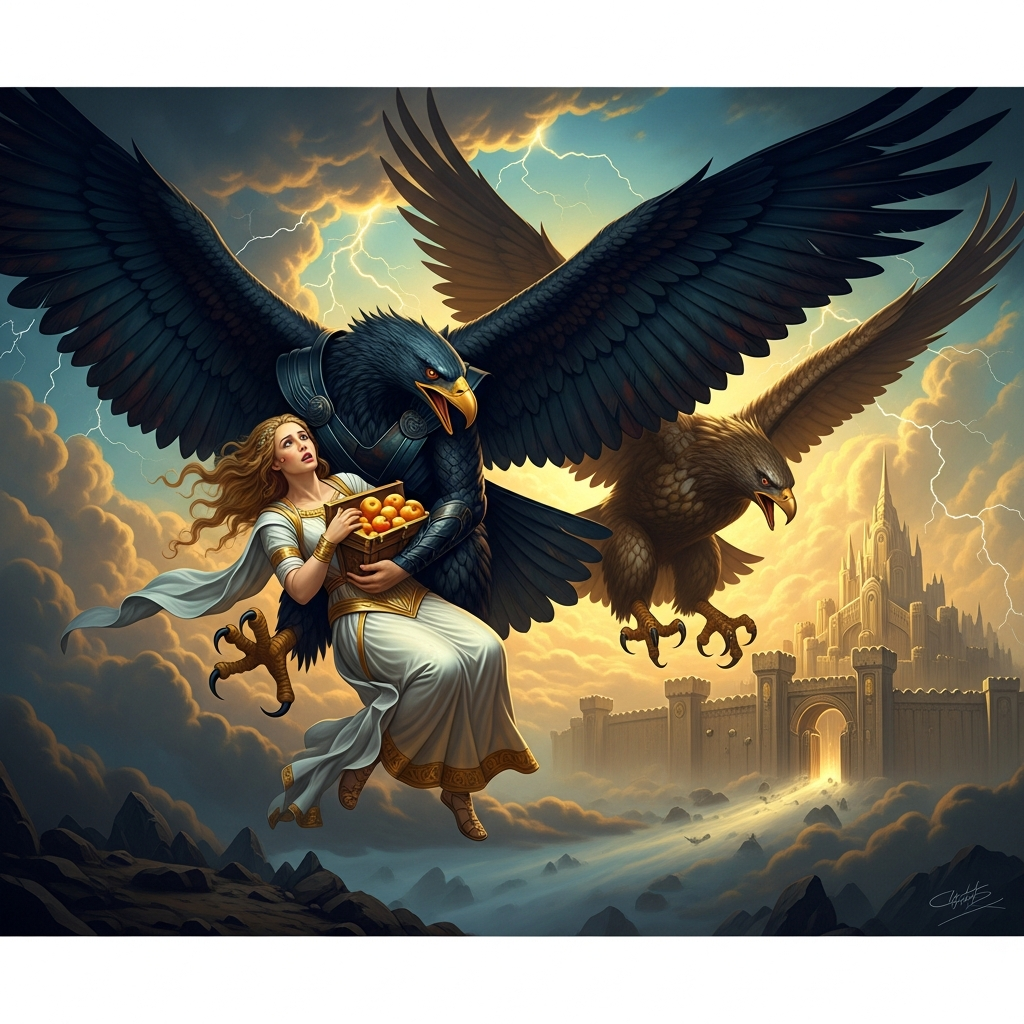
Thjazi, in eagle form, came down from the sky. He seized Idun in his talons. He lifted her, casket and all, into the air. He flew east, to Jotunheim, the land of the giants, and there he kept her in his hall.
Loki watched Idun disappear into the eastern sky. He turned and walked back to Asgard alone.
—
For a few days, nothing happened.
Then the gods began to notice things.
Bragi, the god of poetry, noticed that there was a streak of gray in his beard that had not been there the morning before. He pulled it out. The next morning, two more had grown back.
Frigga, the queen of the gods, noticed lines forming around her eyes. She had not seen them yesterday. She rubbed at them. They did not disappear.
Thor lifted his hammer one morning and felt, for the first time he could remember, a small pang in his shoulder. It was not exhaustion. It was something else.
Within a week, every god in Asgard had visibly aged. Hair was graying. Skin was sagging. Eyes were dimming. Hands were trembling slightly when they reached for cups. Heimdall, who could see for nine days’ ride in any direction, was finding the horizon blurry. Odin, who knew everything, could no longer quite remember the names of certain runes.
The gods convened.
They sat around the great table at the Thingvellir of Asgard, looking at each other in the new pallid light, and someone — possibly Frigga, possibly Bragi, the texts vary — said: Where is Idun?
Idun’s seat was empty. It had been empty for days. No one had thought to ask.
The gods, alarmed, conducted an investigation. Who had last seen Idun? When? Doing what? With whom?
The answer came back: She was last seen leaving the gates of Asgard with Loki, several days ago, on some unspecified errand.
The gods looked at Loki.
—
Loki, faced with a hall of rapidly aging deities all staring at him, panicked.
He confessed everything. Thjazi, the eagle, the bargain. He told them where Idun was — in Jotunheim, in Thjazi’s hall.
The gods were furious. Some of them were inclined to kill Loki on the spot. Others — wiser, calmer, despite their new wrinkles — pointed out that killing Loki would not bring Idun back. The only being in Asgard who could plausibly retrieve her was Loki himself, and Loki could only retrieve her if he was alive.
The gods made the deal. Loki would go to Jotunheim. He would bring Idun back. If he succeeded, his betrayal would be set aside. If he failed, every god in Asgard would have a piece of him.
Freyja, the goddess, lent Loki her falcon-shape — a feathered cloak that allowed the wearer to fly as a falcon. Loki put it on. He launched from the wall of Asgard. He flew east.
—
Thjazi, fortunately for Loki, was not at home.
Idun was alone in the giant’s hall, sitting in a corner, holding her ash-wood casket close to her chest. She had been weeping for days, but quietly. She looked up as the falcon flew in through the high window.
Loki landed on the floor. He turned briefly back into his god-shape to speak to her. He told her: I came for you. There is no time. I am going to turn you into something I can carry. Hold still.
He spoke a quick spell — Loki was, as always, a competent magician — and Idun, with her casket pressed against her chest, was reduced to the size of a single hazelnut. She fit in his beak. He took her up. He launched out the window.
He flew.
Behind him, in his hall, Thjazi returned and found his prisoner gone. He found falcon-feathers on the floor where Loki had landed. He understood immediately. He went outside. He put on his eagle-shape — Thjazi was a giant of considerable magic, and he had his own bird-form, much larger and more powerful than the falcon — and he launched into the sky in pursuit.
The chase was on.
—
Loki, with the nut in his beak, flew west toward Asgard. Behind him, gaining, came the eagle.
Thjazi was faster than Loki. The eagle’s wing-stroke was longer. He was closing the distance steadily. By the time Loki was halfway home, the eagle was visible in the sky behind him; by three-quarters of the way, the eagle was a few wing-beats behind; by the last leagues to Asgard, the eagle was almost upon him.
Loki was tiring. He could feel his wing-beats slowing. The nut in his beak was — though small — heavy with the weight of a goddess and a casket of golden apples. He pushed himself onward.
He could see Asgard’s walls now. He could see the gods on the walls.
The gods saw him too. They saw the falcon coming, the pursuing eagle behind. Odin shouted instructions. The Aesir, suddenly busy, ran to the great pile of wood-shavings that the woodcutters kept along the inner wall — the kindling for the hall fires. They piled it high along the outer wall. They lit it.
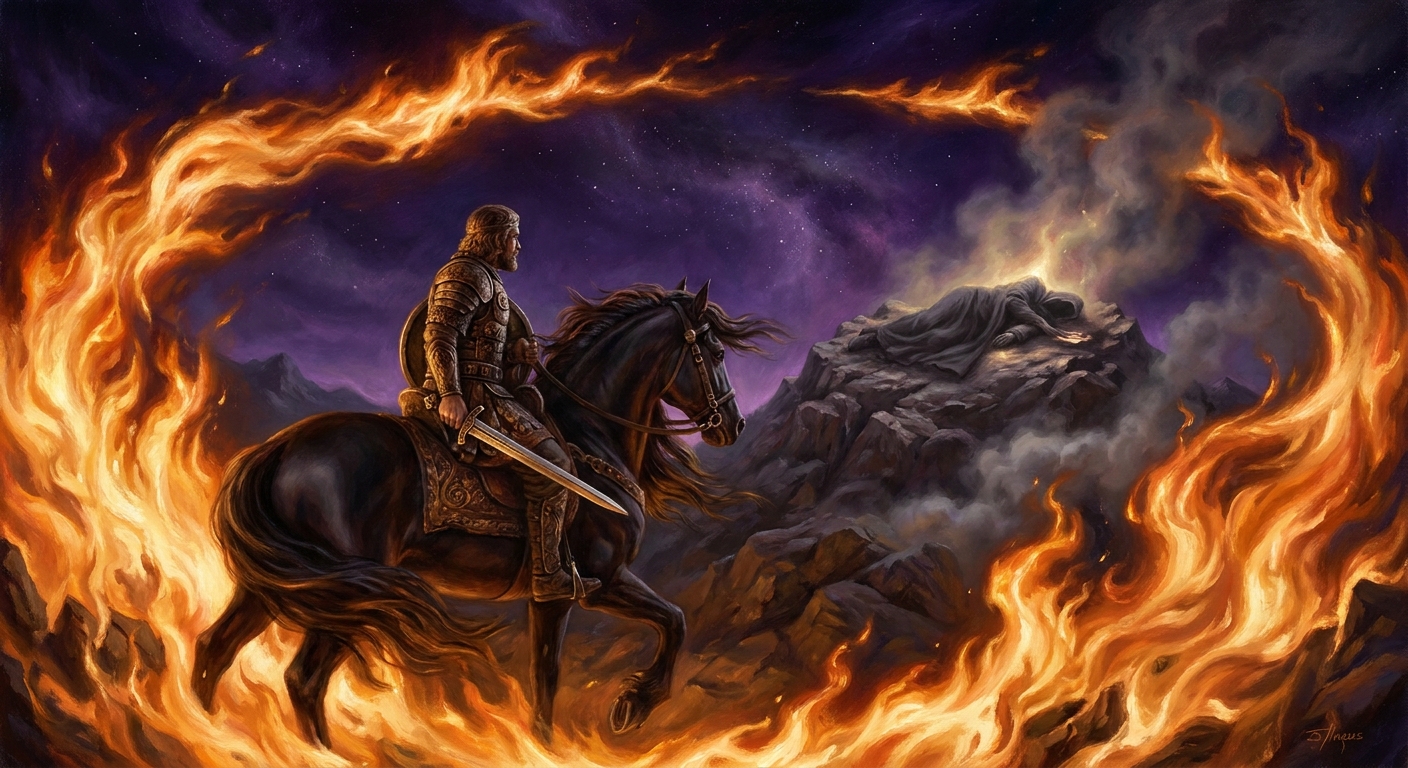
A wall of fire rose along the parapet, just inside the wall.
Loki, exhausted, crossed the wall. He flew over the fire. He landed in the courtyard inside, dropped the nut on the flagstones, and collapsed.
Thjazi, immediately behind him, did not have time to slow down. He hit the wall of flame at full speed. His wings — his enormous eagle wings, made of a giant’s feathered cloak — caught fire. He could not pull up. He crashed into the flames, was burned, and fell to the courtyard floor on the inside, blackened, dying.
The gods, ringed around the courtyard, finished the giant off with their swords. Thjazi was dead.
Loki, panting in the courtyard, turned the nut back into Idun. She rose, slightly bewildered, holding her casket. She opened it. The golden apples were inside, untouched, gleaming.
She handed them out, one each, to the assembled gods. Each god ate his apple. Within hours, the gray hair was darkening. The wrinkles were fading. The trembling hands were steady. Within a day, the Aesir were as young as before.
The crisis was over.
—
There were, as always with Norse stories, consequences.
Thjazi had a daughter — Skadi — who lived in the high mountains and who, when the news of her father’s death reached her, came down to Asgard in full armor demanding weregild. The story of Skadi’s negotiation with the gods, her marriage to Njord, and the laughter Loki finally extracted from her with a goat is told in another myth — and in fact begins where this one ends, with Thjazi’s body smoking in the Asgard courtyard.
Loki was, in the immediate aftermath, forgiven. He had, after all, retrieved Idun. The Aesir set aside his role in causing the crisis on the grounds that he had also resolved it. This forgiveness pattern — Loki causes a crisis, Loki resolves the crisis, Loki is forgiven — would repeat several times in the mythology before, finally, the Aesir would tire of it and bind Loki under a venom-dripping serpent until the end of the world.
But for now, Asgard’s walls were intact. Idun was at her seat. The apples were on the table. Each god ate his daily portion the next morning, and the next, and the next. The maintenance schedule was restored. The gods were, again, as young as they wanted to be.
Until Ragnarok, of course. But that is many stories away. Tonight, in this story, the apples are golden, the goddess is home, and the trickster is forgiven once more, and the long machine of Aesir immortality is humming again as if nothing had ever broken in it.
Scenes
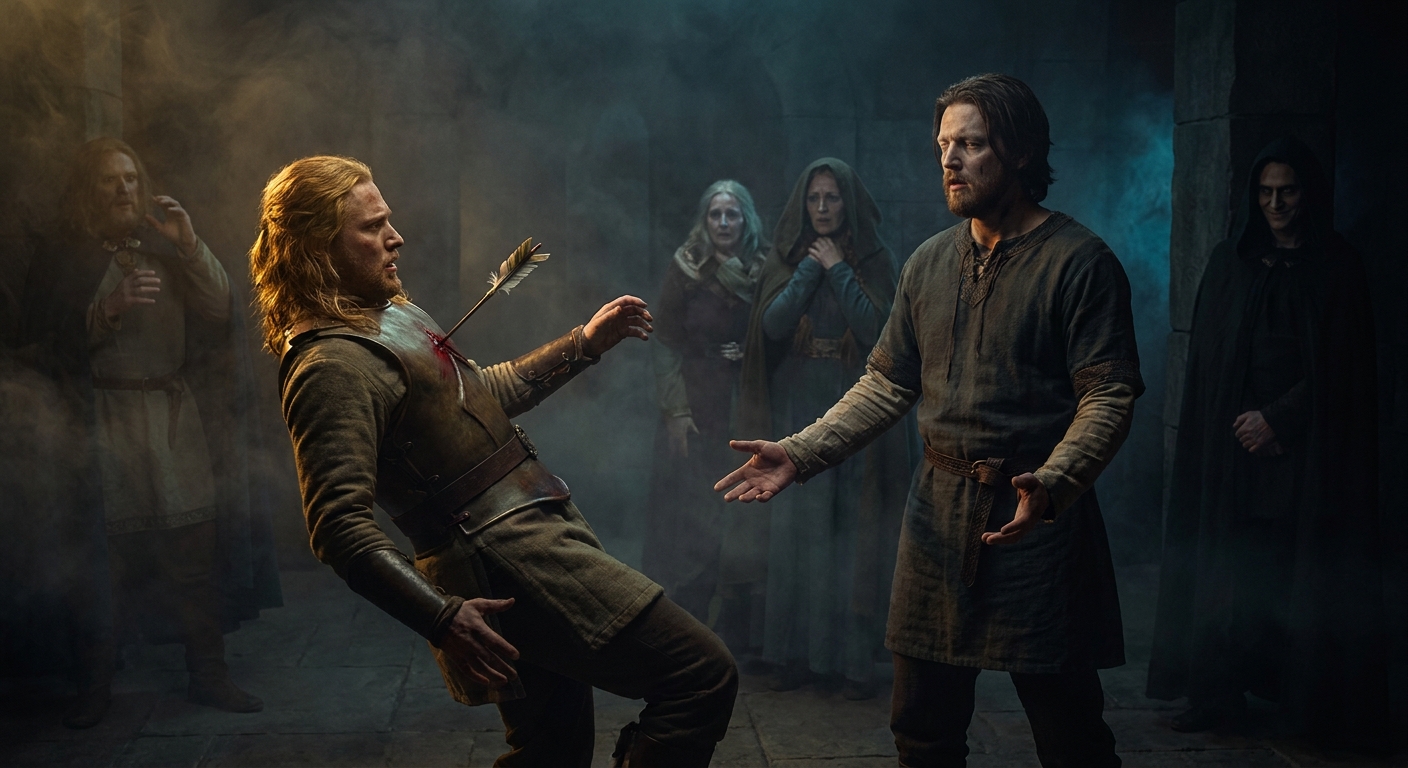
In a forest clearing, Odin, Hoenir, and Loki sit around a fire roasting an ox
In an Asgard hall, Bragi notices a streak of gray in his beard
Above the wall of Asgard, a falcon streaks toward the gates clutching a small nut in its talons
Echoes Across Traditions
Entities


Sources
- Snorri Sturluson, *Prose Edda* (Skáldskaparmál, c. 1220 CE)
- *Poetic Edda* — Haustlöng (Þjóðólfr of Hvinir, c. 900 CE)
- Carolyne Larrington (trans.), *The Poetic Edda* (1996)
- Anthony Faulkes (trans.), *Edda* (1995)
- John Lindow, *Norse Mythology* (2001)