The King Opens His Own Flesh to Feed the Gods
c. 600-800 CE — Classic Maya period; best documented at Yaxchilán, Palenque, Copán · Yaxchilán, Chiapas; Palenque, Chiapas; Copán, Honduras — the major sites with bloodletting imagery
Contents
The bloodletting ritual at the heart of Classic Maya kingship required the ruler — and often the queen — to pierce their own tongue, earlobes, or genitals with stingray spines and obsidian blades, letting blood fall onto paper, burning the blood-soaked paper, and entering the vision state that brought the ancestors.
- When
- c. 600-800 CE — Classic Maya period; best documented at Yaxchilán, Palenque, Copán
- Where
- Yaxchilán, Chiapas; Palenque, Chiapas; Copán, Honduras — the major sites with bloodletting imagery
Lady Xoc kneels on the stone floor.
The carved limestone lintel from Yaxchilán — Lintel 24, in the British Museum — shows the moment with the clarity of a documentary photograph in stone. Lady Xoc, wife of Shield Jaguar II, kneels on the floor of a dimly lit room. Her costume is extraordinary: jade jewelry, an elaborate headdress, a cloth decorated with the complex patterns of the Maya aristocracy. Her husband stands above her holding a torch.
She is drawing a thorn-studded rope through her tongue.
The blood falls from her mouth onto a paper-filled basket below her. The paper will be burned. The smoke will rise. The ancestors will come in the smoke.
This is the bloodletting ritual, the central act of Classic Maya royal ceremony, the act by which the king and queen maintain the relationship between the living and the divine that justifies their political authority. The blood is not spilled as punishment, not shed in grief, not lost to injury. It is a carefully managed gift, offered in the most precise location — the tongue, the organ of speech, the place from which words come — to the beings who require it to be present.
The gods must be fed.
This is a fundamental axiom of Mesoamerican theology that cuts across all civilizations and periods: the divine powers are not self-sustaining. They require blood. Specifically, they require human blood — the most potent of substances because it carries the divine spark that was put into humans at creation, the specific material that the gods’ own sacrifice contributed to the making of people.
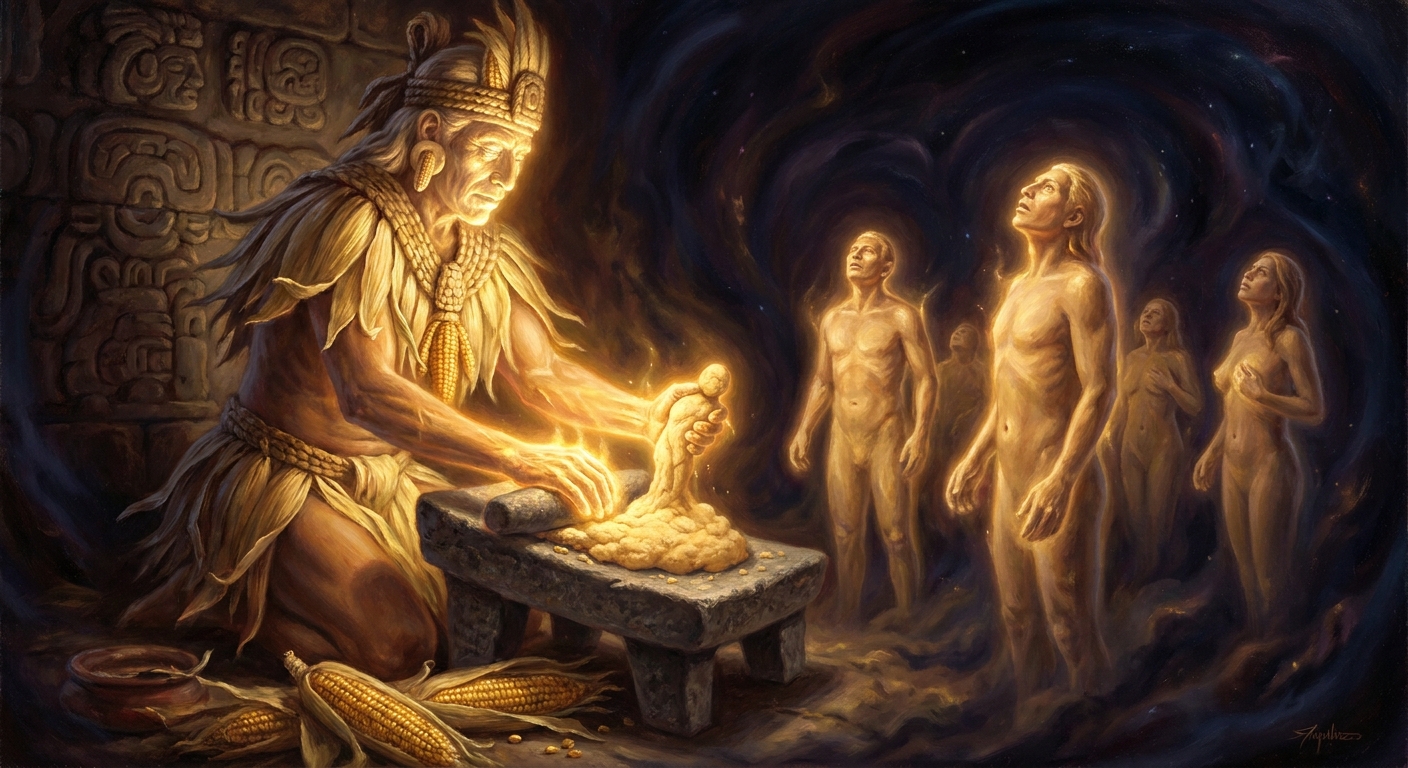
In the Popol Vuh: the first true people were made of corn. In the Aztec tradition: the first people were made of the gods’ blood ground with bone. In both cases, the people carry divine substance in their bodies, and when they bleed, they return that substance to the beings who gave it.
The bloodletting is not sacrifice in the sense of killing. It is a withdrawal of savings.
The Maya rulers bled themselves not just with ropes through the tongue but with stingray spines pushed through the earlobes, the fleshy part of the ear, sometimes through the penis — the most productive of offerings in terms of symbolism, though the least commonly depicted in public art. The obsidian blades and the stingray spines, the instruments of the bloodletting, are among the most commonly found objects in Maya elite burials and caches.
The Vision Serpent appears in the smoke.
Lintel 25 at Yaxchilán — the companion piece to the bloodletting lintel — shows Lady Xoc after the ceremony. The blood-soaked paper has been burned. From the smoke rises an enormous serpent, the Vision Serpent of Classic Maya art, whose open mouth contains the head of an ancestor warrior. Lady Xoc reaches toward the serpent. The warrior in the serpent’s mouth reaches back.
This is the purpose.
The bloodletting does not simply please the gods; it opens a channel between the living and the dead. The specific altered state induced by blood loss — particularly in a ceremonial context with fasting, copal smoke, chanting, and the focused attention of community ritual — produces visions. The Maya understood these visions as genuine contact with ancestral beings, with the lords of the underworld, with the forces that maintain the cosmic cycle.
The king and queen who bleed are the antennas of their community.
Their willingness to open their own bodies in the most intimate places — the tongue that speaks, the ear that hears, the genitals that generate — is the proof of their seriousness, the demonstration that they are not performing religion but conducting it. Anyone can make offerings of food and incense. The ruler gives what only the ruler can give: the blood of the lineage, the specific blood that traces back to the divine ancestors who established the right to rule.
Lady Xoc kneels and bleeds.
The serpent rises.
The ancestor speaks.
The community knows its rulers maintain the channel open.
Echoes Across Traditions
Entities
- Lady Xoc of Yaxchilán
- Shield Jaguar of Yaxchilán
- Pacal of Palenque
- the Vision Serpent
Sources
- Linda Schele and Mary Ellen Miller, *The Blood of Kings: Dynasty and Ritual in Maya Art* (Kimbell Art Museum, 1986)
- Linda Schele and David Freidel, *A Forest of Kings* (William Morrow, 1990)
- Mary Miller and Karl Taube, *An Illustrated Dictionary of the Gods and Symbols of Ancient Mexico and the Maya* (Thames & Hudson, 1993)