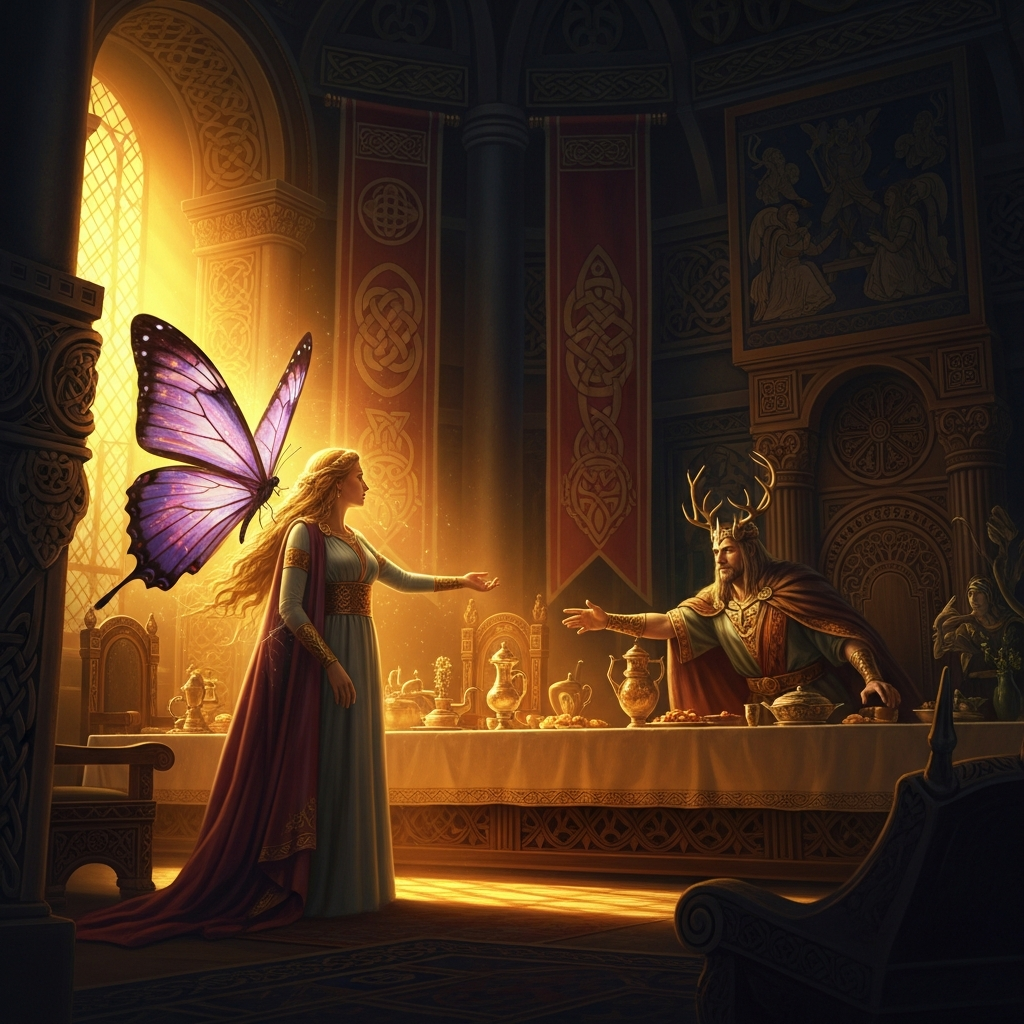
Étaín and the King of the Otherworld
mythic age of the Tuatha Dé Danann — centuries of transformation followed by the mortal age of Ireland · The fairy mounds of Ireland, and the hall of the High King at Tara
Contents
Transformed by a jealous goddess into a butterfly that blows across Ireland for seven years before being swallowed and reborn as a human woman, Étaín is the most beautiful creature in three worlds — and the Otherworld king who loved her first never stops searching through her forgetting.
- When
- mythic age of the Tuatha Dé Danann — centuries of transformation followed by the mortal age of Ireland
- Where
- The fairy mounds of Ireland, and the hall of the High King at Tara
She is the most beautiful woman in the three worlds, which is the beginning of all her trouble.
Midir of the Tuatha Dé Danann loves Étaín with the absolute focus that characterizes divine love: no hedging, no reservation, the whole capacity of an immortal being directed at one person. He brings her to his hall. His first wife Fuamnach, who is a druid-woman of considerable power, looks at the new wife and makes her calculations.
Fuamnach strikes Étaín with a rod of rowan and turns her into a pool of water.
The pool evaporates. The vapor becomes a worm. The worm becomes a purple butterfly, the most beautiful butterfly in the world, whose wings beat a fragrance into the air that heals the sick and refreshes the weary.
Midir knows the butterfly is Étaín. He keeps her with him. Fuamnach finds out and calls a wind that blows the butterfly away from the fairy mound — a wind that lasts for seven years and carries Étaín across every province of Ireland without letting her settle.
At the end of seven years she finds Óengus Óg’s crystal bower on the Boyne. He makes her a shelter. He knows who she is. She sleeps there in her butterfly form for a time. Fuamnach finds her again and raises the wind again.
After seven more years the butterfly, exhausted, falls into a cup of wine on the table of a noblewoman in Ulster. The noblewoman drinks.
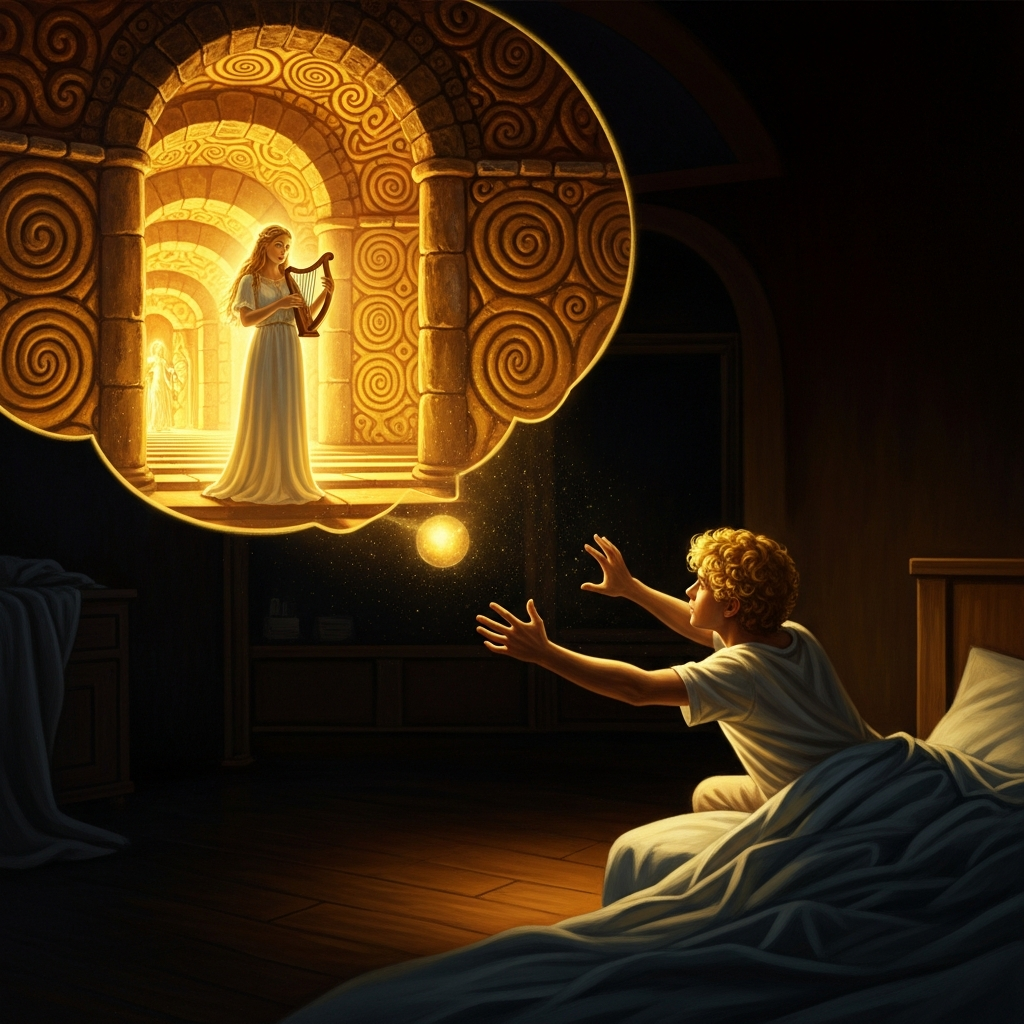
Étaín is reborn as the noblewoman’s daughter — entirely human, with no memory of being Étaín, no memory of Midir, no memory of the butterfly or the seven years of wind. She grows up knowing only that she is the most beautiful woman in Ireland, which she is, in a different body in a different century.
Eochaid Airem, High King of Ireland, hears of her beauty and marries her. She is his queen. She is happy, by all accounts, in the limited way of a woman who is missing three thousand years of her own history but doesn’t know it.
Midir comes to Tara.
He plays fidchell with Eochaid and wins, and his prize is a kiss from the queen. She turns toward the stranger at the feast-table — this beautiful Otherworld man she has never met — and something stirs in the buried memory below everything she knows herself to be. Midir takes the kiss.
He sings to her: O fair-haired woman, will you come with me to the marvelous land where there is music? Hair there is like the primrose flower, bodies are the color of snow. There, no mine and thine, white are the teeth there, dark the brows.
He asks if she remembers.
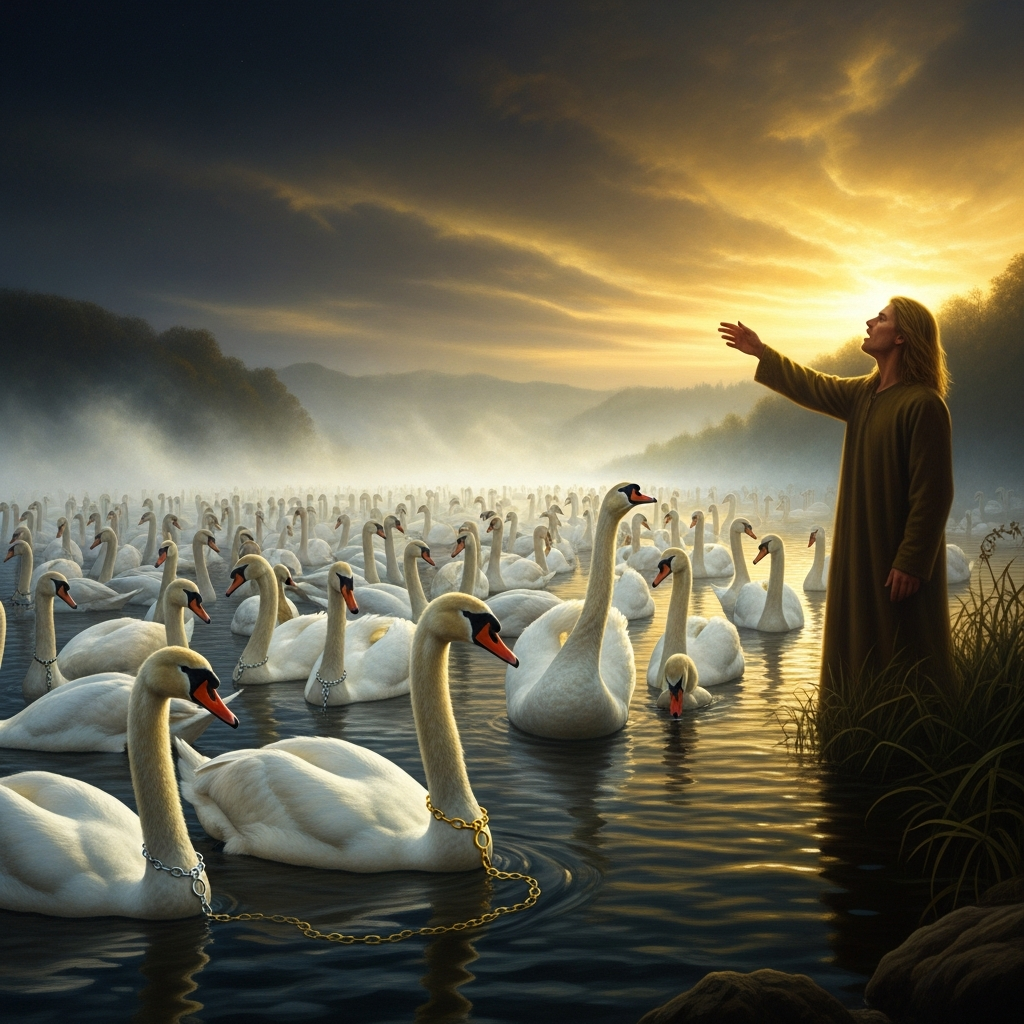
She doesn’t. Or she almost does. The myth holds the ambiguity: whether the woman who eventually goes with Midir is Étaín choosing, or the mortal queen Étaín compelled by an identity she cannot access consciously. They rise together from the feast-hall floor as two white swans and fly through the skylight and are gone.
Eochaid tears open the fairy mounds of Ireland looking for her. He finds her eventually — but this is a different story, with a different ending, and different opinions about whose love had the stronger claim.
The butterfly does not remember the seven years of wind. The woman does not remember the butterfly. But the identity persists through all of it, persistent as a frequency that continues below the range of hearing, until someone plays the right note and the whole chord sounds again.
Echoes Across Traditions
Entities
- Étaín
- Midir
- Fuamnach
- Óengus Óg
- Eochaid Airem
- Ailill
Sources
- Jeffrey Gantz, trans., 'Tochmarc Étaíne,' in *Early Irish Myths and Sagas* (Penguin, 1981)
- Máire Herbert, 'The Universe of Male and Female,' in *Celtic Languages and Celtic Peoples* (1992)
- Alwyn Rees and Brinley Rees, *Celtic Heritage: Ancient Tradition in Ireland and Wales* (Thames and Hudson, 1961)