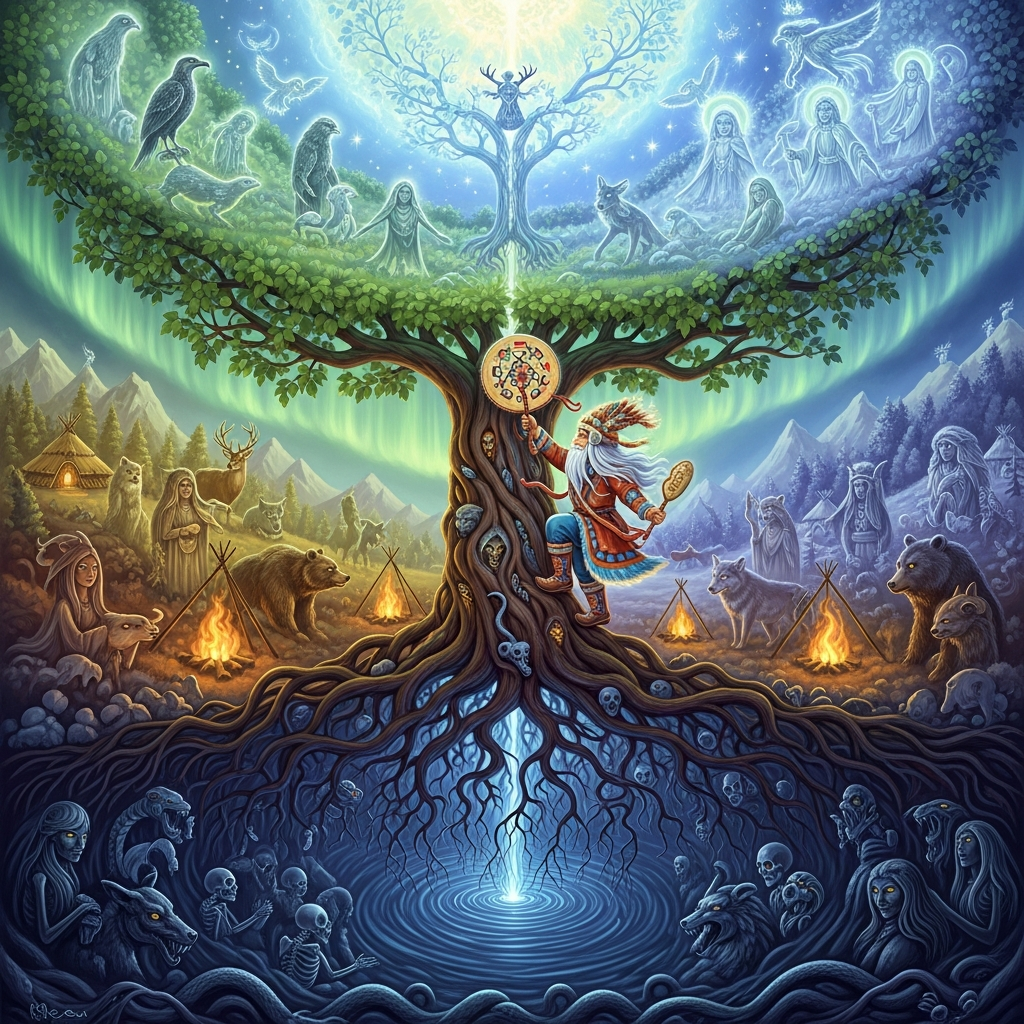
The Three Worlds of the Shaman's Cosmos
Oral tradition; documented from 17th–20th century CE across Siberia, Kazakhstan, Mongolia, and Turkic Central Asia · The Siberian taiga; the steppe; the world between worlds
Contents
In Siberian and Turkic shamanic cosmology, existence is divided into three worlds connected by a World Tree (or World Mountain): the Upper World of the sky gods and celestial beings, the Middle World of humans and spirits, and the Lower World of the dead and chthonic powers. The shaman is the one who can travel between all three — not as a priest who intercedes, but as a psychopomp who physically journeys.
- When
- Oral tradition; documented from 17th–20th century CE across Siberia, Kazakhstan, Mongolia, and Turkic Central Asia
- Where
- The Siberian taiga; the steppe; the world between worlds
The tree stands at the center of everything.
It grows from somewhere below the roots of the world, its trunk passing through the earth and rising into the sky without any visible top, its branches lost in a blue that is also a ceiling and also an opening. This is the World Tree — the axis mundi, the cosmic pillar — and the shaman knows where it is.
The shaman is the only one who can climb it.
In the Middle World, where ordinary people live, the World Tree is not usually visible. It is there — its roots run through every forest, its presence is felt in the way a sacred grove feels different from an ordinary one, in the way certain mountains and certain rivers carry a weight that is not geological — but ordinary people move through it without seeing it clearly. The landscape of the Middle World is the landscape of human experience: birth and sickness and harvest and war and the daily negotiation with the animals and the weather.
But the Middle World is also full of spirits.
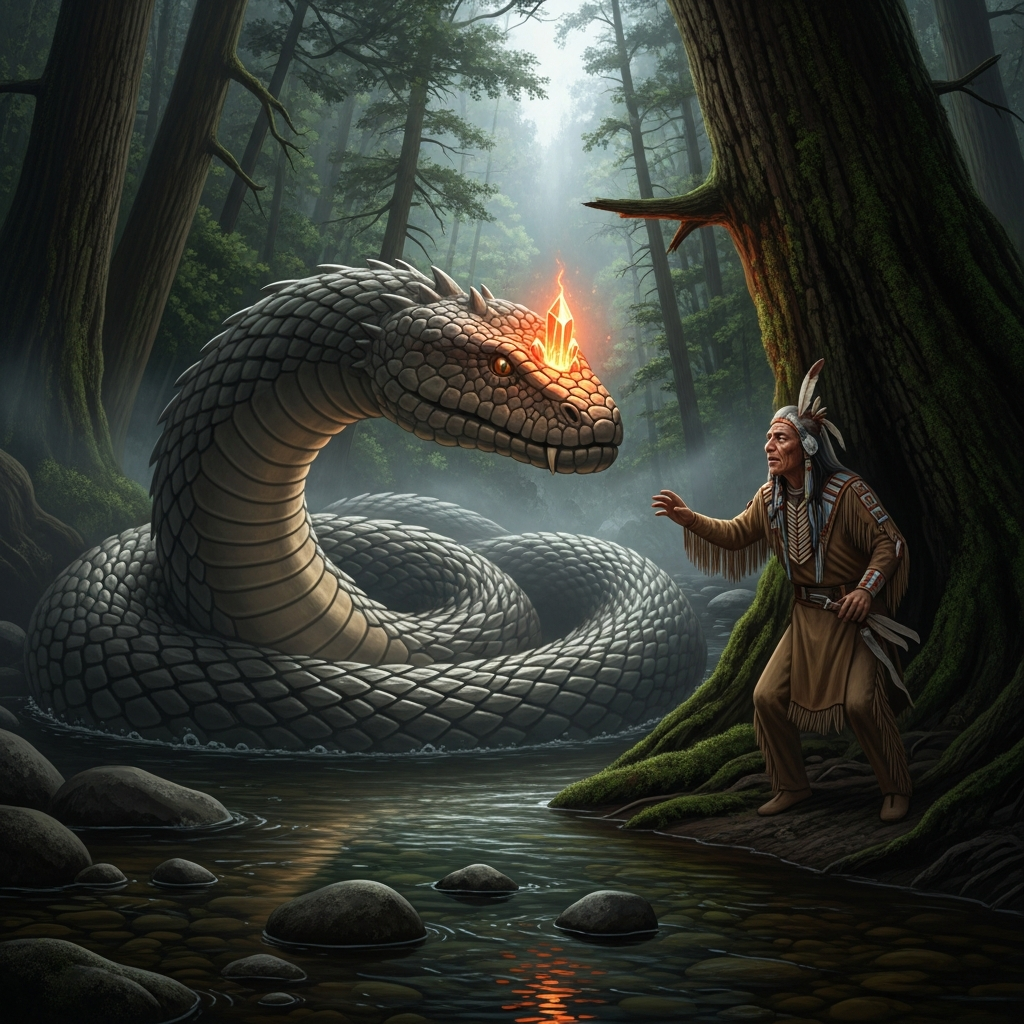
Every river has a master spirit (iye, in some Siberian languages). Every mountain, every forest grove, every unusual rock formation. The spirits of the ancestors move through the Middle World for a time before they proceed to the Lower World. Animal spirits — the real animals’ invisible counterparts — walk the same paths as the animals themselves. The Middle World is not the disenchanted world of modern experience; it is a landscape crowded with presences that require acknowledgment, propitiation, negotiation.
The shaman is the specialist who negotiates.
Above the Middle World, the Upper World rises in layers.
Different traditions count the layers differently: some say three, some say seven, some say nine or seventeen. Each layer is ruled by a different celestial being — in Turkic traditions, the highest level belongs to Tengri, the Eternal Sky. The beings of the Upper World are, on the whole, beneficent. They are the source of sun and rain, of favorable weather, of the divine commission that legitimate rulers carry. They are distant. Reaching them requires a long climb.
The shaman ascends to the Upper World on the back of a bird — sometimes literally, in ceremony, wearing a costume that includes feathers — or by climbing a series of trees whose branches connect the layers. The journey upward is arduous and requires preparation: the shaman must be in a particular state, achieved through drumming, through the plant medicines specific to each tradition, through the trance that is not sleep but something else, a directed attention that keeps the ordinary body present while the spirit body moves.
In the Upper World, the shaman seeks things the community needs: the return of a stolen soul, knowledge of coming weather, the blessing of the higher powers for a specific undertaking. The celestial beings may require gifts or simply the correct address — each one has a specific protocol, specific forms of respect, and the shaman who does not know these will not receive help.
Below the Middle World, the Lower World descends.
It is not hell. This is the crucial distinction that Western observers consistently misread: the Lower World of Siberian shamanism is not a place of punishment. It is where the dead go — the majority of the dead, those who are not ancestral shamans themselves or exceptional dead who remain near the Middle World for a time. It is also where certain powers live that are essential to life: the masters of game animals, the root forces of the earth, the source of iron ore and the knowledge of how to work it.
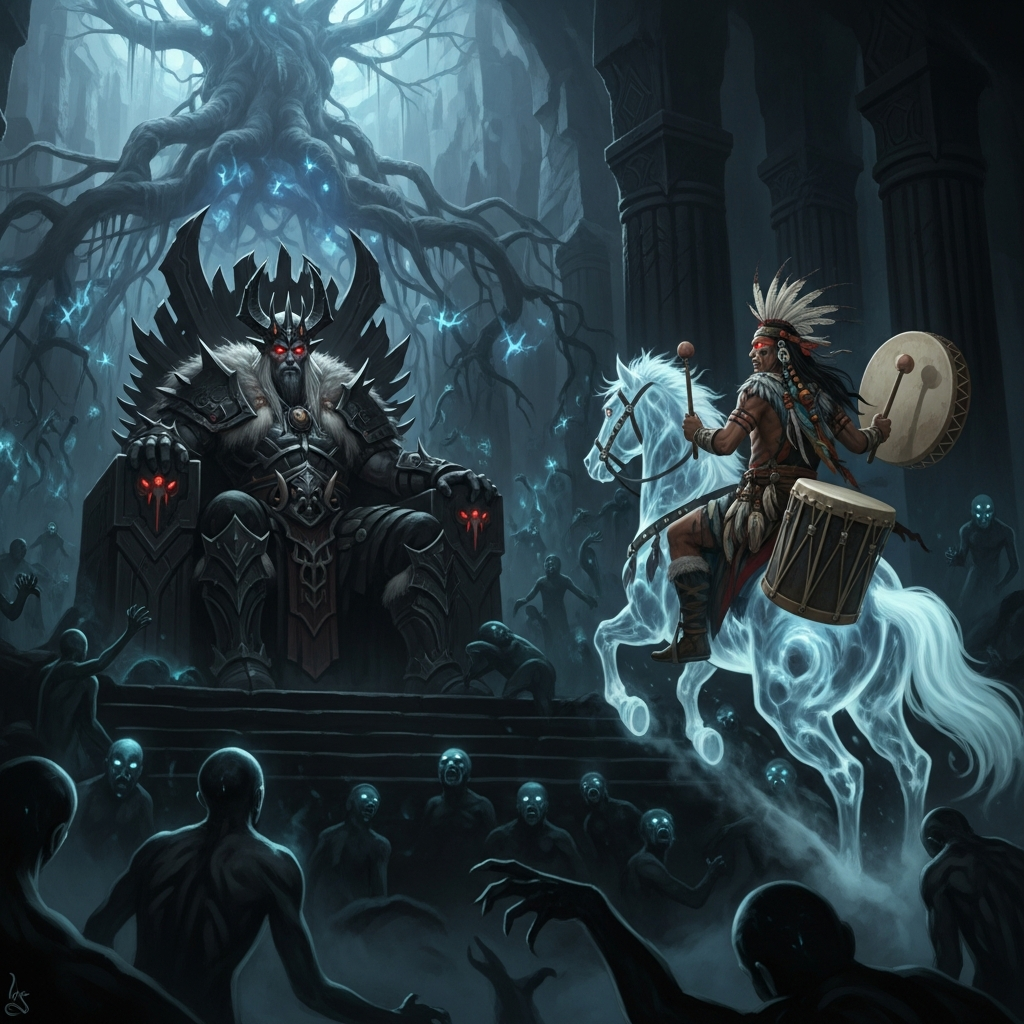
Erlik governs the Lower World in Turkic cosmology — not as a devil but as a judge and administrator, a figure of formidable power who can be negotiated with but not fooled. He has daughters who can assist the visiting shaman. He has bureaucrats who manage the dead. He has preferences about how his realm is entered and exited.
The shaman who descends to the Lower World does so typically for one purpose: to retrieve a soul that illness has stolen. Illness, in this cosmology, is often understood as soul-loss — the departure of some part of the self under stress or fright or through the action of a hostile spirit. The missing piece has gone down and must be brought back. This is what the shaman does: descends, finds the soul piece, negotiates for its return with whatever has taken it, and climbs back.
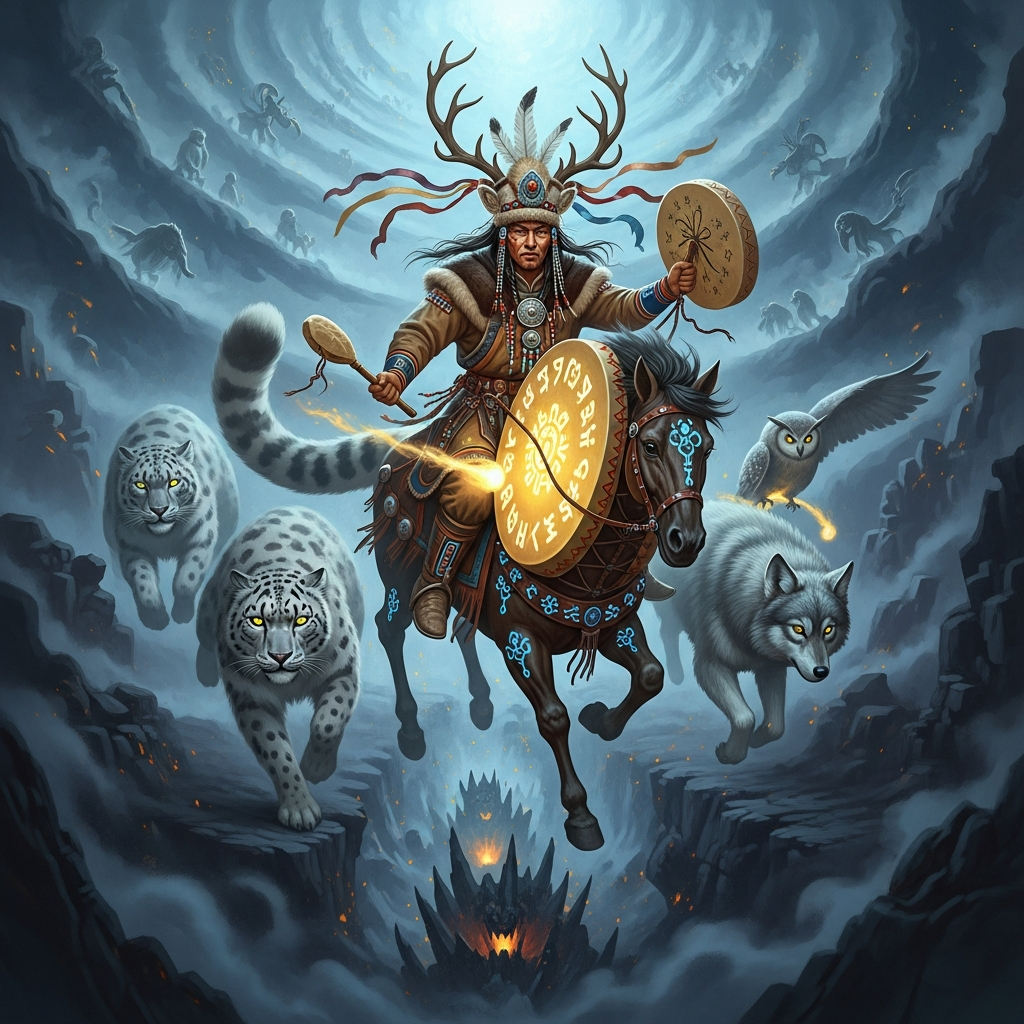
The journey has a shape: down the World Tree, through the passage, into the Lower World, the negotiation, the return. Every element of this shape has a corresponding element in the ritual performance — the drum is the shaman’s horse that carries them down, the costume marks the spirit body, the chanting is both the journey map and the negotiation script.
The drum is the axis.
In the ceremony, the drum is the World Tree held horizontally — its circular form represents the cosmic disc, and the drumbeats are the hoofbeats of the spirit horse that the shaman rides. The tree and the horse and the drum are three names for the same instrument of travel: the thing that carries the shaman’s attention between the worlds.
When the shaman begins to drum, the rhythm pulls the attention out of ordinary Middle-World time. The people who sit with the shaman in ceremony feel it: the room changes quality. The air feels different. Something is happening that is not quite happening in the ordinary way that things happen.
The shaman’s body is still in the room. Their spirit body is already climbing.
The three-world structure answers a problem that every religious tradition eventually confronts: why does the sky seem empty when you look at it, and where do the dead go, and how do you get from here to either?
The Siberian answer is that the sky is not empty — it is full, and it is layered, and above it there are more layers, each one containing beings whose existence is as real as yours — and that the dead go down, not out, into a lower world that is also full and organized and accessible if you know how to descend.
The World Tree is the answer to how: it connects everything. It is the point in the cosmos where all three worlds can be reached from any of the others. It is the fact of connection itself made visible as a tree — because a tree is what the forest taught as the image of things that are simultaneously rooted in the earth and reaching toward the sky.
The shaman climbs it. They have always climbed it. They will be climbing it long after the ceremony is over, long after the drum falls silent, because the World Tree does not stop being the World Tree when no one is watching it.
It is the center. The center does not sleep.
Echoes Across Traditions
Entities
- the shaman (kam)
- the World Tree
- Tengri (sky god)
- Erlik (underworld god)
- the animal spirit helpers
Sources
- Mircea Eliade, *Shamanism: Archaic Techniques of Ecstasy* (Bollingen/Princeton, 1951/1964)
- Uno Harva (Holmberg), *Die Religiösen Vorstellungen der altaischen Völker* (Academia Scientiarum Fennica, 1938)
- Ronald Hutton, *Shamans: Siberian Spirituality and the Western Imagination* (Hambledon and London, 2001)
- M.A. Czaplicka, *Aboriginal Siberia: A Study in Social Anthropology* (Oxford, 1914)
- Anna-Leena Siikala, *The Rite Technique of the Siberian Shaman* (Academia Scientiarum Fennica, 1978)
- Piers Vitebsky, *The Shaman* (Macmillan, 1995)