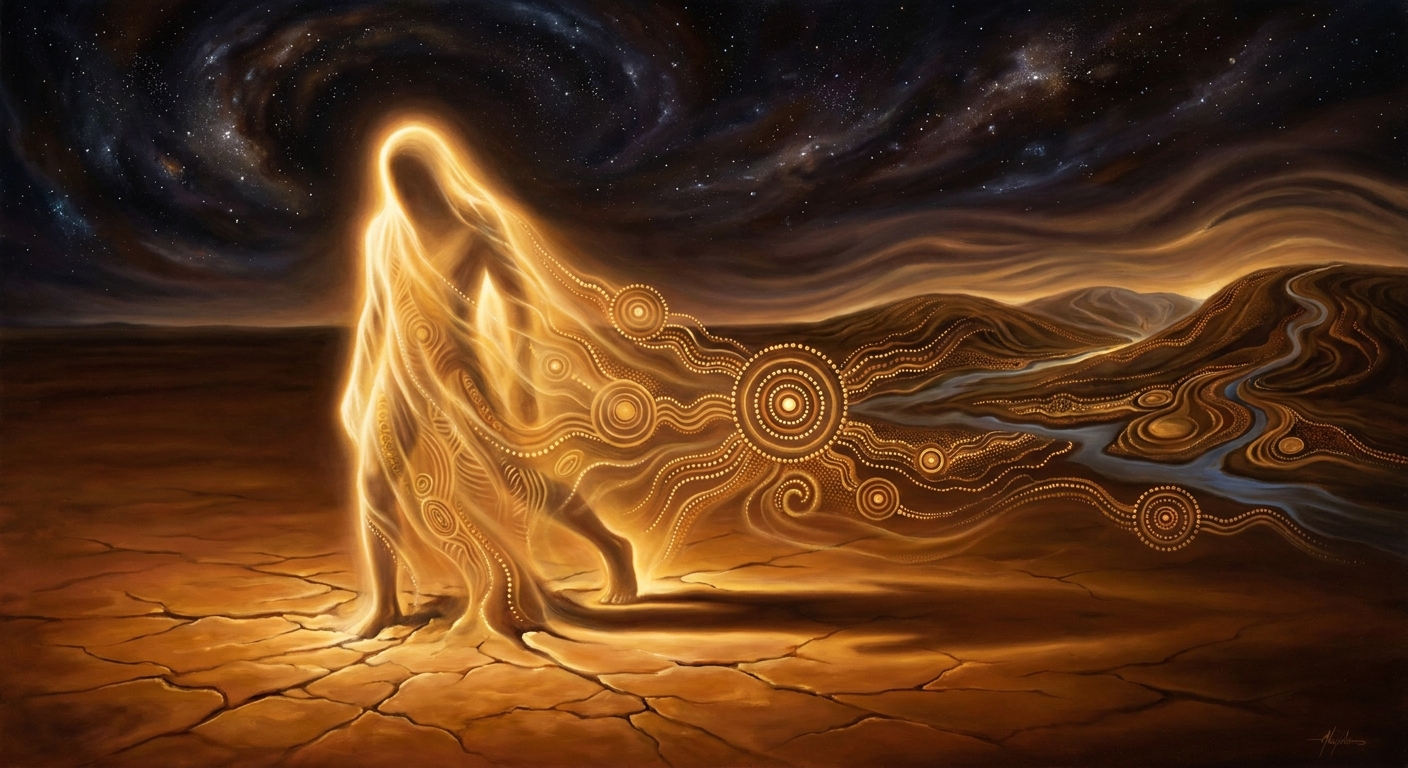
The Sand Story: The Desert as a Living Book
traditional time — the ongoing practice · The Tanami Desert, Northern Territory — Warlpiri homeland in the red sand country
Contents
Warlpiri women of Central Australia tell stories by drawing in the sand with their fingers — a sophisticated narrative system where the drawings are both the story and the cosmological map, erased and redrawn each time, impermanent and eternal simultaneously.
- When
- traditional time — the ongoing practice
- Where
- The Tanami Desert, Northern Territory — Warlpiri homeland in the red sand country
She draws a circle.
One smooth arc in the red sand, the woman’s finger moving with practiced confidence. The circle becomes a sitting person — a U-shape inside it, the standard representation that children learn before they learn to speak. The oldest children watching know immediately: this is a person sitting. The younger children are still learning, and this is how they learn — by watching.
She draws another circle. Inside it, another U-shape. A second person.
She draws a meandering line between the two circles: the path they traveled. A short broken line off to the side of the path: the camp they stopped at. An arc of small marks: the hills on the horizon. She has been drawing for thirty seconds and the ground in front of her is already a map and a story simultaneously — she will narrate it as she draws it, and the drawing will inform the narration, and neither can be separated from the other.
This is the sand story.
The Warlpiri women have been telling stories this way for longer than the tradition has a memory of its beginning. The visual system is standardized — circles are places and people, U-shapes are people sitting, wavy lines are water or journeys, animal tracks are identifiable by their species-specific shapes. But the standardization is not rigid; it is a vocabulary, not a grammar, and the vocabulary allows for the stories to be as simple or as complex as the teller needs.
What the marks encode is not only narrative.
The same U-shape that represents a sitting woman in a children’s teaching story also represents the yam digging position in the story about where to find water in a dry year. The same circle that is a campfire in one story is a sacred site in another. The system is layered: there are public levels that children learn early, and levels that carry sacred knowledge and are restricted, and the deepest levels are known only to the most senior women who hold the full knowledge of their country’s cosmological organization.
The sand story is, in its deepest form, a map of the Dreaming.
She draws the desert this way.
Not a map of what the desert looks like from above — satellite imagery would be better for that. A map of what the desert is: the paths the ancestral beings traveled, the sites where their power remains, the network of obligation and relationship that links the living community to the Dreaming that underlies the physical landscape.
The women’s ceremonies, which are their parallel track of sacred knowledge to the men’s ceremonies, are organized around exactly this knowledge: the relationship between the living community and the Dreaming that the sand story encodes. The ceremonies are performed on the ground, which is the same medium as the sand story — the ground is always the medium, always the text, always the page on which the Dreaming writes its presence.
When the story is done, she erases it.
She sweeps her palm across the drawing and the red sand returns to its undifferentiated state. The children who watched remember what they saw — not the drawing but the knowledge the drawing carried. The drawing was a vehicle for transmission, not a record. The record is in the children’s bodies and memories, where it belongs.
The Dreaming stories do not need to be written down in a form that lasts because the Dreaming itself lasts. The sand story is an opening into what is permanent, not a substitute for it.
She draws another circle.
A new person. A new story. The same desert.
Echoes Across Traditions
Entities
- the Warlpiri women storytellers
- the sand as the medium
- the ancestral beings of the stories
- the children learning the system
- the Dreaming that the drawings access
Sources
- Bell, Diane, *Daughters of the Dreaming* (McPhee Gribble, 1983)
- Munn, Nancy D., *Warlpiri Iconography: Graphic Representation and Cultural Symbolism in a Central Australian Society* (Cornell, 1973)
- Glowczewski, Barbara, *Du reve a la loi chez les Aborigenes* (Paris, 1991)