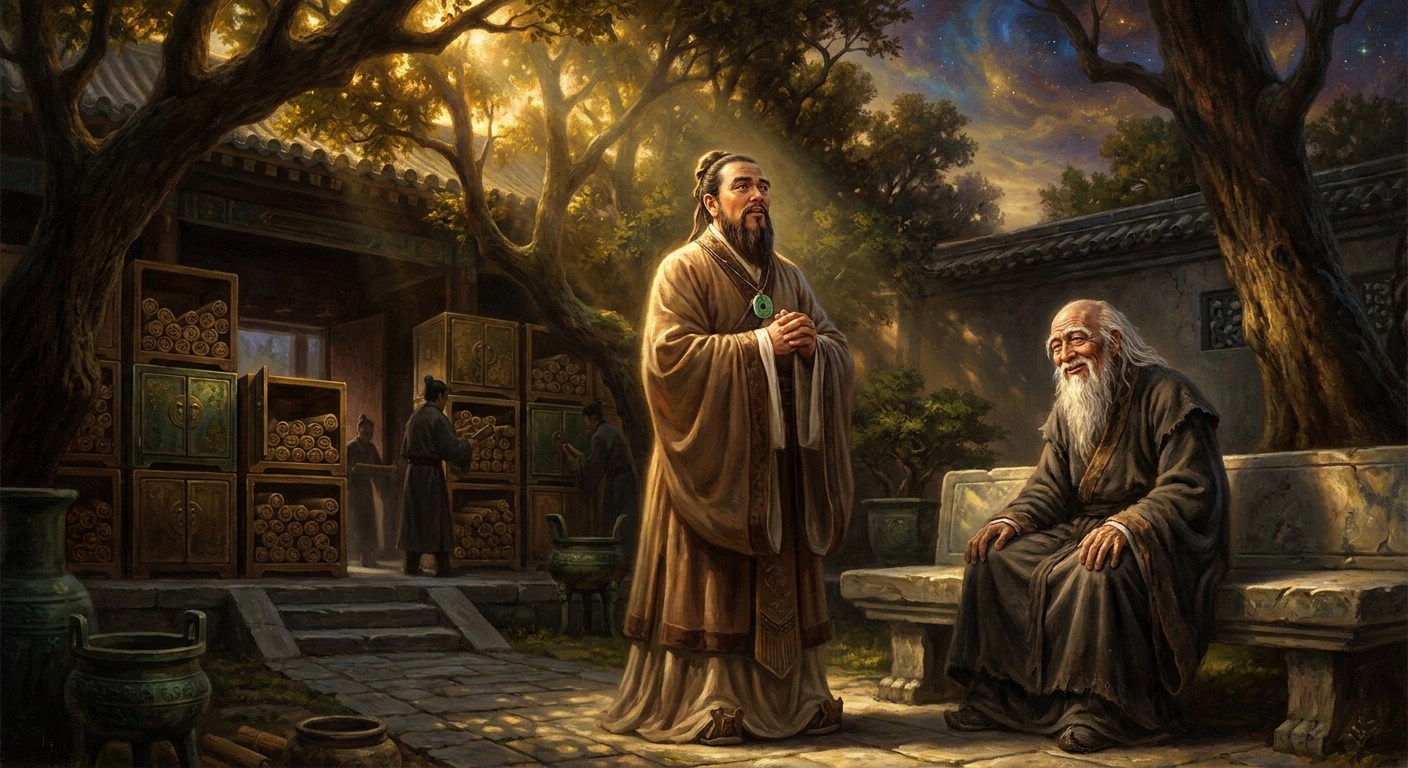
Zhuāngzǐ's Cook: The Ox Already Divided Itself
c. 369-286 BCE — the period of the historical Zhuangzi · The court of Prince Hui of Liang — the setting of the teaching story
Contents
A cook butchers an ox for Prince Hui with such fluid grace that the prince asks for his secret — and the cook explains that he has never learned anatomy, only learned to follow the spaces that are already there.
- When
- c. 369-286 BCE — the period of the historical Zhuangzi
- Where
- The court of Prince Hui of Liang — the setting of the teaching story
The cook works in silence and the silence is not absence of sound.
It is the sound of the knife finding the spaces that are already there — the whisper of blade through the natural gaps between joints, the thud of the cleaver setting through soft tissue where the tissue parts rather than resists, the rhythm of a man whose hands have learned something that his mind stopped directing years ago. Prince Hui watches from the dais and calls out: excellent! your skill is extraordinary!
The cook sets down his cleaver. He wipes his hands. He says: what I work toward is the Tao, which is beyond skill.
He describes his education. When he first began, he saw the whole ox — a solid, large, complex animal requiring a great deal of effort to reduce. He studied. He learned anatomy. He acquired technique. He became skilled in the way that skilled people are skilled: deliberately, through accumulated knowledge of joints and muscle groups and the angles at which tendons separate from bone.
Then something happened.
He stopped seeing the whole ox and started seeing only the spaces. The gaps between joints where the knife slides without resistance. The natural channels in the flesh where the blade passes as through air. The architecture of the animal, which is not a solid mass to be cut through but a structure of relationships, and every structure of relationships has spaces built into it — spaces where the parts are not joined, where the connection is loose, where the blade meets nothing.
He has used this knife for nineteen years. The edge is still sharp. He has never needed to sharpen it because he has never cut where there is resistance, and it is resistance that dulls blades.
A skilled butcher, he explains, changes his knife once a year: he cuts. An ordinary butcher changes it every month: he hacks. He — the cook Pao Ding — changes his knife once in nineteen years: he finds. He does not impose the knife on the ox. He follows the ox’s own structure until the structure offers the path, and the knife goes where the ox says the knife should go.
Prince Hui says: excellent! I have heard the words of a cook and learned how to care for life.
This is the teaching embedded in the teaching: what the prince learns is not anatomy or cooking technique. He learns the principle that applies to everything he does — to governance, to military strategy, to personal conduct. The Taoist master governs by finding the natural channels of social force and moving through them rather than hacking against them. The general who wins without fighting has found the gap in the enemy’s formation that is already there. The sage who speaks rarely says the thing that each listener was already about to understand.
The knife is the action. The ox is the situation. The nineteen years of unspoiled edge is the reward for learning to act through structure rather than against it. Cook Pao Ding sets the cleaver down after each session and steps back to survey his work — the whole ox separated into its natural divisions, the pieces lying in order, no mark of violence on any of them. The ox came apart along the lines it was already organized around. He only followed.
Prince Hui bows. He has learned to care for life. He goes back to his court and tries to find the natural joints.
Echoes Across Traditions
Entities
- Zhuāngzǐ
- Prince Hui of Liang
- the cook Pao Ding
Sources
- Zhuangzi (莊子), Inner Chapters, chapter 3 — 'The Secret of Caring for Life'
- Burton Watson, trans., *The Complete Works of Chuang Tzu* (Columbia, 1968)
- A.C. Graham, trans., *Chuang-Tzŭ: The Seven Inner Chapters* (George Allen & Unwin, 1981)
- Brook Ziporyn, trans., *Zhuangzi: The Essential Writings* (Hackett, 2009)