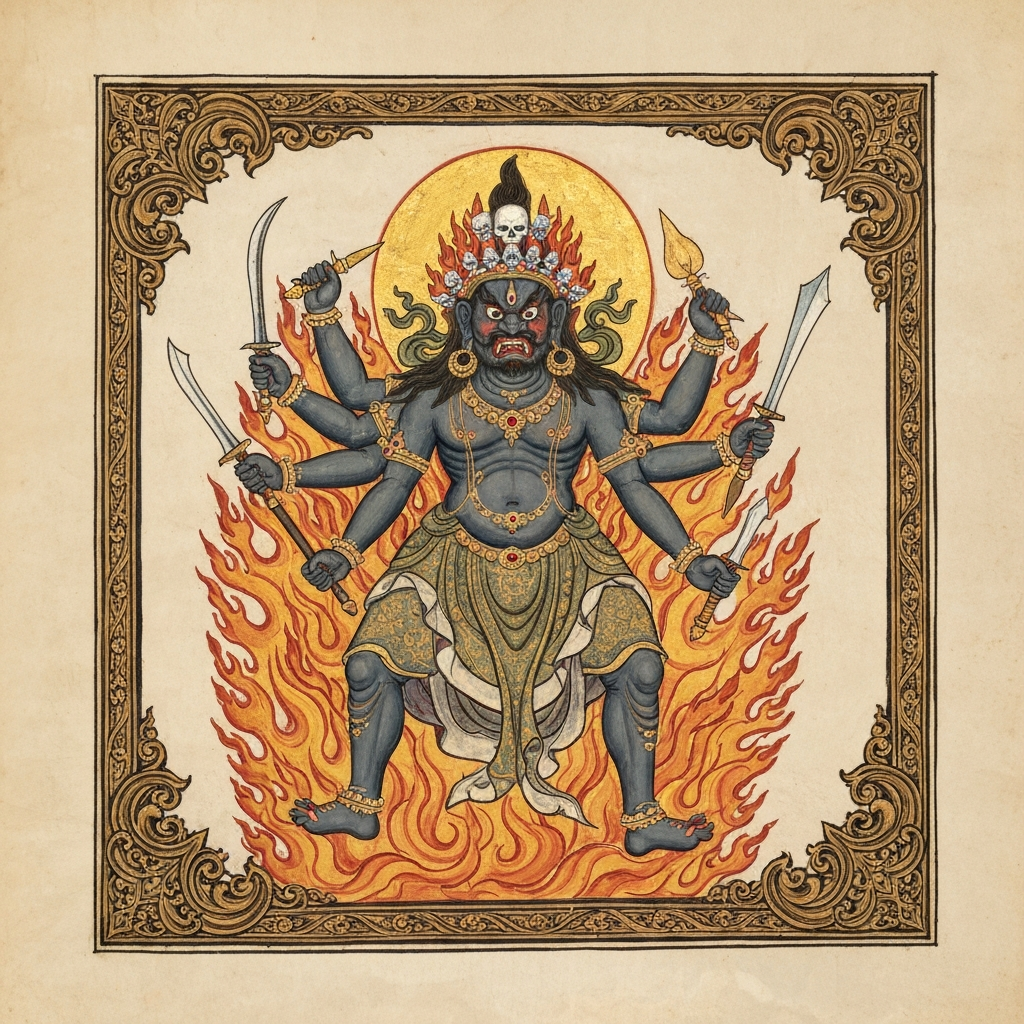
Combat Profile
Devourer of Obstacles
Mahakala annihilates all karmic impediments and ego-constructs in a single apocalyptic moment, leaving only enlightened emptiness.
Wrathful Guardian
Mahakala's fierce presence dissolves delusion and ignorance, protecting the dharma by destroying all forces that oppose spiritual liberation.
Mahakala is the wrathful protector deity par excellence. He is depicted as blue-black or jet-black (representing the absolute, beyond all color and form), with a crown of five skulls (the five poisons transformed into five wisdoms), three bulging eyes (seeing past, present, and future), fangs bared in a fearsome grimace, and a garland of severed heads. He wields a curved knife (kartika) that cuts through ego-clinging, and holds a skull cup (kapala) filled with the blood of demons — symbolizing the transformation of negative emotions into wisdom-nectar.
Despite his terrifying appearance, Mahakala is understood as a wrathful emanation of Avalokiteshvara — the same being who manifests as Guanyin, the gentle mother of mercy. This is one of Buddhism’s most profound theological statements: ultimate compassion and ultimate ferocity are the same being. Gentleness and wrath are not opposites but complementary expressions of the same love, deployed according to what the situation requires.
The parallel to Kali is immediate and acknowledged: Kali, the Hindu goddess of time and death, is a wrathful form of Parvati, the gentle goddess of devotion — the same structural relationship. The parallel to the “wrath of God” in the Hebrew Bible is also apt: the God who parts the Red Sea in love for Israel drowns Pharaoh’s army in the same act. Wrath in service of justice and protection is not cruelty — it is love that refuses to be passive.
“Mahakala’s ferocity is the ferocity of a mother bear defending her cubs — terrifying to behold, but rooted entirely in love.”
1 min read
Mahakala Tantra; Sadhanamala; Tibetan Buddhist liturgical texts