Combat Profile
Sling-Storm Prophecy -
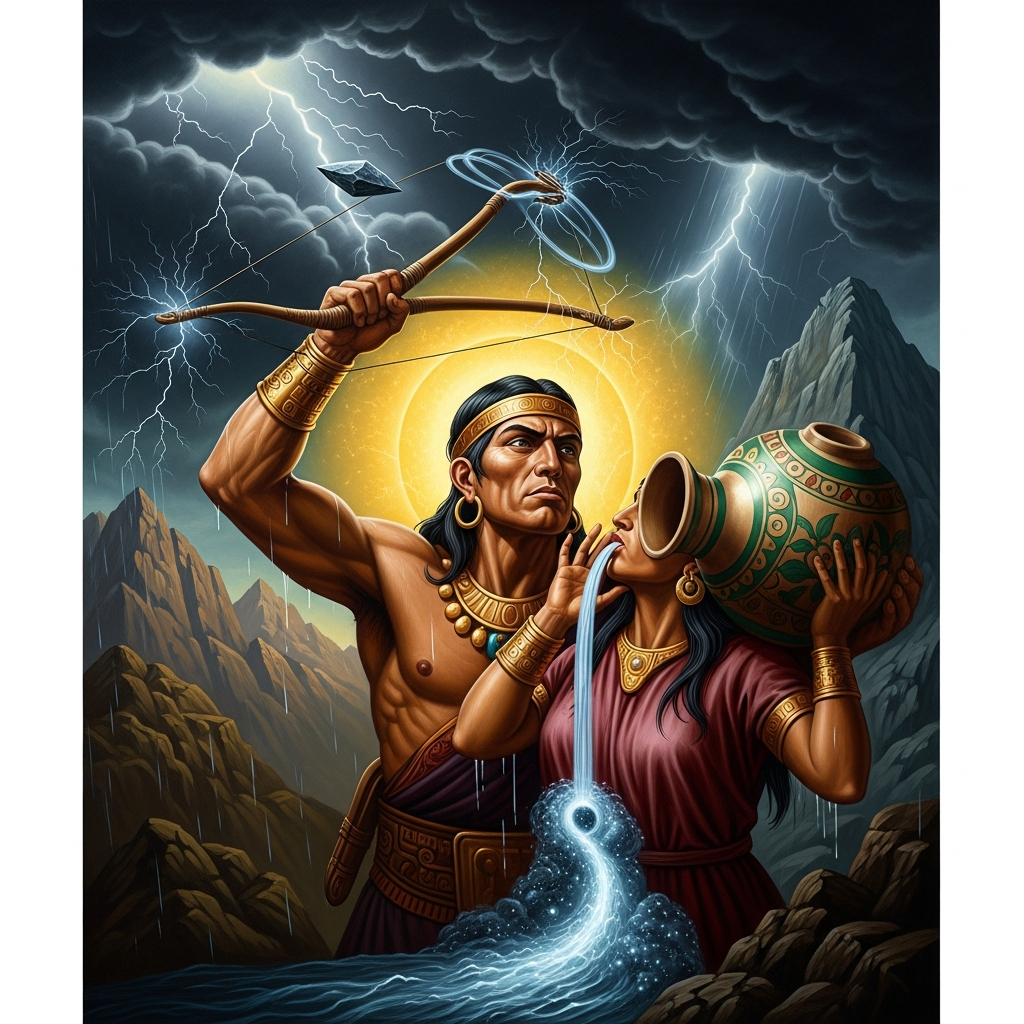
Catequil can hurl lightning with the precision of a battlefield weapon while simultaneously delivering oracular pronouncements; his predictions have the force of physical strikes
Stormborn Sight -
Catequil perceives events occurring during storm conditions anywhere in his territory, and his oracles are most accurate during thunderstorms
His oracle at Porcón was destroyed by Manco Inca's forces (or by the Spanish, accounts differ) specifically because his pronouncements were politically dangerous; power tied to his physical shrine
Lore: Catequil occupies a politically charged position in Andean theology: he was a regional thunder god powerful enough that the Inca state itself feared him and may have destroyed his oracle. The chronicler Pedro Cieza de Leon records that Catequil’s oracle at Porcón (near Cajamarca in the northern Andes) was so influential and so often consulted that it constituted a genuine alternative source of political authority — its pronouncements could legitimize or delegitimize Inca policy. Whether the oracle was destroyed by Manco Inca (who found it inconvenient) or by the Spanish (who found all oracles doctrinally dangerous) remains disputed in the sources.
What is clear is that Catequil was understood as a distinct thunder god from the imperial Illapa — not a subordinate regional spirit but a full deity in his own right, with his own mythology, his own shrine, his own priesthood, and his own oracle function. He could deliver prophecy and summon storms, making him a particularly dangerous deity from the perspective of any political authority that wanted to monopolize both divine communication and weather control.
The oracle at Cajamarca is historically significant because Cajamarca is where Atahualpa was captured in November 1532. The Andean prophetic tradition that the Spanish arrival was foretold — a retrospective claim common to many conquest narratives — is sometimes associated with Catequil’s oracle. Whether the oracle actually predicted anything or whether the interpretation came after the fact, the association suggests that Catequil’s shrine was still politically active in the years immediately before the conquest.
Parallel: The oracular thunder god who becomes politically inconvenient and is destroyed by the authorities he threatens parallels Greek Apollo at Delphi (though Delphi survived longer) and the biblical tradition of prophets who challenge royal authority — Elijah confronting Ahab, Amos expelled from Bethel (Amos 7:10-13). The specific combination of weather control and prophetic authority appears in Norse Odin (who controls weather and fate-knowledge simultaneously) and in the Aztec-Maya Quetzalcoatl who also combined priestly, prophetic, and meteorological domains.
2 min read
The imperial theological hierarchy, which tried to subordinate regional oracles to the Inti-Illapa-Viracocha structure; the Spanish, who systematically destroyed oracular shrines
Cieza de Leon, *Cronica del Peru* (1553); Polo de Ondegardo, *Errores y Supersticiones* (1559); Rowe, *Inca Culture at the Time of the Spanish Conquest*; Arriaga, *Extirpacion de la Idolatria*