Combat Profile
Herd Blessing -
Urcuchillay's favor multiplies livestock and prevents disease among herds; a llama born under his constellation is sacred and must never be slaughtered
Dark Cloud Vision -
Urcuchillay is perceived not in stars but in the dark patches between them (the *dark cloud constellations* of Andean astronomy); herders who learn to read these shapes know the health of their herds and the timing of the rains
A minor deity in the imperial theological hierarchy; his domain is rural and practical rather than cosmological and political
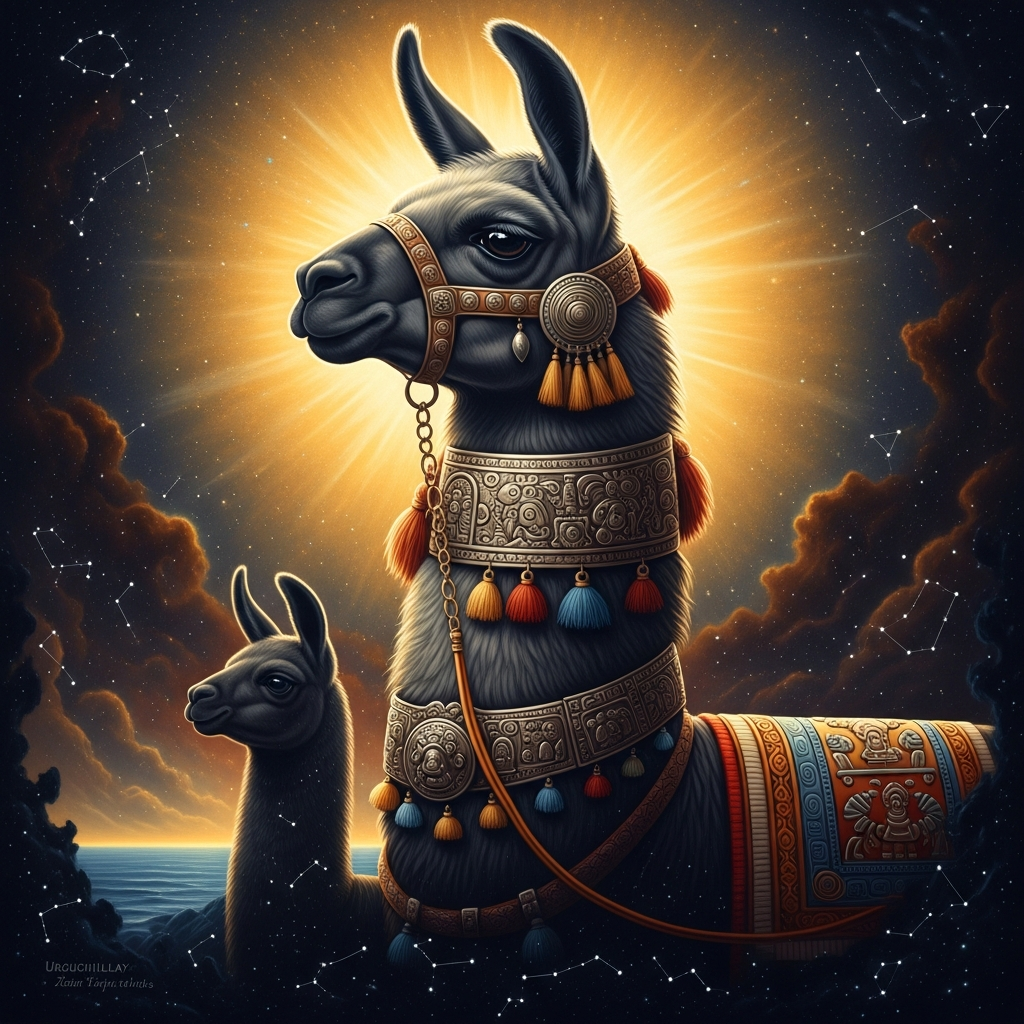
Lore: Urcuchillay represents one of the most distinctively Andean contributions to world astronomy and religion: the dark cloud constellation system. While virtually every other culture on earth builds its star-lore from the points of light in the night sky, the Inca (and especially the herding peoples of the southern Andes) built an entire parallel astronomical system based on the dark patches between the stars — the coal-dark areas where the Milky Way’s light is obscured by intervening dust clouds. These dark cloud constellations (yacana, yutu, hanp’atu, and others) are invisible to cultures that only look at stars, yet perfectly visible to southern hemisphere observers who know what to look for.
Urcuchillay was the great dark llama — a maternal llama with a baby beside it, clearly visible to trained eyes as two dark masses in the Milky Way southwest of the constellation Scorpius. The Inca astronomer-priests tracked this dark llama’s annual path across the night sky and used it to time agricultural and herding activities. The Yacana (another name for this llama constellation) was believed to drink from the ocean each night at the horizon — preventing floods by absorbing the excess water — and its position in the sky corresponded to the timing of the rains.
For the millions of llama and alpaca herders on the high puna, Urcuchillay was perhaps the most immediately practical deity in the entire Andean cosmos: the supernatural shepherd watching over the earthly herds, the celestial prototype of every llama below. When herders performed the señalakuy (the annual ear-marking and blessing of the herds), they invoked Urcuchillay alongside Pachamama, asking the celestial shepherd to protect the earthly flock. Multi-colored llamas were his sacred animals specifically because his dark-cloud image showed the varied hues of the Milky Way’s dusty edges — the divine llama was itself a creature of many colors.
Parallel: Patron deities of herding animals appear across pastoral civilizations: the Norse Freyr is the fertility god whose blessing makes flocks increase; the Greek Pan is the shepherd’s god (the parallel is very close — both are rural, practical, less impressive to urban theologians, but essential to the actual pastoral economy). The biblical Good Shepherd imagery (Psalm 23, John 10) draws on the same pastoral theology of the divine shepherd who watches the earthly flock. Urcuchillay is distinctive in being identified not with a star but with a dark patch in the sky — a reminder that Andean astronomy saw the cosmos through fundamentally different eyes than the northern hemisphere traditions that dominate the history of astronomy.
2 min read
Eclipse and astronomical disruption; the Inca calendrical priests who had authority over the stars and their interpretation
Cobo, *Historia del Nuevo Mundo* (1653); Polo de Ondegardo, *Errores y Supersticiones* (1559); Urton, *At the Crossroads of the Earth and the Sky* (1981); Urton, *The Social Life of Numbers*