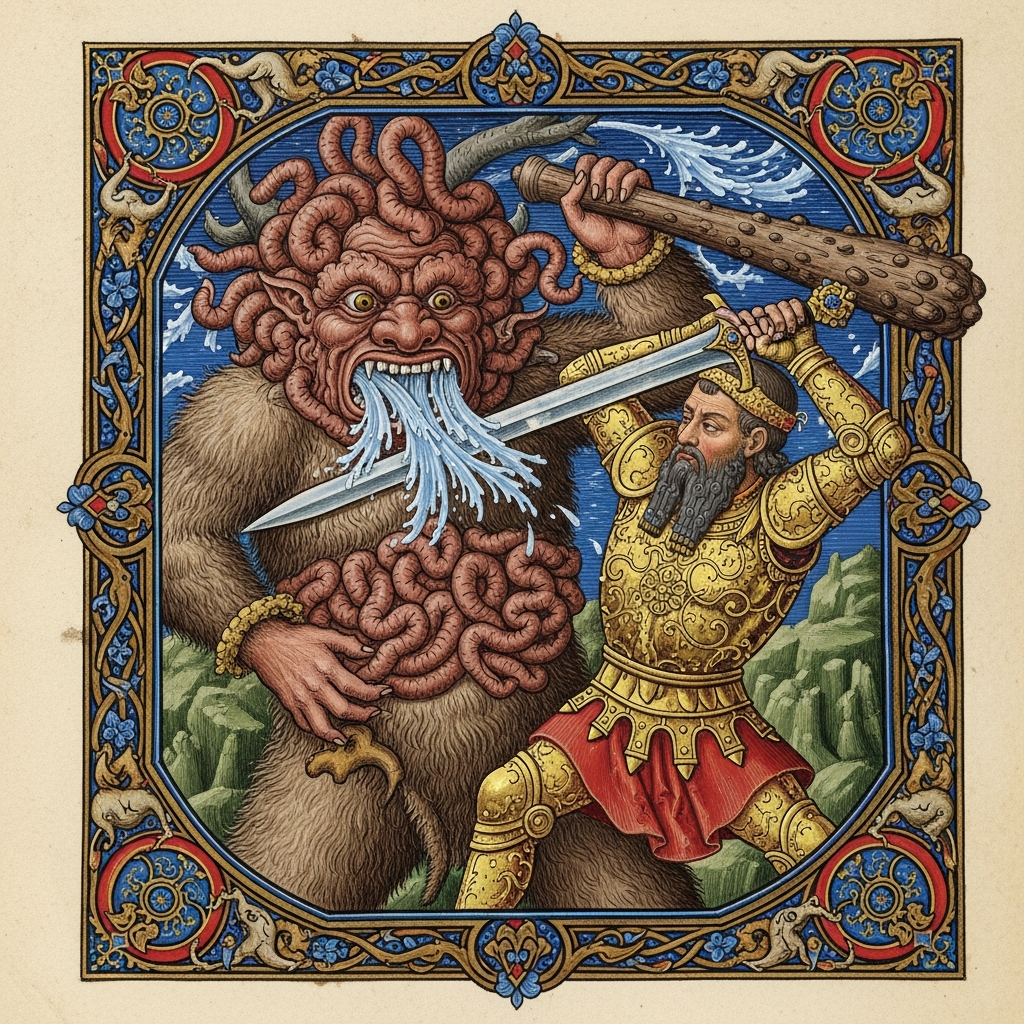
Combat Profile
Roar of the Cedar
Humbaba unleashes a terrifying cry that paralyzes all who hear it and summons the forest itself to entangle enemies.
Sacred Sentinel
As the eternal guardian of the cedar forest, Humbaba cannot be harmed within wilderness terrain and grows stronger as the battle progresses.
“Humbaba’s roar is a flood, his mouth is fire, his breath is death. He can hear a rustling in the forest for sixty leagues.” — Gilgamesh III
Humbaba is the divinely appointed guardian of a sacred, forbidden place — and killing him is Gilgamesh’s original sin (Epic of Gilgamesh III-V). Enlil sets Humbaba over the Cedar Forest in Lebanon (yes, the same Lebanon cedars Solomon will later use for the Temple), equipping him with seven radiant terrors as his armor (Epic of Gilgamesh III). Gilgamesh and Enkidu cut through the forest and butcher its guardian for glory (Epic of Gilgamesh V). The parallel to the Cherubim guarding Eden (Gen 3:24) is structural: both are non-human beings placed by the supreme god at the entrance to a sacred, paradisiacal space, wielding supernatural weapons (Humbaba’s terrors, the Cherubim’s flaming sword). The crucial difference is that no one defeats the Cherubim — Eden remains sealed. Gilgamesh succeeds, and the consequences for killing a divine guardian cascade through the rest of the epic (Epic of Gilgamesh VI-XII).
1 min read
Epic of Gilgamesh, Tablets III-V