Combat Profile
Threshold's Witness
Janus blesses or curses the beginning of any venture; a properly invoked beginning cannot be spoiled by misfortune in its first hour, but a venture begun without his sanction collapses at its first major test
Two-Faced Sight
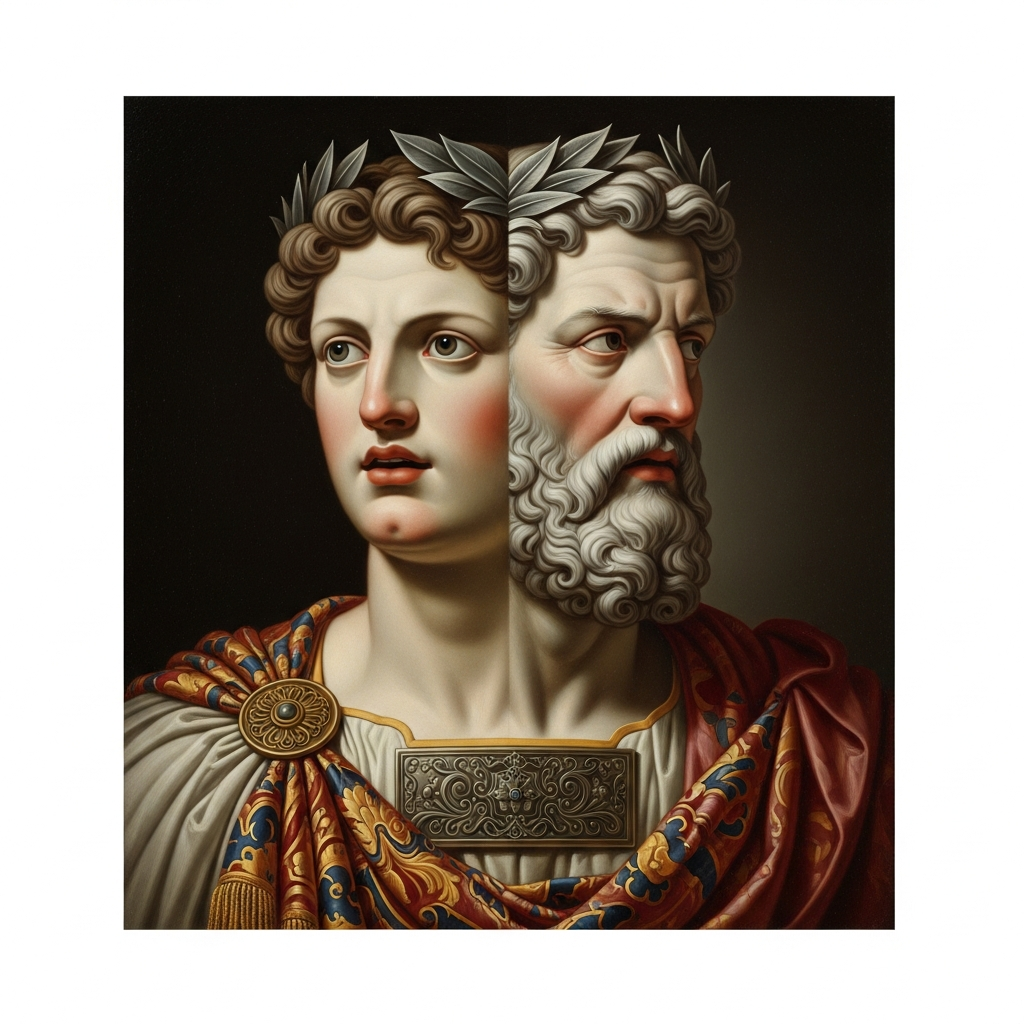
Janus perceives past and future simultaneously; he cannot be ambushed or surprised, and he knows the full consequences of any action proposed in his presence
Janus is the most distinctively Roman of all the gods — he has no Greek counterpart, no Indo-European cognate that scholars can confidently identify, and no clear origin outside Italy. He is the god of doorways, of beginnings, of transitions, of the moment between past and future. He has two faces, looking simultaneously forward and backward. The first month of the Roman year (January) is named for him. The doors of his temple in the Forum stood open in time of war and closed in time of peace; in nearly a thousand years of Roman history, they were closed only a handful of times.
Janus is invoked first in every Roman prayer — even before Jupiter — because no transaction can begin without him. He is the god of the opening, and every opening (the year, the day, the door, the new venture, the marriage, the harvest) requires his presence. He is also, by extension, the god of all transitions: the moment when one becomes a parent, when one steps over the threshold of a new house, when one crosses from peace into war or vice versa. The Janus-faced metaphor in modern English (“Janus-faced” = duplicitous) is a slander on the original deity, who is not deceptive but bidirectional — a god who must look both ways because beginnings are also endings.
Biblical Parallels: Janus has no clean biblical parallel — the Hebrew tradition has no doorway-deity, since worship of thresholds was specifically forbidden (Zephaniah 1:9, “all those who leap over the threshold”). However, the mezuzah on the Jewish doorpost serves a Janus-like function: marking the threshold as sacred, demanding ritual acknowledgment of the transition between outside and inside. Christ’s “I am the door” (John 10:9) appropriates threshold-symbolism for himself, possibly in conscious displacement of doorway-deities like Janus.
Cross-Tradition: Uniquely Roman, with no clear cognates. The two-faced sky-deity Hindu Heruka and the Hindu Yamantaka share some imagery, but the function is different. Janus’s closest functional parallel may be the Hindu Ganesha — invoked first in every prayer, lord of beginnings and remover of obstacles — though Ganesha is not bidirectional. The Gallic Cernunnos is sometimes depicted three-faced, suggesting a Celtic boundary-and-transition god, but his function is hunting rather than threshold.
2 min read