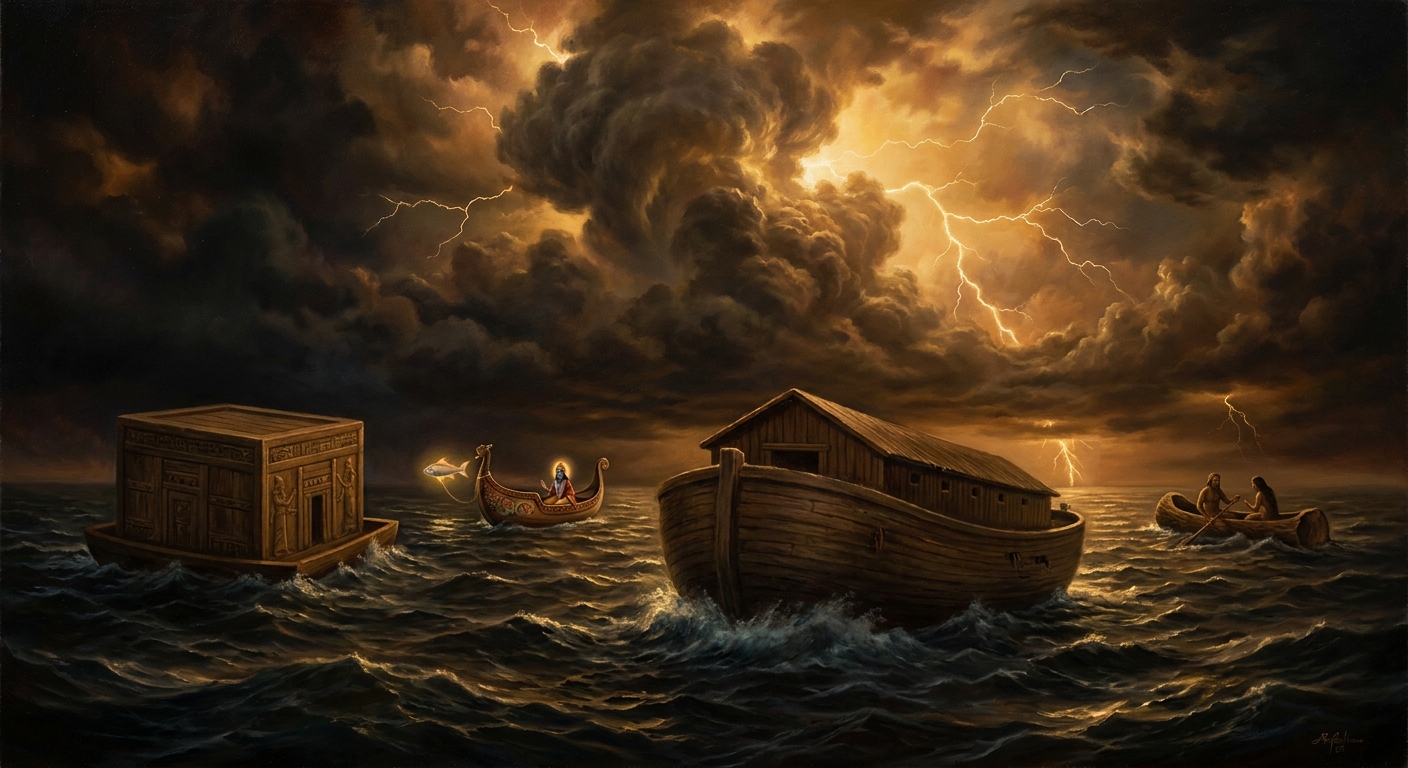
The flood is the most widely-attested mythological scene on earth. Versions exist across the Near East, the Indian subcontinent, the Mediterranean, China, Mesoamerica, the Pacific Northwest, Australia, and West Africa. The cluster is so striking that 19th-century scholars argued for a single historical flood as the source — a great Black Sea inundation, a Mesopotamian river surge, the meltwater pulse at the end of the Ice Age. Most modern scholars resist that move. The pattern is real, but its causes are multiple: floods are common, agricultural civilizations cluster on rivers, and the destruction-and-restart narrative serves theological purposes that have nothing to do with any single inundation.
The Mesopotamian flood story is the oldest in writing. The *Atrahasis* (c. 1800 BCE) and the flood section of *Gilgamesh* (c. 1300 BCE in extant form) tell of Utnapishtim — warned by Enki, builder of a great vessel, survivor of the deluge sent by Enlil because human noise has irritated the gods. The Genesis flood narrative (composed mid-first-millennium BCE) preserves the same basic structure with a monotheized cause: God sees human wickedness, warns Noah, sends rain forty days, ends with rainbow covenant. The literary dependence is now widely accepted in scholarly biblical studies.
But the flood is not just Near Eastern. Manu's flood (Hindu), Deucalion's flood (Greek), Yu the Great's (Chinese), Tata and Nena's (Aztec), the Hero Twins' precursor world-end (Maya) — they cluster, they differ in detail, and they are unmistakably variations on a theme. The list below is not exhaustive; the table notes only major versions.
Comparison Across Traditions 9
| Tradition | Entity | Key Trait | Story / Scene |
|---|---|---|---|
| Mesopotamian | Utnapishtim | The Babylonian Noah; survives the flood sent by Enlil and is granted immortality | In *Gilgamesh* tablet XI, Utnapishtim builds the cube-shaped vessel, releases the dove, the swallow, and the raven Read story → |
| Mesopotamian | Atrahasis | The "exceedingly wise" — older Akkadian name of the flood hero | In the *Atrahasis* epic, the gods send plague, drought, then flood; Enki warns Atrahasis through the reed wall Read story → |
| Jewish | Noah | Genesis hero; builds an ark of gopher wood; survives forty days of rain | God sees the corruption of humanity; Noah and his family are saved with two of every kind; the rainbow seals the covenant Read story → |
| Hindu | Manu | First man; saved by Matsya, the fish-avatar of Vishnu | A small fish in Manu's hands grows; it warns of a coming flood; Manu lashes his ark to the fish's horn and is towed through the waters |
| Greek | Deucalion | Son of Prometheus; survives Zeus's flood with his wife Pyrrha | Deucalion and Pyrrha throw stones over their shoulders; the stones become the new race of men and women |
| Chinese | Yu the Great | Founder of the Xia dynasty; the engineer-hero who tames the great flood | Where his father Gun tried to dam the waters and failed, Yu cuts channels and lets the rivers run — labor for thirteen years without going home |
| Aztec | Tata and Nena | The fourth-sun flood survivors; turned into dogs for breaking taboo | Tata and Nena ride out the flood in a hollow log; afterward they kindle fire and roast fish; the gods turn them to dogs for the smoke Read story → |
| Maya (Popol Vuh) | The Wooden People | The flawed second creation; destroyed by a great flood and inversion of objects | In the *Popol Vuh*, the wooden people who could not pray are destroyed by a black resin rain; their cooking pots and millstones rise up to grind them |
| Yoruba | Olokun | Orisha of the deep sea; once flooded the world in anger | Olokun resented Olódùmarè's ordering of land above sea; she sends the flood, but is bound by Obatala in chains |
What the Pattern Means
The Genesis-Gilgamesh dependence is the locus classicus of comparative biblical study. George Smith, in 1872, decoded the eleventh tablet of the *Epic of Gilgamesh* in the British Museum and discovered a flood narrative older than Genesis and structurally identical: divine displeasure, single righteous man warned, vessel built, animals saved, dove and raven sent, mountain landfall, sacrifice, divine reconciliation. The shock was theological: the Bible was not the original. Subsequent scholarship has refined the dependence (the older *Atrahasis* turns out to be the closer parallel) but the basic finding stands. The Genesis flood narrative is a Hebrew adaptation of older Mesopotamian material, theologically reinterpreted: Yahweh, not a quarrelling council of gods, decrees the flood; the cause is moral, not noise.
But the flood is not only Near Eastern. The cross-cultural pattern is one of the most-studied in comparative mythology. James George Frazer, in *Folklore in the Old Testament* (1918), catalogued over 200 flood myths from every continent. Some he attributed to diffusion from the Mediterranean; others he treated as independent — and modern scholarship tends to agree that the West African, Pacific, and Native American flood stories are independent traditions, not borrowings. (The Maya *Popol Vuh* flood, while contact-era, is structurally pre-Columbian and not a borrowing from Spanish Catholic missionaries.)
The independence of the cluster is itself the puzzle. Why do so many cultures tell flood stories? Several explanations have been proposed:
1. *Real catastrophic floods.* Specific civilizations (Mesopotamia, the Indus Valley, ancient China) really do flood, repeatedly, catastrophically. The Black Sea inundation hypothesis (William Ryan and Walter Pitman, *Noah's Flood*, 1998) proposes a single historical event around 5600 BCE; this is debated.
2. *Universal experience of water as primordial.* Wendy Doniger and others note that water is the universal symbol of formlessness in human cognition; restarting from water is the natural way to imagine restarting at all.
3. *Ritual function.* Mircea Eliade argued that flood myths re-actualize the cosmogony — water returns to undifferentiated chaos, and creation begins again. The flood is not historical memory; it is a theology of renewal.
4. *Independent invention.* Floods are common; agricultural civilizations cluster on rivers; the destruction-and-restart story serves narrative purposes that any storytelling tradition will eventually invent.
The truth is probably all four. Some flood narratives are textually related (Genesis-Atrahasis-Gilgamesh form a clear lineage). Others are independent inventions. The pattern is real, but the causes are layered.
The Hindu flood is a distinct case. The Matsya Avatar version is preserved in the *Shatapatha Brahmana*, the *Mahabharata*, and the *Bhagavata Purana*. Manu, warned by a small fish (Vishnu in incognito), survives a cosmic flood and seeds the new humanity. The dependence on Mesopotamian sources is sometimes argued (David Leeming, *Flood Myths Around the World*, 2010) but contested; the Vedic tradition has its own preoccupations, and the Hindu flood serves cyclical-time theology rather than the linear once-and-for-all logic of Genesis.
Notable exceptions: Egyptian mythology has no canonical flood. The annual Nile inundation was beneficial, not destructive — the agricultural rhythm did not need a destruction myth. The flood-narrative is, on this reading, a story belonging specifically to civilizations that experience flooding as catastrophic. Where the water is friendly, the myth does not develop.
- James George Frazer, *Folklore in the Old Testament* (1918) — the comparative catalogue
- Alan Dundes (ed.), *The Flood Myth* (1988) — modern comparative essays
- David Leeming, *Flood Myths Around the World* (2010) — the global typology
- William Ryan & Walter Pitman, *Noah's Flood* (1998) — the Black Sea hypothesis
- John Day, *From Creation to Babel* (2013) — the Genesis-Mesopotamian dependence