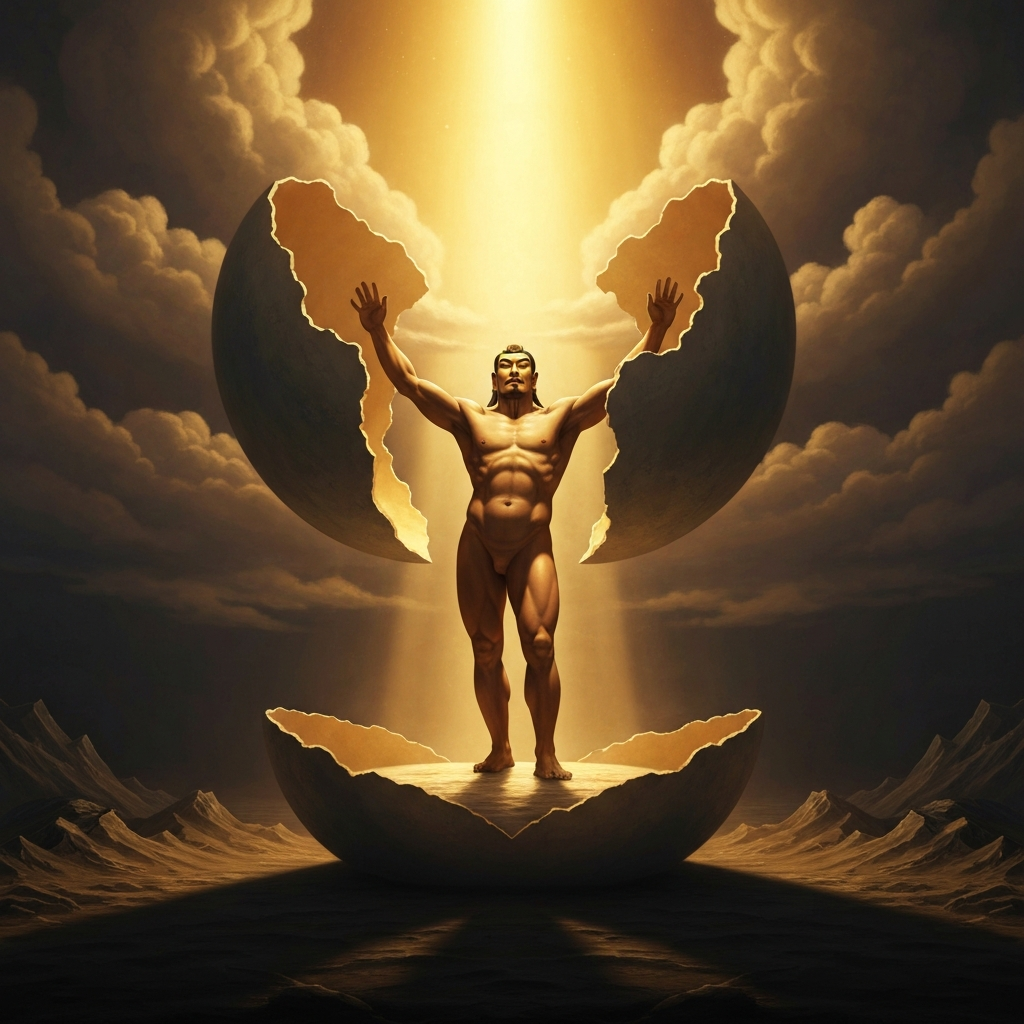
Mén Shén: The Two Who Guard Every Door
Tang dynasty, c. 626-649 CE — the reign of Emperor Taizong · The imperial palace of Chang'an, then the doors of every household in China
Contents
The Emperor Taizong of Tang is haunted by ghosts in his palace until two of his generals volunteer to stand guard all night — and so that the generals may rest, a painter is commissioned to make their images for every door in China.
- When
- Tang dynasty, c. 626-649 CE — the reign of Emperor Taizong
- Where
- The imperial palace of Chang'an, then the doors of every household in China
The Emperor Taizong of Tang cannot sleep.
He has not slept properly since the battle of Xuanwu Gate, where he had his brothers killed to secure the throne. This is history, not accusation — it is what happened, and the emperor knows it happened, and in his dreams his brothers come back to stand at the gate of his bedchamber. Not to harm him, particularly. To stand there. Looking.
He tells his advisors. His advisors do what advisors do: they tell him what he wants to hear, which is that a few more rituals should fix it. The rituals do not fix it. The generals of his court — Qin Shubao, the great cavalryman with the pale complexion who had ridden and fought for twenty years for the Tang cause, and Yuchi Jingde, the dark-faced general who had been the emperor’s bodyguard through the most dangerous battles of the unification — these two men volunteer.
They will stand at the palace gate all night. Every night, in full armor, with their weapons, at the bedroom door.
The emperor sleeps.
Not metaphorically — he actually sleeps, the first proper sleep in months. He wakes rested. The night had been quiet. His two generals had stood at the door. Whatever was in the palace at night had looked at the door and decided to go somewhere else.
But the generals are not sleeping either. They are standing all night in full armor while the emperor sleeps, and generals who do not sleep eventually sicken. The emperor looks at them after a week and sees what his sleep is costing them, and he sends for a painter.
He commissions portraits of both generals in their full armor: Qin Shubao on the left, pale-complexioned and calm, his golden armored figure against a warm background; Yuchi Jingde on the right, dark-faced and forceful, carrying his iron whip. The portraits are painted large, with the detail and authority of official documents. They are hung on the palace gate.
The emperor sleeps again. The generals go home. The portraits guard the door.
This works.
It works in a way that goes beyond the rational explanation available to the Tang dynasty — beyond the psychological explanation that the emperor’s anxiety was resolved by the knowledge of protection, beyond the sociological explanation that the portraits functioned as markers of imperial authority at the threshold. The portraits work in the way that Chinese religious art works, which is the same way that written names work in a society where the written name and the thing named are closely related: to accurately represent the guardians at the door is to have the guardians at the door.
The practice spreads from the palace.
Within a few generations, door gods are on every gate in China. Every household, every temple, every government building, every merchant’s warehouse. The images vary by region: in some places the generals are shown with weapons raised, in others with weapons at rest. In some traditions they carry blessing objects as well as weapons. The pale one and the dark one always face outward — toward whatever is outside, toward the world that approaches the threshold.
They are still there. Red paper figures on every door at New Year, reprinted every year and pasted fresh — the old year’s protection replaced with the new year’s. Two generals in full armor, one pale, one dark, one left, one right, standing at the door of every home in China the way they stood at the emperor’s door that first night when he finally slept.
The painter who copied them the first time, working from life with the generals themselves standing as models, is not recorded by name. The generals are. The emperor is. The painter dissolved into the work, which is also a form of devotion: the artist whose labor is the ongoing presence of the gods at every threshold, every door, every threshold between the dangerous outside and the sleeping inside where what is loved is resting.
Echoes Across Traditions
Entities
- Qin Shubao (Qin Qiong)
- Yuchi Jingde
- Emperor Taizong of Tang
- the palace ghosts
Sources
- Journey to the West (西遊記), Wu Cheng'en, c. 1592 — includes the Taizong ghost story
- Wolfram Eberhard, *A Dictionary of Chinese Symbols* (Routledge, 1986)
- Stephan Feuchtwang, *Popular Religion in China: The Imperial Metaphor* (Curzon, 2001)
- C.K. Yang, *Religion in Chinese Society* (UC Berkeley, 1961)