The Head of Bendigeidfran Still Speaks
circa 500-700 CE — the mythic age of the Mabinogion, after the war with Ireland · The Irish battlefield, then Harlech, then the island of Gwales, then the White Mount in London
Contents
The giant king of Britain, mortally wounded by a poisoned spear, instructs his men to cut off his head — and the head accompanies them for eighty-seven years of feasting and conversation, as vivid and good-company as any living king.
- When
- circa 500-700 CE — the mythic age of the Mabinogion, after the war with Ireland
- Where
- The Irish battlefield, then Harlech, then the island of Gwales, then the White Mount in London
He tells them himself how to do it.
Bendigeidfran, the giant king of Britain, is dying in Ireland from a wound made by a poisoned spear — a small wound, in the foot, the fatal-wound-in-the-foot that appears in the deaths of so many mythological kings, as if the rulers of the world can only be brought down through the part of them that touches the ground. He gathers the seven survivors around him. He is very calm about dying, which is the mark of a man who has thought about it.
“Strike off my head,” he says. “And carry it with you. When you return to Britain, there is a feast prepared at Harlech that will last seven years. Then go to the island of Gwales — there is a hall there with a door facing toward Cornwall, and you are not to open it. When you open it, the head will no longer be pleasant company, and you will have to go to London to bury it in the White Mount, with my face toward France.”
He has made the arrangements. He is a king to the last.
They take his head.
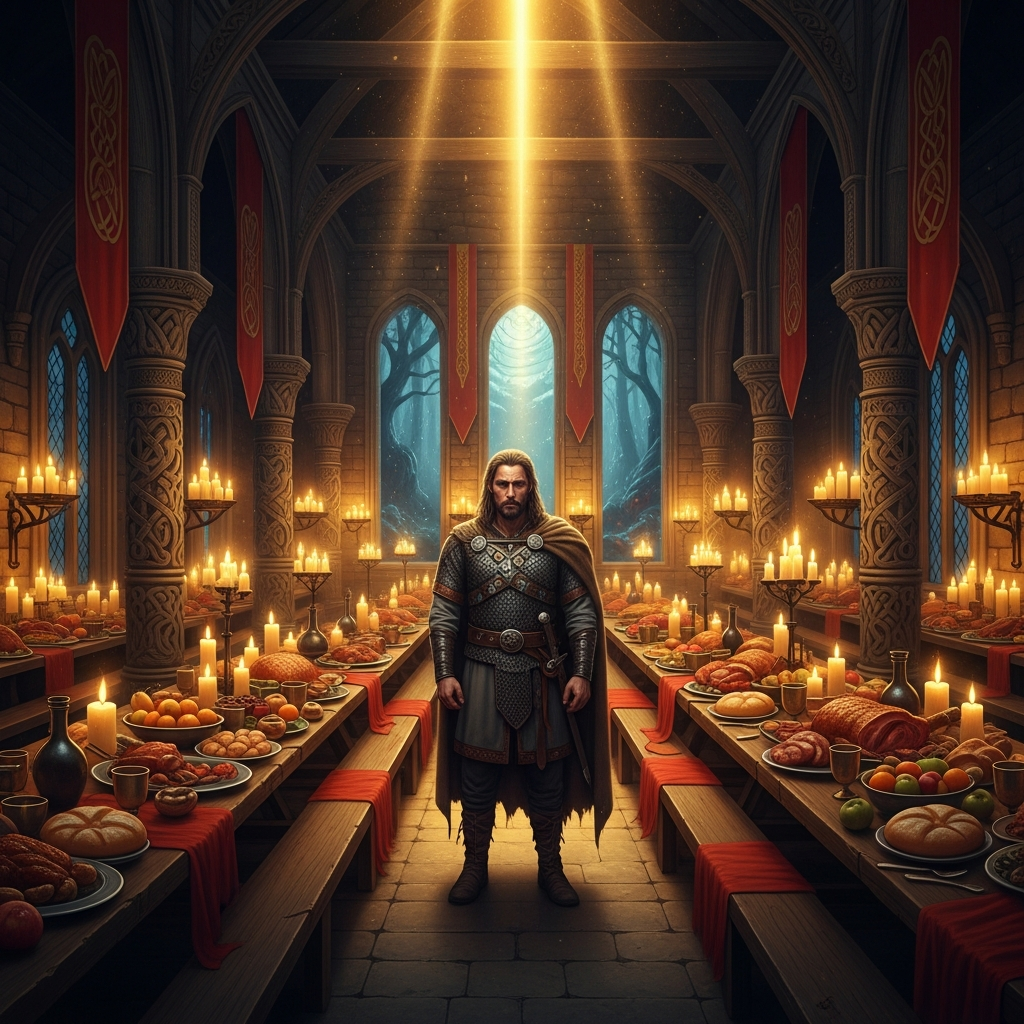
At Harlech, the head sits with them at the feast and converses as it always did: with the quality of a man who was good company while he was alive, who had thoughts worth hearing, who is not diminished by the absence of a body in his conversational range. He is, by every account, excellent table company for seven years. The feast at Harlech is not a funerary grief-feast but a genuine celebration of a king who was worth celebrating.
Then Gwales, and the birds of Rhiannon, and the eighty-seven years that pass without the weight of years, and the head in the center of everything, and the one door they should not open.
Heilyn opens it.
The grief arrives simultaneously with the knowledge that it is time to go.
They take the head south to London, to the White Mount — the hill where the Tower of London now stands. They bury it there in the earth, facing France, with the instruction that it guards Britain from sea-borne invasion as long as it remains in the ground. It is a foundation deposit, a sovereignty object buried in the earth at the kingdom’s center, the king’s power rooted in the land after his death.
Later — much later — in the legend of King Arthur, the head is said to have been dug up by Arthur himself, who felt that Britain should not need any protection but his own sword. The story records this action as a mistake, one of three unfortunate disclosures Arthur made, and after the head was removed, the foreign invasions began.
The mythology is a conservation argument: some protections are older than the current administration and do not need to be replaced by it. The head in the earth is doing something the living king cannot see. The head is company you do not immediately lose when the body falls.
Bendigeidfran at the feast, severed from his body, continuing to be the king he always was — this is the Welsh tradition’s image of what sovereignty means when it is genuine: not a function of physical power but of presence, wisdom, the quality of a person that persists beyond the conditions that produced it.
He told them exactly how to do it. They did it. The head is in the ground.
Echoes Across Traditions
Entities
- Bendigeidfran
- Bran the Blessed
- Manawydan
- Pryderi
- Rhiannon
- The seven survivors
Sources
- Jeffrey Gantz, trans., *The Mabinogion* (Penguin, 1976)
- Sioned Davies, trans., *The Mabinogion* (Oxford World's Classics, 2007)
- Anne Ross, *Pagan Celtic Britain: Studies in Iconography and Tradition* (Routledge, 1967)