Endymion, the Sleeping Shepherd
Mythic age, undatable — Endymion is variously placed in the heroic generation before the Trojan War or in a vaguely pre-historical Aeolian past. Sappho mentions the love affair in the seventh century BCE. · Mount Latmus in Caria, on the western coast of Asia Minor — the mountain where the shepherd kept his flock and where the cave that holds him is said to be
Contents
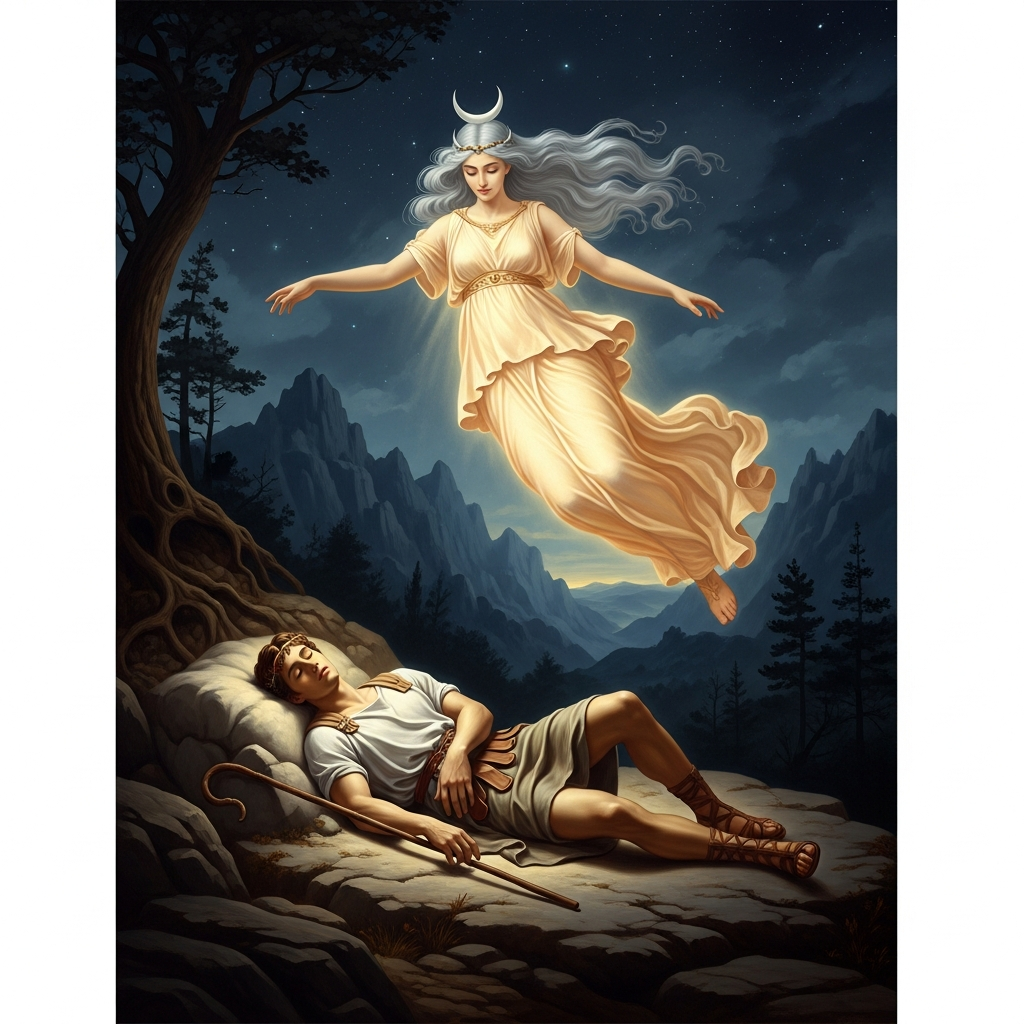
Selene, the moon, looked down one night and saw a shepherd asleep on the slopes of Mount Latmus. She fell so deeply in love with him that she went to Zeus and asked for a single, strange gift: that the shepherd sleep forever, never aging, never dying, never opening his eyes. Zeus agreed. Each night Selene descends from the sky to lie beside him on the mountain. He has been sleeping for ten thousand years. He will never wake.
- When
- Mythic age, undatable — Endymion is variously placed in the heroic generation before the Trojan War or in a vaguely pre-historical Aeolian past. Sappho mentions the love affair in the seventh century BCE.
- Where
- Mount Latmus in Caria, on the western coast of Asia Minor — the mountain where the shepherd kept his flock and where the cave that holds him is said to be
The mountain is in Caria, on the coast that looks west toward the Aegean.
It is called Latmus. The slopes are dry — limestone, scrub oak, thyme — and at the upper ranges there are caves. The town below is also called Latmus, though it is now mostly ruins. The shepherd’s flock grazes the lower slopes by day; at evening he brings them down to a fold near the village; at night he sleeps in a cave on the mountain when the weather is dry.
His name is Endymion. He is a young man — beautiful, it is said, beautiful in the specific way that pulls the eye and stays in the memory. His parentage is given variously: in some versions he is the son of Aethlius (a son of Zeus) and Calyce; in others he is descended from Zeus directly; in still others he is simply the king of Elis whose tomb the Eleans show at Olympia. The genealogies do not agree. What they agree on is that he is beautiful, and that he becomes a shepherd on Latmus.
One night he is sleeping in the mouth of his cave on the mountain.
The moon comes up over the eastern ridge.
Selene is the moon — the older Greek moon, the Titaness, before the moon-functions were partly absorbed by Artemis. She is the daughter of the Titans Hyperion and Theia, sister of Helios (the sun) and Eos (the dawn). Each night she rises out of the sea on the eastern side of the world, drives her chariot — drawn by white horses or by oxen, depending on the source — across the night sky, and descends into the western sea before her brother the sun rises in his turn. She is a working goddess. She crosses the sky every night.
The pattern is supposed to be: rise, cross, set. The pattern is not supposed to include stopping.
But on this night Selene looks down at the slope of Latmus and she sees the shepherd in the mouth of the cave, lit by her own light. He is asleep. His head is on his arm. His face is turned up toward her.
She stops.
The chariot pauses in the sky over Mount Latmus. The night briefly does not advance. Selene leaves the chariot — the white horses standing patiently in mid-air — and descends to the mountain. She walks across the limestone slope to the mouth of the cave. She kneels beside the sleeping shepherd. She looks at him.
She is in love.
This is what the older sources say happened. Not love at second sight, not love after acquaintance, not love after his name has been told to her. The moon-goddess looks down once and stops driving the night, and walks down the air to the cave on Latmus, and from that moment on she will not be able to keep her chariot moving without thinking of him.
She watches him until close to dawn.
Then she goes back to the chariot. She finishes the night. She sets in the western sea.
She comes back the next night.
This is the part that becomes the recurring action. Every night for the rest of her existence, when Selene rises, she rises with the same destination at the back of every revolution. She crosses the sky; she descends to Latmus; she comes to the cave; she watches the shepherd sleep. He never wakes. He never sees her. The shepherd is one of the few mortals in Greek myth for whom a goddess’s love is not catastrophic — and he is exempt from the catastrophe by being unconscious of it.
But Selene wants more than the watching. She wants the shepherd preserved. She has watched too many beautiful men age and die — this is the recurring grief of the Olympian and Titanic immortals, the lovers they cannot keep — and she does not want to watch this one age.
She goes to Zeus.
The interview varies among the sources. In some versions Zeus is offended — Endymion has, in one tradition, attempted to seduce Hera and is being punished, with the eternal sleep as the punishment, and Selene’s love is incidental. In other versions Zeus is moved by Selene’s request and grants the gift directly. In still others, Endymion himself has asked Zeus for one wish, and the wish is eternal sleep, forever young — choosing the sleep, voluntarily, as the price of preservation.
The traditions disagree on whose initiative produced the sleep. They agree on what the sleep is.
Endymion is laid under a sleep that is unbroken, dreamless, and permanent. He does not age. He does not die. His body remains as it was on the night Selene first saw him — twenty years old, beautiful, breathing slowly, eyes closed. The cave on Mount Latmus becomes his bedchamber. He will not leave it. He will not open his eyes again.
He is, by the Greek reckoning, immortal — but immortal in the way a statue is immortal. He has been removed from time by being removed from awareness. The cost of his preservation is the cancellation of his consciousness.
Selene visits him every night.
The geometry of the visits is precise.
She crosses the sky. She descends to Latmus. She enters the cave. She lies down beside him on the cave floor. She rests her head on his shoulder, or her hand on his chest, or her cheek against his cheek — the iconography varies; the gesture is intimate. She talks to him, in some versions, though he cannot hear. She watches his breathing — slow, even, unchanged from any other night. She stays as long as she can.
Before dawn she returns to the chariot. The night must finish. The sun must rise. She drives across the western sky and down into the sea, and the day proceeds.
This goes on, by every reckoning, for thousands of years. Endymion is in the cave under his eternal sleep when Heracles is born, when Troy falls, when Athens is built, when Alexander rides east, when Caesar is killed, when Augustus dies. The mythic timeline of every Greek event proceeds while Endymion sleeps. The mountain weathers. The cave erodes. The shepherd does not change.
In one version — Pausanias preserves it — Endymion and Selene have fifty daughters together. They are called the Menai, the months: the fifty lunar months that fit, by Greek reckoning, into the Olympic four-year cycle. The conceptions, presumably, are silent. The shepherd does not wake even for them. The daughters are conceived in his sleep, born in the moonlight, and become the calendrical units of the Olympic festival itself.
This is the deeper logic of the myth. The moon and the sleeping man together produce the months. Time itself, in its lunar reckoning, is the offspring of his unchanging sleep and her endless rotation. He is the still point; she is the motion; their union is the calendar.
The myth is mostly silent.
This is what is unusual about it. There is almost no dialogue. There is almost no action. The sleeping man does not say anything because he cannot; the moon-goddess says little because there is no one to hear her. The myth consists of a recurring image — the goddess descending to the cave, the man asleep, the long watch through the night — repeated for thousands of years.
Sappho mentions it in fragment 199, briefly, in a way that suggests her audience knew the story without explanation. Theocritus references it in two of his pastoral Idylls, again briefly, as a stock comparison: Endymion sleeps still, you know, and the moon still comes down. Apollodorus summarizes it. Pausanias gives the topographical detail (the cave on Latmus, the tomb at Olympia, the conflicting traditions). Cicero, writing in Rome four centuries after Sappho, uses Endymion as a philosophical example: what use is unconsciousness without dreams? what use is preservation without awareness? what is Endymion’s eternity actually worth to him?
Cicero’s question is the right one. Endymion has been given immortality, but immortality of an extremely specific kind: he is preserved without being present. He has the duration of a god without the consciousness of a god. He is a beautiful, breathing object on a cave floor in Caria, around whom history keeps occurring, and he is not aware of any of it.
The Greeks were aware of this paradox. The myth is not a fantasy of immortality fulfilled; it is a fantasy of immortality given a closer look.
Keats made him English.
In 1818, the young poet John Keats published Endymion: A Poetic Romance — a four-thousand-line epic that takes the Greek shepherd as the figure for the soul’s pursuit of beauty. Keats’s Endymion is awake; Keats’s Endymion travels through the underworld and the ocean and the air after his vision of Cynthia (Selene); Keats’s Endymion is restless. Keats has converted the myth into something it was not — a quest, a wandering, a story with motion in it.
The opening line — A thing of beauty is a joy forever — has become so canonical in English that most readers do not realize it is the opening line of an Endymion poem. The line has become detached from the shepherd and become a piece of common English wisdom. But it was originally Keats’s gloss on Endymion’s preservation: the shepherd’s beauty is what is being preserved, and the preservation is the joy forever, and the joy is — Keats does not entirely admit this — also the disappearance of the man who is being preserved.
Keats was twenty-three when he wrote it. He died of tuberculosis three years later, at twenty-five, in Rome — preserved, in the only way poets are preserved, by what he had written. His tomb is in the Protestant Cemetery in Rome and bears the inscription Here lies one whose name was writ in water. He had wanted to be remembered.
There is something appropriate, perhaps not coincidental, in the fact that the great English poem about Endymion was written by a young man who knew he was dying. Keats understood the offer Selene was making: preservation in exchange for unconsciousness. He understood why a poet might be tempted by it and also why a poet might resist.
Endymion, in Keats’s poem, eventually wakes. The Greek myth refuses this. The Greek shepherd stays asleep.
The cave on Latmus is still there.
The mountain is now called Beşparmak Dağı, in modern Turkey, in the province of Aydın. There are Byzantine-era ruins on the upper slopes — a monastery, a few chapels, tombs cut into the rock. The Byzantine monks, when they took the mountain over from its earlier inhabitants, did not entirely banish the older legend. They renamed the cave but kept the story. The local memory of the shepherd asleep in the mountain persisted, in a Christianized form, into the late medieval period.
There is also a tomb at Olympia, on the racecourse, which Pausanias says is Endymion’s. The Eleans showed it to him in the second century CE. It cannot be both: the sleeper cannot be in the cave on Latmus and also buried at Olympia. The contradiction does not bother the tradition. He is somewhere asleep, somewhere not aging, somewhere with the moon visiting. The exact coordinates are theological, not geographical.
The deepest reading of the myth is that he is in everyone’s life.
There is some moment, in any life, that one would freeze if one could — some night on a mountain, some shoulder against one’s own, some condition of being twenty years old and asleep that one would, given the choice, like to have not end. The myth of Endymion is the parable of that wish granted, and shown for what it actually entails. The wish is preservation. The cost of preservation is the cancellation of every subsequent moment. He gets the night on the mountain forever. He does not get the morning. He does not get any morning. He does not get to know that the moon came back.
The Greeks gave him what he wanted. They also showed, in giving it, what wanting it actually costs.
The myth is one of the oldest in the surviving Greek corpus. Sappho refers to it in the seventh century BCE as a story already familiar to her audience. Hesiod does not mention it directly, but Hesiod’s omission is unusual — most major mythological figures appear somewhere in his catalogues — and may indicate that the Endymion tradition was originally Aeolian rather than Boeotian, a story of the eastern Greek coast that took longer to migrate west.
The geography matters. Mount Latmus is on the Carian coast, the Greek-Anatolian frontier where the older mountain-cult traditions of Asia Minor met the Aegean Greek world. The shepherd-in-the-cave-with-the-moon-goddess pattern has analogues in the older Anatolian traditions (the dying-and-rising shepherd-god Tammuz / Dumuzi has structural similarities to Endymion, though the relationships to the goddess are very different). It is plausible that the Greek myth absorbed an older Anatolian shepherd-cult and reshaped it: not the dying god of the Mesopotamian pattern, but the sleeping god — the shepherd preserved by being placed outside time rather than killed and resurrected.
Sappho’s fragment situates the affair in the moonlight specifically. The poem does not survive whole; what we have is the line and the moon set, and the Pleiades, and it is the middle of the night, and the hours go by, and I sleep alone — which is sometimes paired with another fragment that mentions Endymion’s sleep. The juxtaposition is deliberate: Sappho contrasts her own loneliness with the moon-goddess who has at least the sleeping shepherd to descend to.
By the Hellenistic and Roman periods, the myth becomes a stock subject for sarcophagus reliefs — Selene descending in her chariot to the sleeping Endymion is one of the most common scenes on Roman funerary monuments of the second and third centuries CE. The reason is theological: the Romans read the myth as an allegory of the soul preserved by divine love. The shepherd asleep on his mountain became the figure of the dead beloved, preserved in unchanging beauty by the goddess who comes nightly to visit. The tomb relief was the way you said let her be like Endymion — let her be preserved as he was preserved.
The myth becomes, in this reading, a parable about death itself. Endymion is the dead, made beautiful by being held outside time. Selene is the love that survives them, descending nightly to where they lie, faithful, repeating, unchanged. The Greek myth becomes the Greek consolation: the body in the cave is not gone; the moon is still coming for it; the night that contains them both is permanent.
Keats understood this when he was dying. The shepherd is everyone, eventually. The moon is the thing that keeps coming back to look.
Echoes Across Traditions
Entities
- Endymion
- Selene
- Zeus
- Hera
Sources
- Sappho, fragment 199 Voigt (7th century BCE)
- Pausanias, *Description of Greece* 5.1.4
- Apollodorus, *Bibliotheca* 1.7.5
- Hyginus, *Fabulae* 271
- Theocritus, *Idylls* 3.49-51, 20.37-39
- Cicero, *Tusculan Disputations* 1.38.92
- John Keats, *Endymion* (1818)